.jpg)
Spalding, Lincolnshire
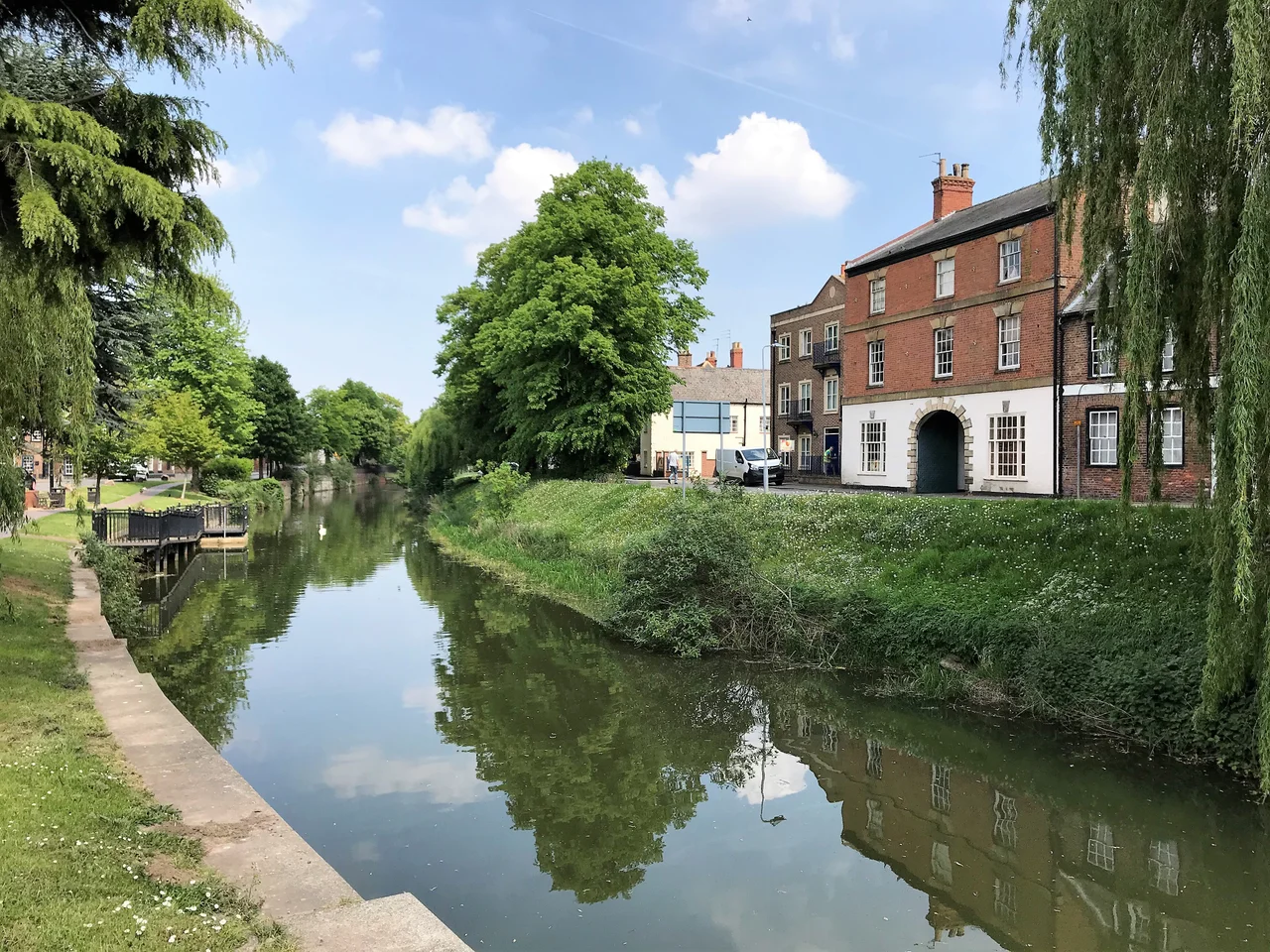
On 2 October 1979 at the Keymarkets supermarket in Spalding, a cashier passed a packet of something across a glass plate, a laser flickered, and a till read its first barcode. It was the first time it had happened in the United Kingdom. Spalding was the test site - a market town of around thirty thousand people in the heart of the Lincolnshire Fens, on the River Welland between Peterborough and the Wash, surrounded by some of the richest vegetable-growing soil in Britain. The town has been doing things first for a long time. Spaldingas tribesmen settled here in the 6th century. Crowland Abbey monks held land in 1086. Dutch flower-merchants brought tulip bulbs in the 1930s. And from 1959 to 2013, and again since 2023, the Spalding Flower Parade has filled the town with floats decorated in millions of tulip petals - a celebration of the colour, the work, and the curious Dutch-Lincolnshire blend that defines this corner of England.
Tulip Country
Spalding sits on the silt of an old estuary - the kind of soil that was reclaimed from marshland by 17th-century Dutch engineers and has been growing flowers and vegetables ever since. The land is flat as a tabletop. The drains run dead straight to the horizon. In late April and early May the bulb fields explode into stripes of red, yellow, pink, and white that you can see from the air for miles. The tulip industry took root here in the 1930s when John and Leonard van Geest, two Dutch brothers, started importing tulip bulbs from the Netherlands and founded a company that would dominate British fresh produce for half a century - Geest Horticultural Products, later just Geest, eventually sold for £485 million in 2005 to Bakkavor. The flower fields are smaller now than they were at peak. Production has been hit by competition and changing consumer tastes. But the tulips still bloom, and the parade still runs.
The Flower Parade
The first Tulip Parade ran on the first Saturday of May 1959. Volunteers built float frames - some of them at the Chain Bridge Forge - and decorated them with tulip petals fixed individually to wire mesh. The themes changed year on year: nursery rhymes, fairy tales, world cultures, anniversaries. At peak, more than 100,000 visitors crammed into the town to watch the procession move through the streets. The crowds dwindled in the 21st century. By 2012, fewer than 40,000 came. The county council and district council announced they would not fund the parade beyond 2013. It looked like the end. Then in 2023 a volunteer effort led by Stephen Timewell, paid for by crowdfunding, revived it. The 2023 revival drew large crowds, and as of 2025 it is once again a fixture of the town calendar. When the tulips are early, daffodils get used. When they are very early, crepe paper substitutes for petals. The parade has never quite been the same as the year before, and that, perhaps, is the point.
Ayscoughfee Hall and Lutyens's Pavilion
At the heart of Spalding's old town stands Ayscoughfee Hall, a 15th-century gentry house that the Urban District Council bought in 1898 to celebrate Queen Victoria's Diamond Jubilee. The hall is now a museum. Its formal gardens hold one of Edwin Lutyens's most distinctive war memorials - a brick pavilion at the head of a long reflecting pool, surrounded by yew hedges, commemorating the 224 men from Spalding who died in the First World War. Lutyens, the architect of the Cenotaph in Whitehall, designed it at the invitation of Barbara McLaren, the widow of the town's MP who had died in a flying accident at RAF Montrose in 1917. The memorial cost £3,500, half of it given by McLaren and her father-in-law. It was unveiled in 1922. Spalding Parish Church of St Mary and St Nicolas, built by William de Littleport of Spalding Priory in 1284, stands further along the river. The tower and spire went up in 1360, before the Black Death had quite finished reshaping the country.
Fenland and the Future
Spalding has had two of its own power stations since the Millennium - a 860-megawatt gas-fired plant opened in 2004 by InterGen, and a 300-megawatt expansion that opened in 2019. Plans for a £160 million battery energy storage system on adjacent land were submitted in 2021. The town's vegetable industry remains central to British supermarket supply: Bakkavor, FESA UK, Fowler-Welch, Greencore. The Coronation Channel, opened in 1953, diverts flood water around the town centre and ended the periodic inundations of the historic core. The Spalding Water Taxi runs from Easter to October between the High Street and Springfields Outlet Shopping Centre. The Pinchbeck Engine Museum, just north, preserves a Victorian steam pumping engine that drained the Fens. Spalding is small, busy, slightly unfashionable, deeply productive. It feeds the country, gives it tulips in spring, and once, on a particular Tuesday in October 1979, taught it how to scan a barcode.
From the Air
Spalding sits at 52.79N, 0.14W, in the flat South Holland fenland between Peterborough and the Wash. The town lies on the River Welland, which is bordered north and south by some of Britain's richest agricultural silt - in April and May the bulb fields are a striking patchwork of colour visible from the air. Nearest airports: Peterborough Conington (EGSF) about 18 miles south-west, Fenland (EGCL) similar distance south, RAF Wittering (EGXT) to the south-west. Best viewed at 3,000 feet in late April for the tulip fields, otherwise good for spotting the strict geometry of fenland drainage.
Nearby Stories
- RAF Coningsby 1 km away
- Rockingham Castle 5.3 km away
- True's Yard Fisherfolk Museum 7.7 km away
- Belvoir, Leicestershire 8.7 km away
- Connington South Rail Crash 13 km away
- RAF Feltwell 15 km away
- Laxton, Nottinghamshire 19 km away
- Silver Pit 57 km away