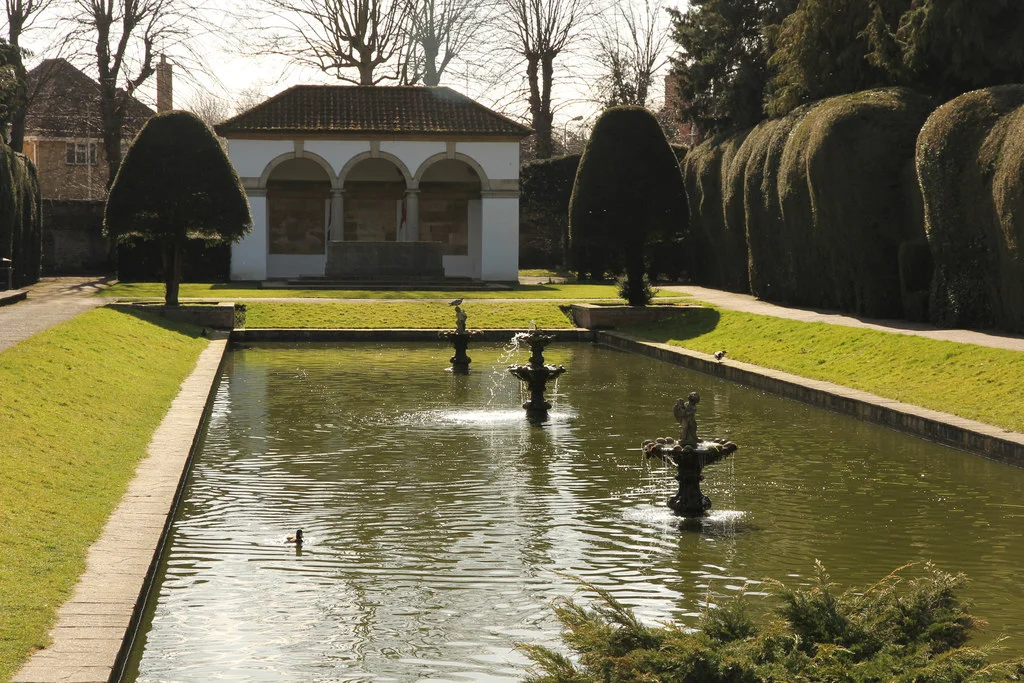

Spalding War Memorial
Barbara McLaren was thirty years old when she lost her husband. Francis McLaren had been the Member of Parliament for the Spalding Division of Lincolnshire and a Royal Flying Corps officer, killed in 1917 in a flying accident near RAF Montrose - not shot down, not killed in battle, just one of the many young pilots of the Great War whose aircraft simply failed. He left two sons. His widow refused to grieve him alone. Within months of the Armistice she had a plan: a memorial to all the Spalding men who had died - 224 of them, more than the population of an entire small village - and she had a famous architect in mind. Her aunt was the garden designer Gertrude Jekyll. Through Jekyll she knew Edwin Lutyens, the architect already at work on the Cenotaph in Whitehall and on the great cemeteries of the Western Front. McLaren wrote to him. He agreed. And she made one absolute condition: her husband must receive no special honour. He would be one name among 224.
The Architect of Grief
Edwin Lutyens had spent his pre-war career designing country houses for the rich. From 1917 onwards he gave nearly all his time to memorialising the war dead. For the Imperial War Graves Commission he designed the Stone of Remembrance, used in the first British cemeteries from 1920 onwards. He designed The Cenotaph on Whitehall in London, unveiled in its permanent stone form in 1920, which became and remains the focus of national Remembrance Sunday commemorations. He designed the Thiepval Memorial to the Missing of the Somme, unveiled in 1932, still the largest British war memorial in the world - a vast brick and stone arch carrying the names of 72,337 men whose bodies were never recovered. Spalding was one of his first town-level commissions. He drew a U-shaped cloister around a circular lily pool, with a Stone of Remembrance at its head and a cross in the middle. McLaren approached the council with the plan in January 1918.
A Town Argues
Spalding did not simply accept the gift. The proposal generated debate in the local press through the rest of the war and the months afterwards. Alternative schemes were put forward. Why not convert Ayscoughfee Hall into a youth centre instead? Why not a simple clock on the corn exchange? Why not an obelisk in the market place, or a cenotaph, or a fund for war widows? On 1 August 1919 the district council held a public meeting at which three hundred people attended and the three leading options were each given fifteen minutes. On 23 August a public vote was held. Seven options were on the ballot. A modified version of the McLaren-Lutyens proposal - a smaller pavilion in the gardens of Ayscoughfee Hall, paired with a separate clock on the corn exchange building - won 459 votes. The full Lutyens scheme came second with 286. The obelisk came third. Democracy had spoken: Spalding wanted both its commemoration and its clock.
What Was Built
The memorial that stands today was constructed by Hodson Limited of Nottingham at the south end of the Ayscoughfee Hall gardens, replacing an old folly known as the Owl Tower. It cost £3,500 in 1922 money - perhaps £200,000 today. Barbara McLaren and her father-in-law each contributed £1,000. Her brother-in-law donated a pair of painted stone flags. The rest came from voluntary subscription that took until the year of the unveiling to collect. A brick pavilion stands at the head of a long reflecting pool, the pool itself originally an 18th-century canal in the garden that Lutyens remodelled in the style of an Italian formal garden. Three low fountains were added later. Yew hedges line both sides. On the east side, iron gates lead through to a peace garden added in 1994. In front of the pavilion stands a Stone of Remembrance, twelve feet long, carved from a single piece of rock with the slight Greek-temple curvature called entasis that Lutyens used on all his Stones - so subtle the eye cannot quite see it but the mind can feel it. The inscription reads: THEIR NAME LIVETH FOR EVERMORE.
Unveiling and Afterwards
The unveiling took place on 9 June 1922. General Sir Ian Hamilton, who had commanded at Gallipoli, presided. Reverend Alfred Jarvis dedicated the memorial. Hamilton's speech that day did not pretend the war had ended war. The result has been so different, he told the gathered crowd. Europe is a seething cauldron of racial hatred. Mesopotamia, India, Egypt - all straining at the leash of civilisation. If you want to end war, you must end hatred. A bugler played the Last Post. The crowd sang the national anthem. Barbara McLaren and her two sons laid floral tributes around the Stone of Remembrance. A separate plaque was set elsewhere for Francis McLaren alone, inscribed: THIS STONE COMMEMORATES FRANCIS WALTER STAFFORD McLAREN MEMBER OF PARLIAMENT FOR THE SPALDING DIVISION 1910-1917 WHEN HE FELL IN THE SERVICE OF HIS COUNTRY AT THE AGE OF 31. Lutyens used the pavilion design again in several Western Front cemeteries, but none of his other public war memorials follow this template. Historic England has called Spalding an exceptional departure - which it is, and which it was meant to be. A grieving young widow asked for something private at public scale, and the master of monumental architecture quietly gave her what she asked.
From the Air
Spalding War Memorial sits at 52.78N, 0.15W, in the gardens of Ayscoughfee Hall in central Spalding on the south bank of the River Welland. The pavilion and long reflecting pool are surrounded by formal yew hedges and are visible from the air as a distinct rectilinear feature in the green of the gardens. Nearest airports: Peterborough Conington (EGSF) about 18 miles south-west, Fenland (EGCL) similar distance south, RAF Wittering (EGXT) to the south-west. Best viewed at 1,500-2,500 feet on a clear day; the gardens and the parish church spire to the north together mark the historic core of the town.
Nearby Stories
- RAF Coningsby 1 km away
- Rockingham Castle 5.3 km away
- True's Yard Fisherfolk Museum 7.7 km away
- Belvoir, Leicestershire 8.7 km away
- Connington South Rail Crash 13 km away
- RAF Feltwell 15 km away
- Laxton, Nottinghamshire 19 km away
- Silver Pit 57 km away