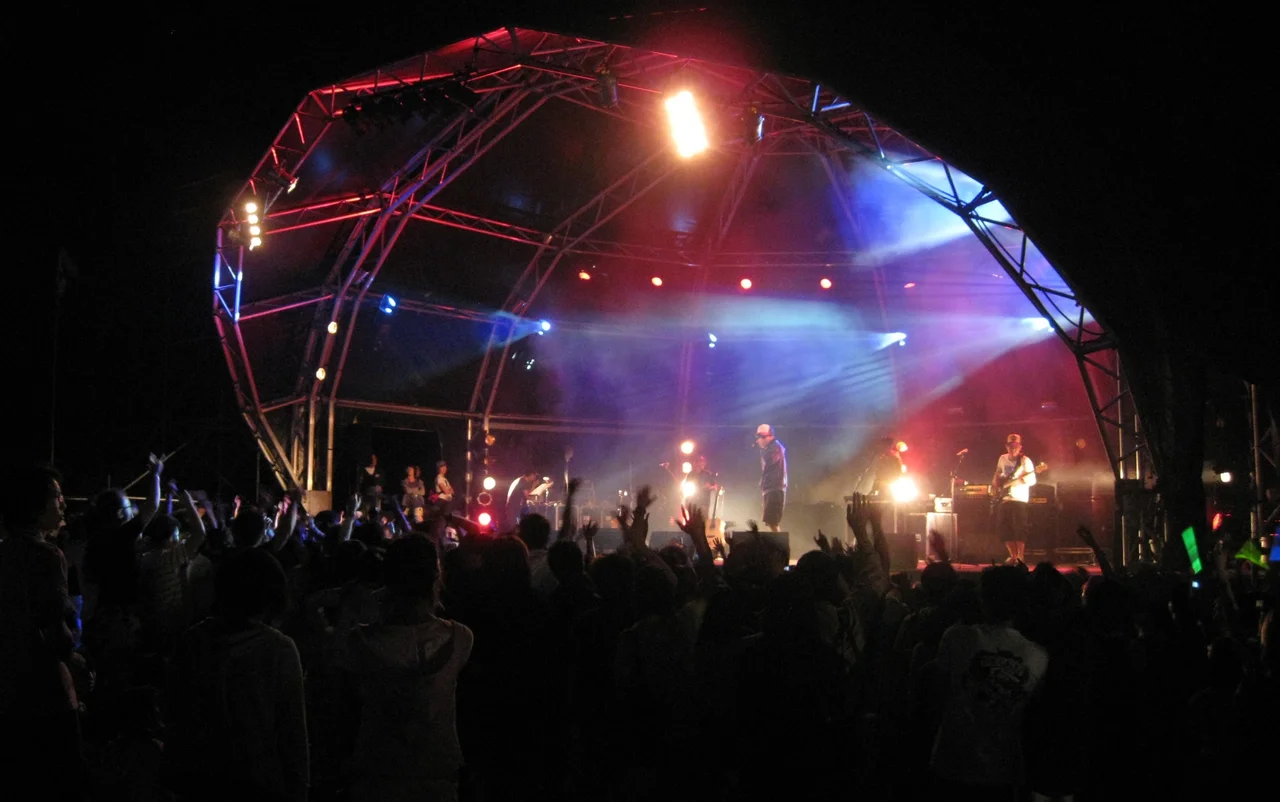

Spring Scream
Wade Davis and Jimi Moe were Americans living in Taiwan in the mid-1990s, and they had a simple idea: throw a music festival on the beach at the southern tip of the island each April when the weather was perfect and the tourists hadn't yet arrived. The first Spring Scream, in 1995 in the Year of the Pig, ran for three days at a venue called Magic Studios. Bands sold their own merchandise from stalls; someone printed hand-dyed shirts. At its peak the festival hosted up to 300 acts on 8 stages, added a film festival, art exhibitions, and camping, and became the defining music event of Taiwan's outdoor festival calendar. The last editions under the original organizers ran around 2018–2019; a revival attempt in 2019 under new management drew almost no one, and the festival as originally constituted has not returned since.
A Festival Born from Expat Enthusiasm
Davis and Moe organized the first Spring Scream with the energy of people who had never run a major event and weren't yet certain they were doing it. The early years had the handmade quality of the best small festivals: bands cooked food for each other (a tradition that ended after 1999 when the operation became too large), volunteers cleaned the toilets (a duty that outlasted the cooking by one more year, ending in 2000), and organizers handed out free CDs of demo songs from performing bands so audiences could discover music they'd just heard live. The cover price was 200 New Taiwan dollars for the first two years — roughly equivalent to a few dollars — before gradually rising as the festival grew. By 2002, 150 bands were playing. By 2004, 200 bands performed across 11 days, the longest the festival has ever run.
The Rules That Shaped the Sound
Spring Scream's organizers made a decision in 1998 that shaped the festival's identity for years afterward: all bands had to perform at least one original song. The following year they tightened the rule further — all music had to be original. No covers, no tribute acts. This was a deliberate choice in a market where cover bands dominated the club circuit, and it gave Spring Scream a reputation as the festival where original Taiwanese music actually got heard. The 1998 edition, in the Year of the Tiger, was broadcast on MTV Asia and enjoyed widespread media coverage — a moment that announced the festival's arrival to an international audience. Bands from overseas began appearing alongside Taiwanese acts. The stages multiplied. By the mid-2000s, the festival had added a poster contest, a logo contest, and a short film festival, each running alongside the main musical programming.
Kenting as the Setting
The festival's location matters as much as its lineup. Kenting in early April sits at the edge of the warm season — the sea is clear and still-warm enough for swimming, the air temperature hovers in the low-to-mid twenties Celsius, and the typhoon season that will eventually close the beaches is months away. The festival has moved venues several times: from Magic Studios to the beach, to LiouFu Campground (where it settled for most of the 2000s), and to the Eluanbi Lighthouse area in later years. Whatever the venue, the setting is the same — Taiwan's southernmost coast, where the Taiwan Strait and the Philippine Sea meet and the night sky is darker than almost anywhere else on the island. Camping is part of the experience. Staying through the night, the sound of the nearest stage carrying across the water, is a particular kind of festival memory that the setting makes possible.
The Chinese Zodiac and the Name
Each year, Spring Scream adds the current Chinese zodiac animal to its name — Year of the Pig, Year of the Rat, Year of the Ox — cycling through the twelve animals of the traditional calendar. The practice started in 1995, the Year of the Pig, and has continued unbroken since. It gives the festival a built-in annual identity and links it to a calendar system that most of Taiwan's population uses alongside the Gregorian calendar to mark the years. For longtime attendees, the zodiac year becomes a way of remembering which edition they went to, which bands they saw, which friends they met at the campground. The dragon years, which come every twelve years, tend to feel like particularly charged editions — the Year of the Dragon in 2000 drew 120 bands and saw the media given free press passes for the first time, a sign of the festival's growing seriousness.
From the Air
Spring Scream takes place in the Kenting area at approximately 21.98°N, 120.80°E, near the southernmost tip of Taiwan's main island. Festival venues have included the Eluanbi Lighthouse area — the lighthouse itself is a visible navigation landmark at the very tip of the peninsula. The LiouFu Campground, where the festival was held for most of its history, lies in the interior of the southern peninsula. Nearest major airport: RCKH (Kaohsiung International), approximately 70 kilometers north. The coastal road through Kenting and south to Eluanbi is the main access route; the peninsula narrows dramatically at the southern tip, making the geography unmistakable from the air.
Nearby Stories
- Fangliao 18 km away
- Orchid Island 25 km away
- Zhaori Hot Spring 41 km away
- Ten Drum Rende Creative Park 69 km away
- Barclay Memorial Park 102 km away
- Mavulis Island 102 km away
- 1991 Eruption of Mount Pinatubo 741 km away
- Scarborough Shoal 780 km away