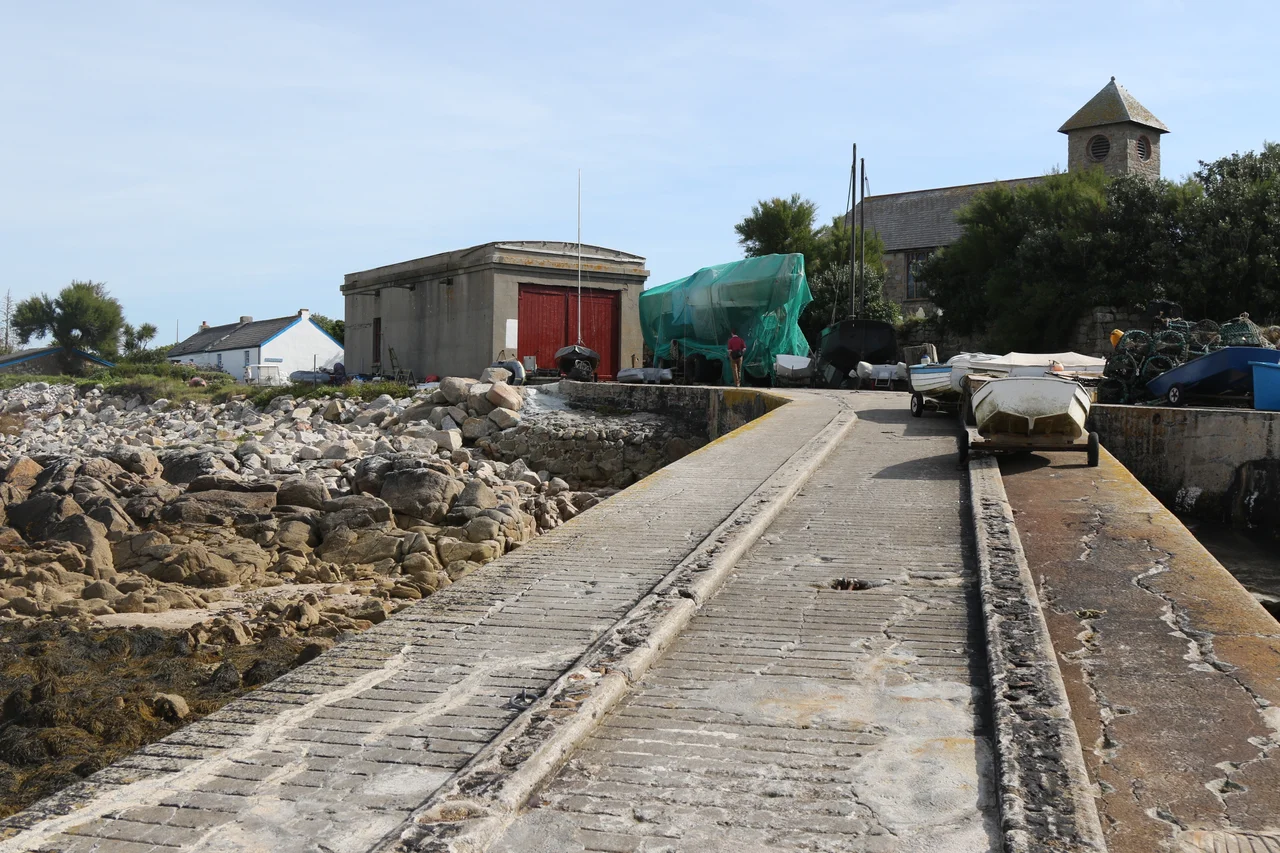

St Agnes Lifeboat Station, Isles of Scilly
On the night of 13 December 1907, the seven-masted American schooner Thomas W. Lawson was in trouble off Annet. She was the only such ship ever built, a 475-foot iron-hulled cargo vessel with seven steel masts, and she was struggling in a westerly gale off the most dangerous water in southern England. The St Agnes Lifeboat went out and put a man aboard her - William Thomas Hicks, a local pilot - to try to guide her into shelter. He didn't make it. The Lawson foundered at Minmanueth Rock and sank, taking Hicks and sixteen of her own crew down with her. The next morning, William's son Frederick Charles Hicks, twenty-two years old, put off in the local pilot gig Slippen with seven other men. They rowed an open boat through the wreckage of the gale and pulled the schooner's captain and engineer alive off Hellweather Rock. The British awarded Frederick Hicks the RNLI Silver Medal for Bravery. The American government sent him a gold watch and gave gold medals to all eight men in the Slippen. He had buried his father the same week.
The Station and the Slipway
St Agnes Lifeboat Station opened in 1891 - one of the small, all-volunteer outposts that the Royal National Lifeboat Institution maintained around the most dangerous coasts of Britain. The first station had a single slipway. In 1904 the RNLI rebuilt it to a much more ambitious specification, designed by their architect W. T. Douglass. The cost was 5000 pounds - a serious sum in the Edwardian era - and the structure ran 1068 feet from the back of the boathouse to the toe of the slip. It was built of Jarrah wood from Western Australia, a dense red hardwood resistant to marine borers, bolted to granite and concrete pillars across the irregular shoreline. Two rails ran the length of it, carrying a double bogey trolley that bore the lifeboat down to the water. The older 1891 slipway was kept for high-tide launches. The whole arrangement was an enormous piece of engineering for a station that served eighty-five permanent residents. It was justified entirely by the geography around it - the Western Rocks, Annet, the Crebawethans, the approaches to Bishop Rock, all crowded onto the coastal map within a few kilometres of where the boat lay.
The Lawson, the Father, the Son
The Thomas W. Lawson was a one-of-a-kind ship. Built in 1902 in Quincy, Massachusetts, she was the only seven-masted schooner ever launched, an attempt to compete with steam by using massive sail area and a tiny crew on a steel hull. She had a difficult sailing reputation - she rolled hard in heavy weather and was overpowered for her size - but she was profitable in calm conditions, carrying coal and oil along the American eastern seaboard. On her first transatlantic voyage in late 1907 she was bound for London with paraffin oil. She ran into a westerly gale off the southwestern approaches and made for shelter at Scilly. By the night of 13 December she was anchored in deteriorating weather off Annet. The St Agnes Lifeboat went out and put William Thomas Hicks aboard to act as pilot. The wind veered, the anchors dragged, and the schooner was driven onto Minmanueth Rock. She broke up in the dark. Hicks was killed with sixteen of the eighteen-man crew. His son Frederick was twenty-two, working the Scilly pilot gigs. The next day, with eight men in the Slippen, he rowed to Hellweather Rock and pulled the schooner's captain, George Dow, and his engineer Edward Rowe alive from the wreckage. He swam from the gig with a line to reach them. He had every reason to be paralysed by grief. He went anyway.
The Gold Watch and the Closing
The British recognition came quickly. Frederick Charles Hicks received the RNLI Silver Medal for Bravery. The American recognition was more extravagant. The United States government, whose ship had been lost, struck gold medals for every one of the eight men in the Slippen and presented Hicks himself with a gold watch. For an island community with no formal economy beyond piloting and bulb farming, the gold medals were a significant transfer of public honour from the world's emerging great power to a Cornish village. The Lawson's oil cargo washed up on Annet, where it killed rabbits and seabirds; the smell was still on St Agnes eighteen months later. The lifeboat station continued until 1920, when shifting patterns of marine emergency - faster ships, better radio, the move toward motor lifeboats stationed at St Mary's - made the St Agnes pulling and sailing boat redundant. The RNLI closed the station. The Jarrah slipway and the boathouse remained. The Isles of Scilly Council later identified them as Buildings of Local Significance.
What the Slipway Still Says
Walk down the lane in Lower Town today and you will find the slipway and the boathouse still standing, the Jarrah wood weathered silver but solid, the rails gone, the trolley gone, the lifeboat gone. The structure is part of the conservation area now, protected for what it represents. For thirty years - the working life of the station - the bell at the boathouse rang into a village of fewer than a hundred people and the volunteer crew left whatever they were doing and ran. Some of them did not come back. The Hicks family alone gave a father to the Lawson; in a community that small, almost every household had someone in the gigs. The Slippen still exists - she is rowed in the Cornish pilot gig regattas every Friday evening in summer. The boat is the same boat. Frederick Hicks's grandchildren and great-grandchildren still live on Scilly. The slipway, the gig, the medal, the watch, and the empty boathouse all sit on the same kilometre of coast. They do not need a museum. They are the museum.
From the Air
The St Agnes Lifeboat Station sits at 49.8936 N, 6.3500 W, on Periglis Beach in Lower Town on the western shore of St Agnes. The nearest airport is St Mary's (EGHE), about 4 km north-northeast, with Land's End (EGHC) some 47 km east on the Cornish mainland. The 1680 St Agnes lighthouse, on Higher Town just south of the station, is the primary visual landmark. The 1068-foot slipway is the most distinctive feature of the western shore from the air, a long pale line running into the surf. Recommended viewing altitude is 800-1500 ft AGL. Bishop Rock lighthouse, 10 km southwest, gives the broader scale of the rescue area the station once served.
Nearby Stories
- Wolf Rock Lighthouse 17 km away
- The Brisons 18 km away
- SS Irma (1905) 22 km away
- HMS Brisk (1851) 31 km away
- Cape Cornwall Mine 57 km away
- SM U-27 73 km away
- Wolfpack Prien 162 km away
- Tower of Hercules 696 km away