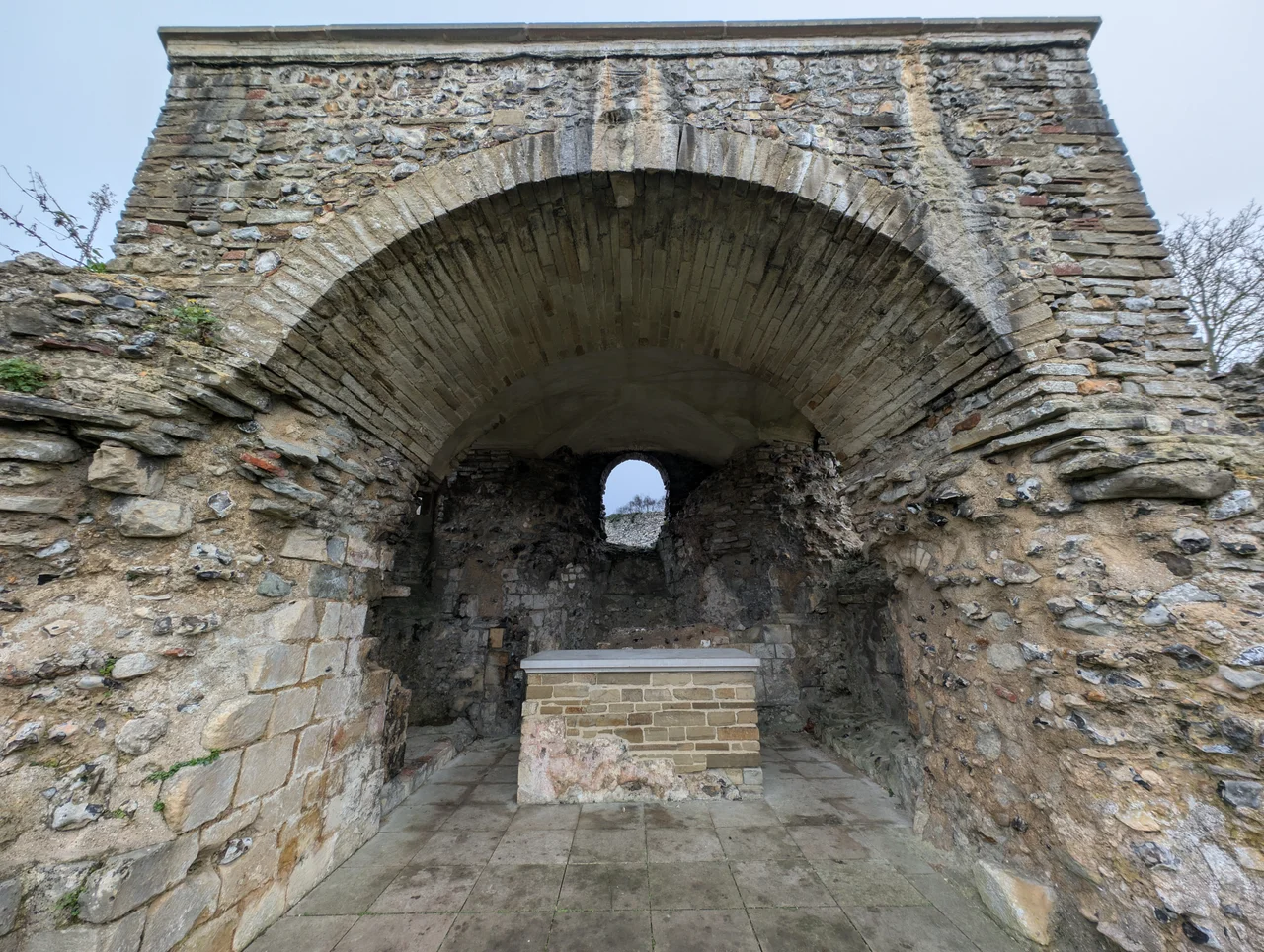

St Augustine's Abbey
In 597, a Roman monk named Augustine stepped onto a Kentish beach with forty companions and a mission from Pope Gregory I to convert the Anglo-Saxons. The king he came to meet, Ethelbert, already worshipped in a pagan temple just outside the walls of Canterbury, though his wife Bertha was a Christian. Within a year, the king had handed over that temple and its precincts to the missionary, and from that improbable gift grew the abbey that would shape English Christianity for nearly a thousand years - and outlast its own demolition by another five hundred.
The Mission That Stuck
The foundation date in the abbey's chronicles is 598, recorded by William Thorne three centuries later. The church itself was consecrated in 613. Augustine was buried here when he died, and the abbey came to bear his name; his successors as Archbishop of Canterbury - Mellitus, Justus, Laurence, Theodore of Tarsus - were buried alongside him in the church of Saints Peter and Paul. So were Ethelbert and Bertha. Within a generation, this small precinct held the bones of every king and bishop who had brought Christianity to the English. For two centuries, St Augustine's was the only important religious house in Kent. The historian G. F. Maclear called it a missionary school where classical knowledge and English learning flourished. The scriptorium produced manuscripts; the library swelled with both religious and secular books. The English church was, in a very literal sense, written here.
Wealth, Walls, and a Saint's Body
Even the invading Danes spared the place. In 1027, King Cnut handed over all the possessions of Minster-in-Thanet, including the preserved body of Saint Mildred. Pilgrims came for the relic and left their gifts behind. After the Norman Conquest of 1066, William the Conqueror respected church property even as he confiscated everything else. The Anglo-Saxon buildings were torn down and rebuilt in the heavy Norman style. From about 1250 onward came what one historian called a time of worldly magnificence - lavish new buildings, royal visits, banquets for thousands. The cloister, the refectory, and the kitchen were rebuilt from scratch. A walled vineyard, a brewhouse, a bakehouse, a great hall, an abbot's lodging - everything an English monastery of the high Middle Ages should have, in stone.
Henry's Great Transfer
In 1538, that millennium ended in a single signature. Abbot John Foche surrendered the monastery to the Crown. Henry VIII had broken with Rome, and the Dissolution of the Monasteries was less a religious purge than what historians call the great transfer - economic and religious power moving from clerics to laymen. Some of the abbey's stone went to fortify Calais. The library of two thousand manuscripts, painstakingly copied for nine centuries, was destroyed. The treasure was plundered. For the rest of Henry's reign, the buildings served as a royal residence; after the Restoration in 1660, Charles II and his brothers spent a night in the gatehouse on their way to London. Then came centuries of slow attrition. The Hales family carted stones away to build their own house. The Great Court became a bowling green. Ethelbert's Tower, the last Norman tower standing, was demolished in 1822. By the 19th century, one guidebook said the abbey had reached its lowest point of degradation.
What Survived the Centuries
The night of 31 May 1942 brought another blow. German bombs in the Baedeker Blitz devastated the missionary college that had risen on part of the site. Fyndon's Gate, the medieval gatehouse where Charles II had once slept, was so badly damaged it had to be rebuilt entirely. Yet what survived has been preserved with care. In 1940, the British government took the ruins into its keeping. Since 1976, The King's School, Canterbury - itself claiming descent from Augustine's original teaching mission - has used the surviving college buildings for boarding houses and a library. Today the abbey forms part of a UNESCO World Heritage Site together with Canterbury Cathedral and St Martin's Church, the three places that mark where English Christianity began. Walking the foundations, you can trace the rotunda and nave, find the gravesite of Augustine himself, and look across at the cathedral that grew up to overshadow the mother house.
Reading the Ground
What's striking on the ground today is how legible the ruins remain. The Chapel of the Blessed Virgin Mary still has surviving floor tiles, relaid where craftsmen once knelt to lay them six centuries ago. The Norman nave is a roofless skeleton in sunlight. The Anglo-Saxon St Pancras church, smaller and earlier than the great Norman building, sits a short walk away - one of the few places in England where you can read fourteen centuries of architecture in a single afternoon. The pilgrims who once crowded here came for Saint Mildred's miracles and Augustine's blessing. The visitors who come now look at flint and stone and try to imagine the choir that once filled this empty air with plainchant. Both are, in their way, the same act of attention.
From the Air
Located at 51.278°N, 1.088°E in Canterbury, Kent, just east of the cathedral city walls. The closest airport is Manston (EGMH, now closed to scheduled flights) about 13nm northeast; London City (EGLC) lies 47nm west-northwest and Lydd (EGMD) sits 24nm southwest. Recommended viewing altitude is 2,000 to 3,000 feet AGL for clear sight of the ruined nave alongside Canterbury Cathedral. The two World Heritage sites - cathedral, abbey, and St Martin's Church - cluster together within a single mile of city centre. Look for the cathedral's central tower (Bell Harry) as your primary visual landmark; the abbey ruins lie immediately east, just outside the medieval walls.
Nearby Stories
- Ringlestone Inn 3.4 km away
- Cliffs Pavilion 3.5 km away
- Citadel of Calais 6.5 km away
- 2021 English Channel Disaster 11 km away
- Stag Inn, Hastings 15 km away
- Dungeness Lighthouse 19 km away
- Clacton Pier 32 km away
- Four Days' Battle 54 km away