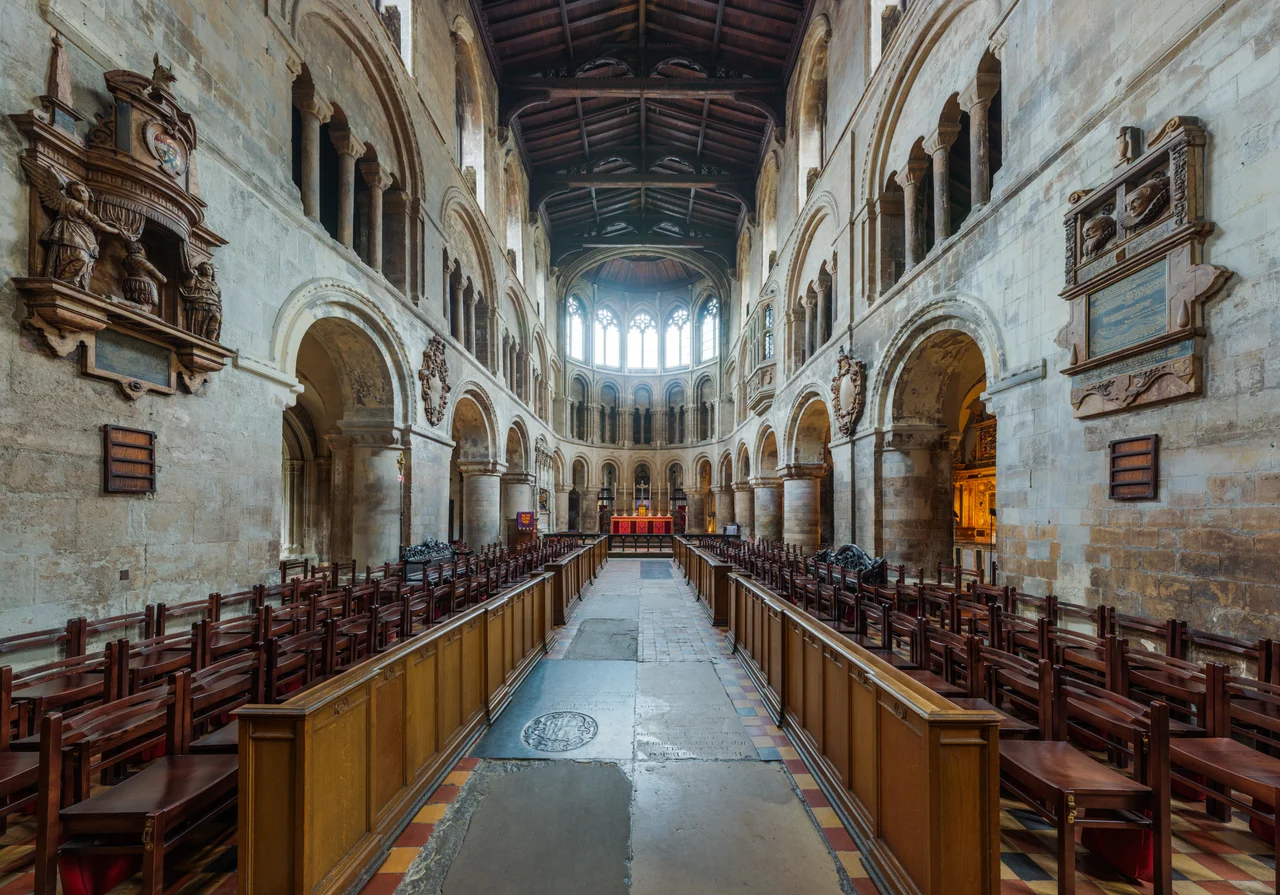

St Bartholomew-the-Great
Rahere was a prebendary of St Paul's Cathedral and a man of the court when he made his pilgrimage to Rome. On the way back, he fell ill with malaria and made a vow: if he recovered, he would build a hospital for the sick poor. He did recover. But then came the dream. A winged beast transported him to a high place, where he received a message from "the High Trinity and the court of Heaven" directing him to build a church in London's Smithfield. He returned to England, discovered that the land in his vision was royal property, and persuaded Henry I to grant it to him on the strength of the divine instruction. In 1123, the priory church and hospital of St Bartholomew rose from what had been a small cemetery at Smithfield.
Nine Centuries in Smithfield
St Bartholomew-the-Great is the oldest surviving church fabric in London. The Norman crossing arches and choir date to the 12th century, visible in the rounded arches and thick stone columns that characterize Romanesque architecture before the pointed arch arrived. The nave was demolished after the Dissolution of the Monasteries in the 1540s — Henry VIII's dissolution claimed about half the priory's church — but what remained was substantial enough to continue as a parish church.
Having survived the Dissolution, the building then survived the Great Fire of London in 1666, which swept through the City but stopped before reaching Smithfield. Poet Laureate Sir John Betjeman, who took a flat overlooking the church in Cloth Fair, considered it to have the finest Norman interior in London. The brick clock tower in the southwest corner dates to 1628, housing bells cast between 1500 and 1514.
Benjamin Franklin's Year as a Printer
In 1724, a young Benjamin Franklin arrived in London — sent by the Governor of Pennsylvania, Sir William Keith, ostensibly to buy printing equipment. Keith's promises of financial support evaporated on arrival, and Franklin found himself stranded, needing work. By 1725 he found it as a journeyman printer in a shop inside the building that is now the church of St Bartholomew-the-Great.
The Lady Chapel at the east end had been in secular use since the Dissolution, divided into workshops. Franklin worked here for about a year, typesetting books, before eventually returning to Philadelphia. The north transept, meanwhile, had served as a blacksmith's forge and then been occupied by squatters in the 18th century. The church's afterlife as a commercial space is as interesting as its religious history.
A Church That Films Love
The visual weight of the Norman interior — the massive columns, the rounded arches, the dim light filtering through small windows — has made St Bartholomew-the-Great one of London's most filmed churches. The fourth wedding in Four Weddings and a Funeral was filmed here in 1994. Shakespeare in Love used it, as did Robin Hood: Prince of Thieves, The End of the Affair, Amazing Grace, Elizabeth: The Golden Age, The Other Boleyn Girl, the 2009 Sherlock Holmes film, Avengers: Age of Ultron, and Transformers: The Last Knight.
William Hogarth, the satirical painter and engraver, was baptized here. W.G. Grace, the cricketer, was a member of the congregation. The 11th Duke of Devonshire and the Hon. Deborah Mitford were married here in 1941. The church continues to operate as an active parish — its professional choir is unusual for a parish church — while simultaneously serving as a location for productions that want to show medieval England without going to the countryside.
Rahere's Ghost and Rahere's Garden
The tomb of Rahere, founder of the church, stands immediately to the north of the high altar. It was constructed about 250 years after his death in 1144, so the painted effigy lying beneath its elaborate canopy is a medieval interpretation of a man already long gone. Whether his remains are actually in the tomb is uncertain.
During repair work in the 19th century, someone removed a sandal from Rahere's opened tomb. The sandal was returned, but the foot it had once covered was not. Since then, the legend holds, Rahere appears in the church as a shadowy cowled figure every July 1st at 7am, emerging from the vestry. The tradition of handing out hot cross buns every Good Friday continues a practice started when twenty-one sixpences were placed on a gravestone with instructions that the bequest fund an annual distribution to twenty-one widows in perpetuity. The widows are gone, but the hot cross buns remain.
From the Air
Located at 51.5189°N, 0.0997°W at West Smithfield in the City of London. St Bartholomew's Hospital is immediately adjacent. Nearest airports: London City (EGLC, ~6nm east), Heathrow (EGLL, ~14nm west). The Old Bailey (Central Criminal Court) is about 0.3 miles to the south; St Paul's Cathedral is 0.4 miles southeast. The distinctive bulk of the Barbican complex is visible 0.3 miles to the northeast.
Nearby Stories
- Stevenage 5.7 km away
- Malling Abbey 5.7 km away
- 1952 Farnborough Airshow Crash 7.7 km away
- Ingatestone Hall 8.2 km away
- Hellfire Caves 9.1 km away
- The Carrington Event: The Solar Storm That Could Happen Again 9.8 km away
- Bletchley Park 16 km away
- Castle Hedingham 23 km away