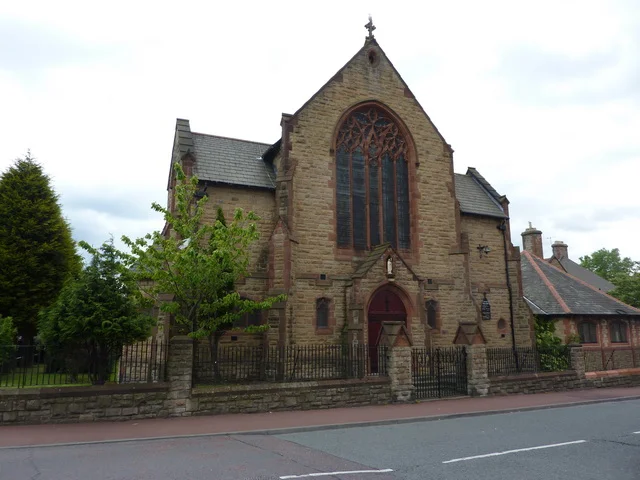

St Benet's Church, Sunderland
Stand on the corner of Thomas Street North and George Street North in Monkwearmouth and the slim Gothic Revival spire of St Benet's still defines the corner, exactly as its architects intended in 1889. Half a kilometre to the east the Stadium of Light now dominates the skyline, but St Benet's came first. It was the first Catholic church to be built on the north side of the River Wear in nineteenth-century Sunderland, the result of nearly thirty years of patient fundraising by a community that, for centuries, had largely had to worship across the river or not at all.
A Chapel Behind Roker Avenue
The story begins in 1861, almost three decades before the present church was finished. A priest, Fr George Dunn, bought a parcel of land behind Roker Avenue and built a Catholic school and chapel on the site. For the local Catholic community living on the north bank of the Wear, that small chapel became their place of worship: the closest they had had since the Reformation. England was still in the early decades of the Catholic Emancipation era, and the construction of Catholic churches in northern industrial cities was a slow, often contested undertaking. The north Sunderland community made do with what they had, knowing they would eventually want something larger and more permanent.
Father de Floer's Project
The push for a proper church came in 1873 when Fr Jules de Floer arrived in the parish. De Floer began the fundraising and planning that would, sixteen years later, produce St Benet's. The architects chosen were the practice of Dunn, Hansom and Dunn: Archibald Matthias Dunn, his son Archibald Manuel Dunn, and Edward Joseph Hansom. The firm specialised in Gothic Revival Catholic churches across the north of England, and they brought that idiom to Monkwearmouth in 1889 with a building that was solid, vertical, and unmistakably Catholic in a Sunderland still dominated by Anglican parishes. The opening of the new church in 1889 was the largest single Catholic architectural statement on the north side of the Wear since the Reformation.
The Redemptorists Arrive
From 1900 the parish was handed to the Redemptorist congregation, the missionary order founded by Alphonsus Liguori in eighteenth-century Naples and known for its emphasis on parish missions, retreats, and preaching to working-class communities. The Redemptorists were a good match for Monkwearmouth, a working district of shipyards and terraced streets, and they served the parish continuously for 111 years. The church became a hub for Catholic life in the surrounding streets: First Communions, marriages, requiems, the round of feast days, the small daily Masses. In 2011 the Redemptorists withdrew, leaving the parish back in the hands of priests of the Diocese of Hexham and Newcastle, the diocese that had originally entrusted it to them a century earlier.
Three Churches, One Priest
Today a single priest serves three Catholic churches in Monkwearmouth: St Benet's, Sacred Heart and St John Bosco, and St Hilda's. The Mass times are staggered because no priest can be in two places at once. St Hilda's celebrates Saturday vigil at 6 pm. Sacred Heart and St John Bosco has Masses at 4:30 pm Saturday and 9:30 am Sunday. St Benet's has its single Sunday Mass at 11 am, the late morning slot that gives parishioners time to walk over after breakfast and gather in the same Gothic Revival space where their grandparents and great-grandparents worshipped. The compromise speaks to the broader decline of clerical numbers across the Catholic Church in England, but it also speaks to the resilience of a parish that began with a chapel behind Roker Avenue and has kept its doors open ever since.
From the Air
St Benet's sits at 54.914 north, 1.378 west in Monkwearmouth, on the north bank of the River Wear in Sunderland. Recommended viewing altitude 1500 to 2500 feet. From the air the church stands half a kilometre west of the prominent Stadium of Light, which is the easiest landmark for locating it. The River Wear and its bridges, including the Wearmouth Bridge and the Queen Alexandra Bridge, lie immediately south. Nearby airports: Newcastle International (EGNT) is roughly 12 nautical miles north-west; Durham Tees Valley (EGNV) is about 23 nautical miles south. The North Sea coast at Roker is about 1.5 nautical miles east.
Nearby Stories
- Seaton Carew 2.7 km away
- HMS Unity (N66) 6 km away
- George Stephenson's Birthplace 6.1 km away
- Raby Castle 9 km away
- Cragside 15 km away
- Whitby Abbey 21 km away
- German submarine U-2367 46 km away
- Alexander L. Kielland (Platform) 277 km away