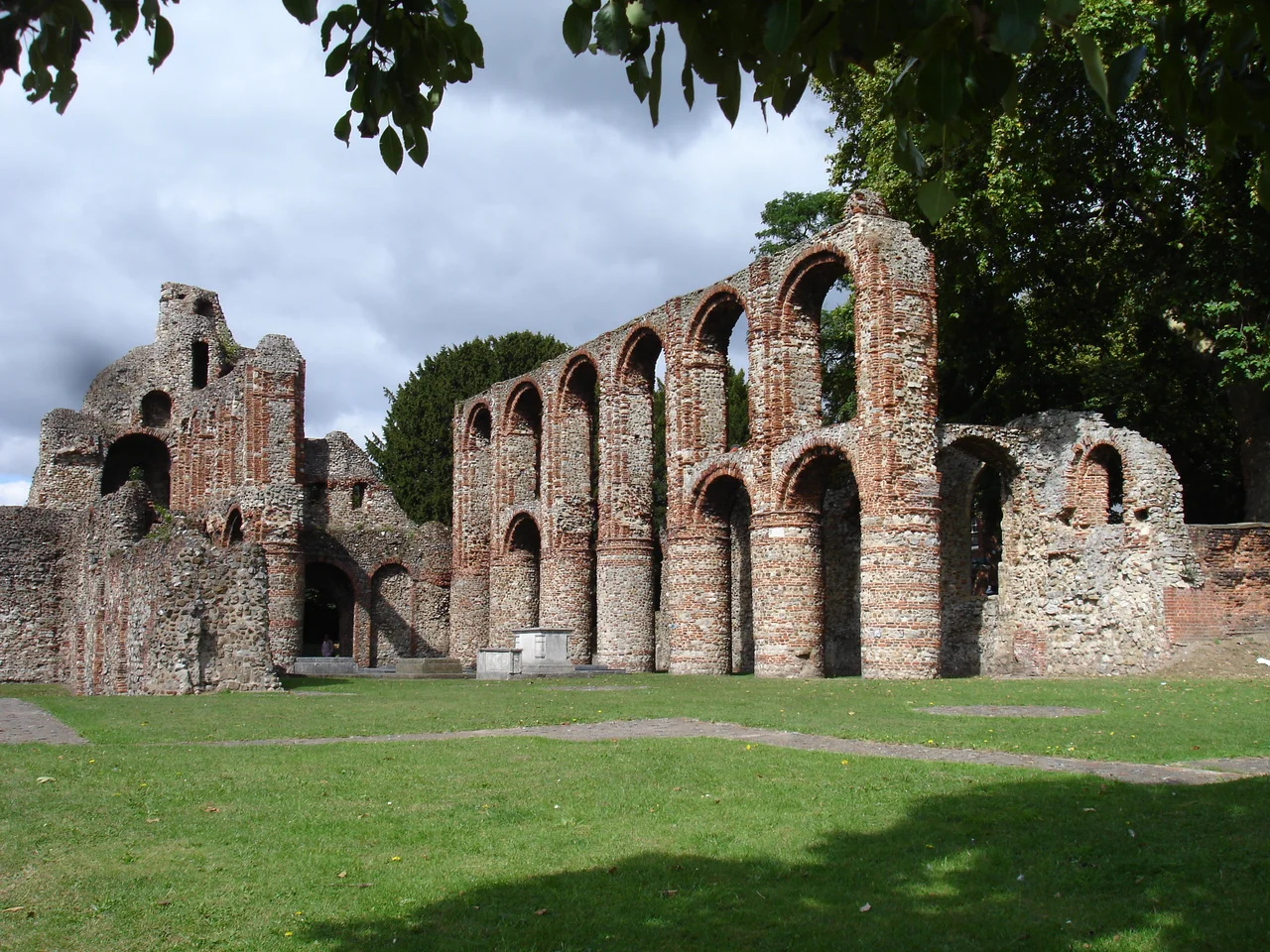

St Botolph's Priory
If you walk south from the centre of Colchester toward the railway station, the road dips and rises and then opens onto a roofless ruin that looks like a cathedral with its skin pulled off. The west front of St Botolph's Priory still stands - two great Norman arches flanking a third where a doorway once was, walls of grey septaria and reused Roman brick, the bones of a rose window cut clean through the stone above. There is no roof. There has been no roof since 1648, when New Model Army cannon set against Colchester's South Gate sliced this church apart. What stands today is half a building - and half a building still tall enough to make passers-by look up.
England's First Augustinians
Around 1093, on the site of an existing Anglo-Saxon church dedicated to the East Anglian saint Botolph, a community of canons was established under a new rule borrowed from continental Europe. They lived in common, like monks, but went out into the parish to preach, hear confessions, and run schools - the rule attributed to St Augustine of Hippo. England had Benedictine houses, Cluniac houses, and the great cathedral abbeys; what it did not yet have were Augustinians. St Botolph's Priory was the first. By the time of its dissolution in 1536 it would still be considered the leading Augustinian house in England, the mother house of a movement that eventually included York's St Mary, Walsingham, Carlisle Cathedral, and dozens of smaller foundations. The priory honoured three saints - Botolph, Julian and Denis - and its main west door was called the Pardon Door, because on the feast of St Denis on 9 October, known in medieval Colchester as Pardon Day, pilgrims who came through it were granted indulgences for their sins.
A Church Twice the Length You See
The church the canons built was Norman in style and ambitious in scale. By the consecration in 1177 it stretched 176 feet - about twice as long as the surviving ruins. A central tower rose where nave and transepts crossed. The nave alone was 110 feet long, the rose window in the gable end one of the earliest examples of its kind in England. Side chapels accumulated over the centuries: a lady chapel with a perpetually burning Eternal Light funded by income from a strip of land down at Colchester's Hythe port; a chapel to St Catherine of Alexandria, recorded by the early fifteenth century; a Becket chapel by 1281; a Holy Trinity chapel by the early 1500s. The house began with twelve canons, one for each Apostle. In 1281, a Colchester benefactor named Master Simon de Eylondia paid to add a thirteenth canon, who was bound to celebrate mass daily at the altar of St Thomas for Simon's soul and the souls of his parents Robert and Cecily.
Always the Poorer Cousin
Despite the foundation grant from Henry I and the prestige of being first, St Botolph's was always the smaller, poorer brother of the older Benedictine St John's Abbey at the other end of Colchester. St John's drew the rich patrons; St Botolph's took decades to finish its church. The priory's income was a patchwork - tithes from the king's manor of Hatfield, a third of Middle Mill on the Colne, churches at Layer de la Haye and Marks Tey, fields at Greenstead, watermills along Bourne Brook, the rectory at Chigwell appropriated in 1440. The 1291 Taxation valued the priory's temporal holdings at £42 16s 5d a year - respectable, but a fraction of what a great Benedictine house earned. Henry I had also imposed a curious feudal duty: the canons were obliged to supply the king, during Welsh expeditions, with a horse worth five shillings, a sack and a pike. A community of choristers and intellectuals owed the king a warhorse for fighting in Wales. The medieval church and crown were never fully separable.
The Last Prior, the Roundhead Guns
Twenty-six priors led St Botolph's between Ainulf, recorded in 1116, and Thomas Turner, elected in 1527. Turner was the last. In 1536, in Henry VIII's first wave of Suppression, the priory was dissolved; the canons dispersed, the bells were taken, the lead was stripped from the roof, and the buildings passed into private hands. The nave was retained as a parish church, the rest of the conventual buildings ruined. For just over a century the truncated church served the people of the suburb outside Colchester's South Gate. Then came the summer of 1648 and the siege. Sir Charles Lucas's Royalist garrison held the town; Thomas Fairfax surrounded it with the New Model Army. Cannon were sited to fire at South Gate. St Botolph's stood in the line of fire. Parliamentary artillery reduced the priory church to the ruin you see today - the west front and a portion of the nave still standing, the rest blasted to rubble. The parish built a new Victorian Gothic church beside the ruins in 1837, partially covering the old cloister.
What Remains
The priory is now in the care of English Heritage and free to visit. The west front is the most photographed view: three deep round-arched openings cut into a wall of Roman brick and septaria, the original masonry visibly recycled from the Roman colonia that once stood here. Inside the empty nave, the great cylindrical piers of the arcade still rise, capped with their cushion capitals. The east end - where the high altar would have stood, where the canons gathered for the chanting of the hours - is grass. The Roman builders who supplied the bricks did not know they were building a Norman priory. The Norman canons did not know they were building a ruin. The Roundheads did not know they were preserving a skeleton. Each generation made the building over for its own use, and the version that survives is the version of refusal - a church that refuses to fall any further, eight and a half centuries after the first stone was laid.
From the Air
St Botolph's Priory ruins sit at approximately 51.89 N, 0.90 E, immediately south-east of central Colchester just outside the line of the old Roman wall and a short walk from Colchester Town railway station. Recommended viewing altitude is 1,500-2,500 ft AGL; the roofless rectangle of the priory is most easily identified by the Victorian Gothic church (1837) attached at its south-east corner. London Stansted (EGSS) is 28 nm west; Southend (EGMC) is 24 nm south-west. Class G airspace below the Stansted TMA.
Nearby Stories
- Woolpit 2 km away
- Tilty Abbey 3.6 km away
- Saxmundham 5.6 km away
- RAF Bottisham 6.5 km away
- Kelvedon Hatch Secret Nuclear Bunker 6.6 km away
- Maunsell Forts 7.4 km away
- Battle of Assandun 15 km away
- Broadstairs 36 km away