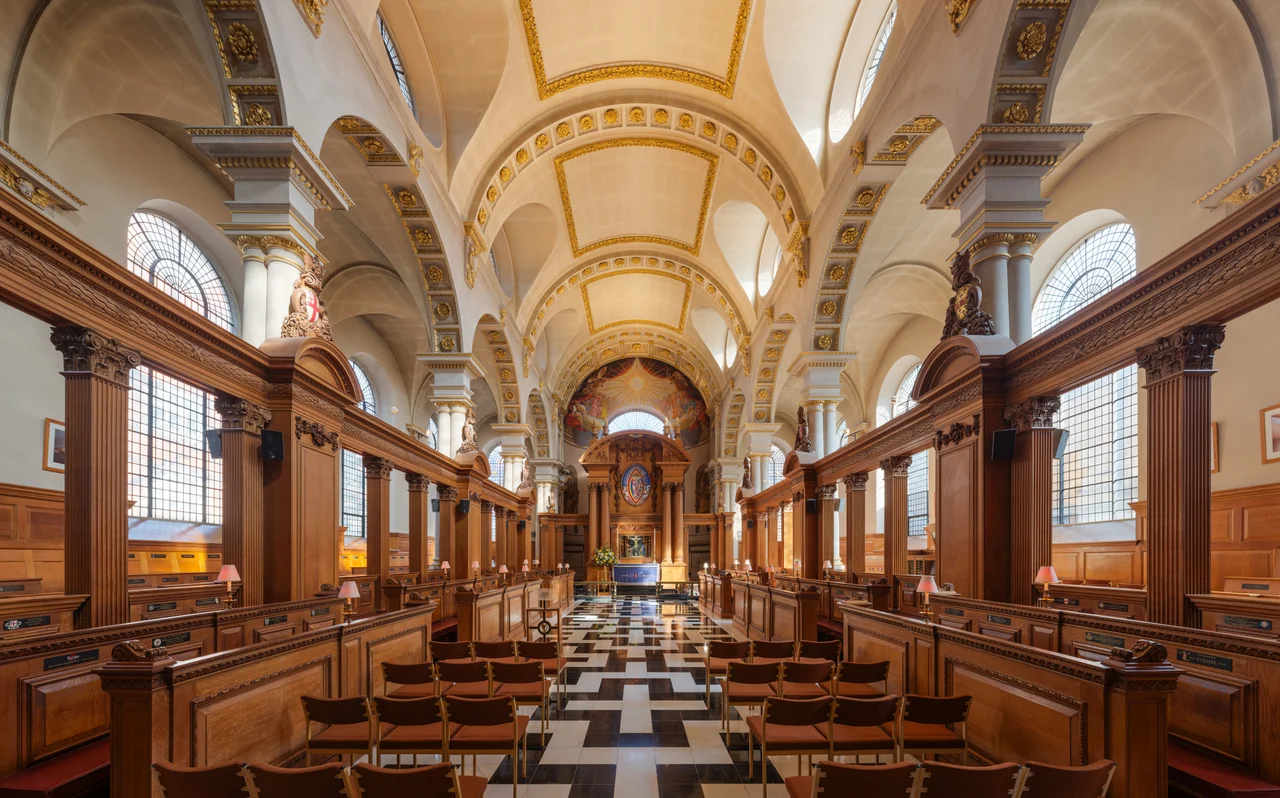

St Bride's Church
In 1703 a baker's apprentice named Thomas Rich, working a few streets away on Ludgate Hill, decided to make his fiancee a wedding cake that would look like something other than a flat round cake. He looked up. Across the rooftops rose the new spire of St Bride's Church on Fleet Street, then only a year or two finished: an obelisk of stone in four diminishing octagonal stages, the tallest church steeple Sir Christopher Wren ever designed except for St Paul's itself. Rich copied its shape into icing. The tiered wedding cake has been with us ever since. The church kept its spire. The bakers kept the model.
The Oldest Layer
St Bride's is one of the most ancient sites of Christian worship in London, possibly Celtic Irish in origin. Tradition claims it was founded in the 6th century by St Bridget of Kildare or her missionaries, on the conversion of the Middle Saxons. The dedication itself is unusual, the only Celtic-Irish church name surviving in the east of Britain, and historians have argued for centuries about where it came from. Some attribute it to Irish missionaries proselytising the Saxons. The historian Christopher Brooke proposed that the dedication actually arrived with the Vikings, particularly the Hiberno-Norse from Dublin, who had a taste for the cult of Brigid and who carried it to the British coast in the 10th and 11th centuries. Either way, the present church is the seventh on the site. A holy well, possibly originally sacred to the Romano-Celtic goddess Brigantia, almost certainly drew worship here long before the first stones were laid.
Wynkyn de Worde and the Presses
In 1500 Wynkyn de Worde, William Caxton's apprentice and the man who effectively founded English commercial printing, set up his press in a building next door to St Bride's. Until 1695, London was the only city in England where printing was legal, and Fleet Street became the natural home of the trade. From that initial press, an industry grew. By the 19th and 20th centuries, every major British national newspaper had its offices on or near Fleet Street; the journalists drank in the same pubs, married in the same church, and were buried from the same vault. St Bride's became the journalists' church, and remains so. Since 2012 it has held an annual Journalists' Commemorative Service, usually on the first or second Thursday in November, remembering reporters and photographers killed pursuing their work.
Roanoke
In the late 1580s, Eleanor White, daughter of the artist and governor John White, was married in St Bride's to the tiler and bricklayer Ananias Dare. The young couple sailed with John White and the small party of English colonists who attempted to plant the first English colony in North America at Roanoke Island, off what is now North Carolina. On 18 August 1587, Eleanor gave birth on Roanoke to a daughter, the first child of English parents born in North America. They named her Virginia Dare. White sailed home for supplies and was prevented from returning for three years by the Anglo-Spanish War. When he finally got back to Roanoke in 1590, the colony was empty: the houses dismantled, the people gone, only the word CROATOAN carved on a post. What happened to Virginia and her parents and the other colonists has never been resolved. St Bride's commemorates her with a memorial that replaced an earlier 1999-stolen marble bust.
Wren and the Second Great Fire
In 1665 the Great Plague killed 238 St Bride's parishioners in a single week. The following year the Great Fire destroyed the medieval church entirely along with most of the surrounding city. Christopher Wren took the commission to rebuild and made St Bride's one of his largest and most expensive parish churches, completed and reopened on 19 December 1675. The spire he added between 1701 and 1703 reaches 226 feet, second only to St Paul's among his designs; its tiered design is attributed to Nicholas Hawksmoor, working in Wren's office. The top eight feet were replaced after a lightning strike in 1764. On 29 December 1940 the church was gutted again, this time by Luftwaffe firebombs that started 1,500 fires across the City of London in a single night, the so-called Second Great Fire. St Paul's was saved only by the firewatchers on its roof. St Bride's was not. The rebuilding, paid for by newspaper proprietors and journalists, was completed in a neo-baroque style with collegiate-style seating, and the new building was consecrated in 1957. The 1940 bombing had one unintended gift: it cleared the way for archaeologists to excavate the church's earliest foundations, the 6th-century Saxon work that may date back to the first wooden chapel.
The Crypt Beneath
Today the crypt is open to the public as the Museum of Fleet Street, displaying Roman coins, medieval glass, and the foundations of seven earlier churches stacked one above the next. Post-war excavations also uncovered nearly 230 lead coffins with plaques from the 17th, 18th, and early 19th centuries, the bones of parishioners that the Museum of London has used as a study population for the causes of death in early modern London. John Milton was a parishioner. So was John Dryden. So was the diarist Samuel Pepys, who was baptised here and who, in 1664, buried his brother Tom; the vaults were so overcrowded by then that Pepys had to bribe the gravedigger to "justle together" the corpses to make room. The composer Thomas Weelkes, the poet Richard Lovelace, the novelist Samuel Richardson, and the steam engine pioneer Denis Papin are all buried here. The 4,000-pipe John Compton organ, installed for the 1957 rededication, still fills the rebuilt nave. The bells, first cast in 1710, were the first ring of twelve to be rung in a full peal anywhere in England. And the spire, the cake, the Saxon foundations, and the parishioners all remain at the heart of Fleet Street.
From the Air
Coordinates 51.5138 N, 0.1058 W on Fleet Street in the City of London, between Ludgate Hill and the Strand, immediately east of the Royal Courts of Justice. Recommended viewing altitude 800-1500 ft. From the air, the spire of St Bride's is unmistakable: four diminishing octagonal stages topped by an obelisk and a ball, 226 feet tall, distinctive against the surrounding office blocks. St Paul's dome lies a short distance east. Nearest airports: London City (EGLC) about 5 nm east, London Heathrow (EGLL) about 15 nm west. Class D airspace under London City CTR; transit clearance required. Best visibility in late afternoon when the spire catches western light against the dark of the City.
Nearby Stories
- Stevenage 5.7 km away
- Malling Abbey 5.7 km away
- 1952 Farnborough Airshow Crash 7.7 km away
- Ingatestone Hall 8.2 km away
- Hellfire Caves 9.1 km away
- The Carrington Event: The Solar Storm That Could Happen Again 9.8 km away
- Bletchley Park 16 km away
- Castle Hedingham 23 km away