
St Clement Danes
Four times a day — at 9am, noon, 3pm, and 6pm — the bells of St Clement Danes play "Oranges and Lemons." The nursery rhyme's connection to this church may be apocryphal, but the bells play it anyway, because the association is older than anyone alive and the people of London have come to expect it. On 10 May 1941, the bells fell silent when the Luftwaffe gutted the interior and brought them crashing to the ground. They were recast after the war. In 1958, St Clement Danes was reconsecrated in the presence of Queen Elizabeth II as the Central Church of the Royal Air Force. The bells play again, four times daily, as they have for centuries.
Built by the Danes, Rebuilt by Wren
The story of the Danes' connection to this church is ancient enough to have several competing versions. The most popular holds that Viking settlers established a church in the village of Aldwych in the 9th century, during the Danelaw period when London sat on the boundary between English and Danish-controlled territory. Being seafarers, they dedicated it to St Clement, the patron saint of mariners.
Whatever its true origins, the medieval church was in such poor condition by the late 17th century that it needed complete replacement. Christopher Wren rebuilt it between 1680 and 1682 in Portland stone, incorporating the existing tower, with an apse at the east end. James Gibbs added a steeple in 1719. The resulting building — Wren's work capped by Gibbs's tower — stood on its island in the Strand for more than two centuries before the Blitz found it.
The Night the Interior Burned
On the night of 10 May 1941, Luftwaffe bombers hit St Clement Danes. The outer walls, the tower, and Gibbs's steeple survived. The interior did not. Everything inside — the woodwork, the furnishings, the organ, the ceiling — was destroyed by fire. The ten bells fell to the ground. The building stood as a roofless shell for seventeen years.
The RAF's appeal for funds to restore it succeeded, and the restored church was completed under the supervision of Sam Lloyd. The inscription added under the rebuilt royal coat of arms summarizes the building's three-stage biography: Christopher Wren built it 1682. The thunderbolts of aerial warfare destroyed it 1941. The Royal Air Force restored it 1958. (The inscription contains an error — it reads 1672 rather than 1682 — but has not been corrected.)
A Floor Made of Memory
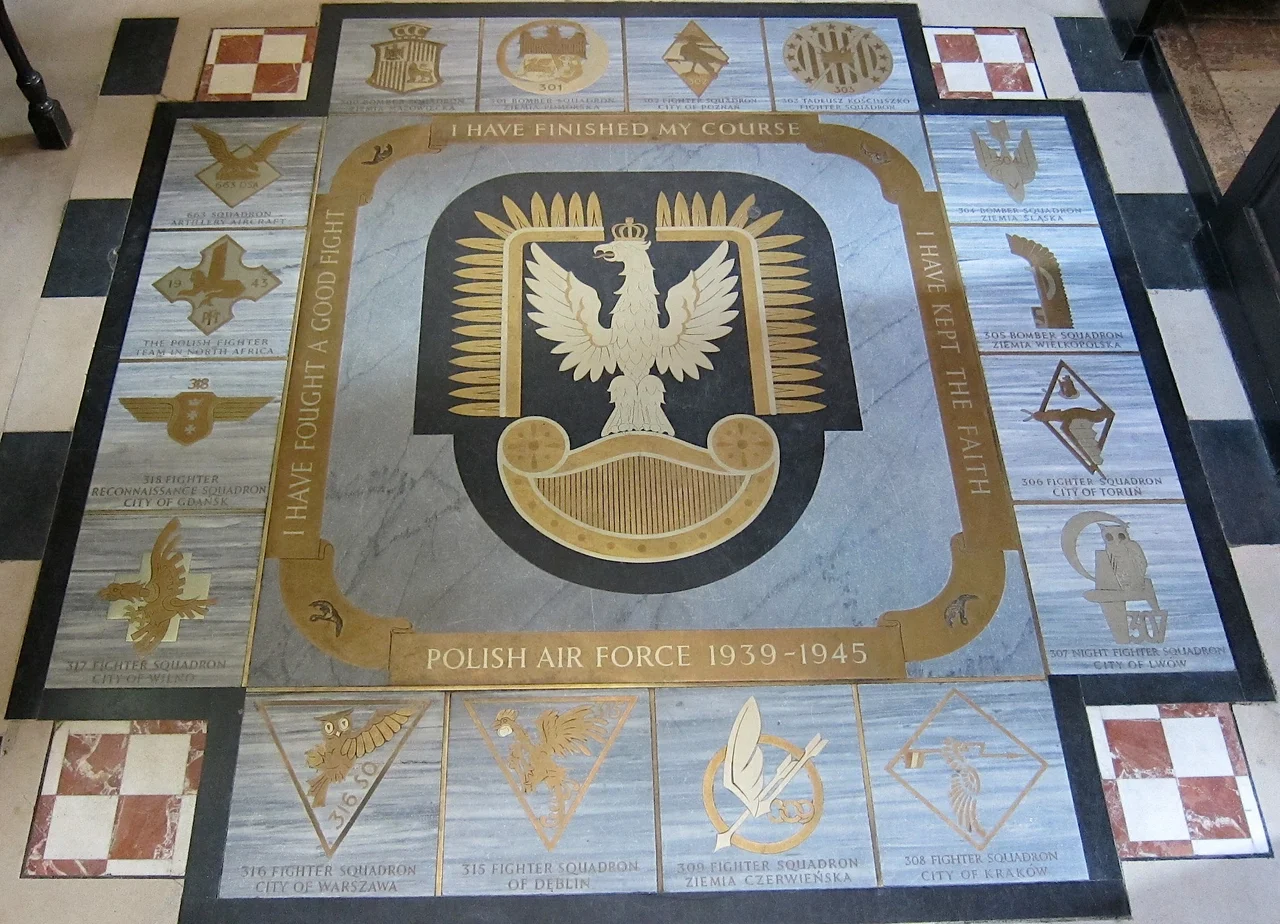
Walking into St Clement Danes, the first thing to register underfoot is the Welsh slate floor — inscribed with the badges of over 800 RAF commands, groups, stations, squadrons, and other formations. Near the entrance, a ring of Commonwealth air force badges surrounds the RAF badge itself. In the north aisle, a memorial on the floor honors the Polish airmen who fought in the Battle of Britain and the liberation of Europe.
Books of Remembrance list the names of RAF personnel who died in service, as well as American airmen based in the UK who died during the Second World War. Near the altar, plaques carry the names of RAF, Royal Flying Corps, Royal Naval Air Service, and Commonwealth personnel awarded the Victoria Cross and the George Cross. The lectern was a gift from the Royal Australian Air Force. The font was donated by the Royal Norwegian Air Force. The altar came from the Dutch embassy. The organ, installed in 1958, was a gift from the United States Air Force.
The Contested Statue and the Notable Dead
Outside the church stand two statues of RAF wartime leaders: Hugh Dowding, who commanded Fighter Command during the Battle of Britain, and Arthur "Bomber" Harris. Both were sculpted by Faith Winter. Harris's statue, erected in 1992 by the Bomber Harris Trust, generated protests from Germany — including from the mayors of Dresden and Hamburg — due to his role in the strategic bombing of German cities. The statue was unveiled by Queen Elizabeth The Queen Mother, who appeared surprised when she was jeered by protesters. It was guarded by police for some time afterward and has been repeatedly targeted with graffiti.
The church has a long list of notable associations. Pierre Radisson, the French fur trader who helped found the Hudson's Bay Company, was buried in the churchyard in 1710. King Harold Harefoot is recorded as buried here, though there is no memorial. William Webb Ellis, often credited with inventing Rugby football in 1823, was once rector. And in the 1949 novel Nineteen Eighty-Four, Winston Smith encounters a picture of St Clement Danes as it was before the war — a building he has known only as a ruin that was never rebuilt.
From the Air
Located at 51.5131°N, 0.1139°W on the Strand in the City of Westminster, immediately west of the Royal Courts of Justice. The church sits as an island in the middle of the Strand's traffic. Nearest airports: London City (EGLC, ~7nm east), Heathrow (EGLL, ~14nm west). The Thames is approximately 0.3 miles south; Trafalgar Square is 0.4 miles west.
Nearby Stories
- Stevenage 5.7 km away
- Malling Abbey 5.7 km away
- 1952 Farnborough Airshow Crash 7.7 km away
- Ingatestone Hall 8.2 km away
- Hellfire Caves 9.1 km away
- The Carrington Event: The Solar Storm That Could Happen Again 9.8 km away
- Bletchley Park 16 km away
- Castle Hedingham 23 km away