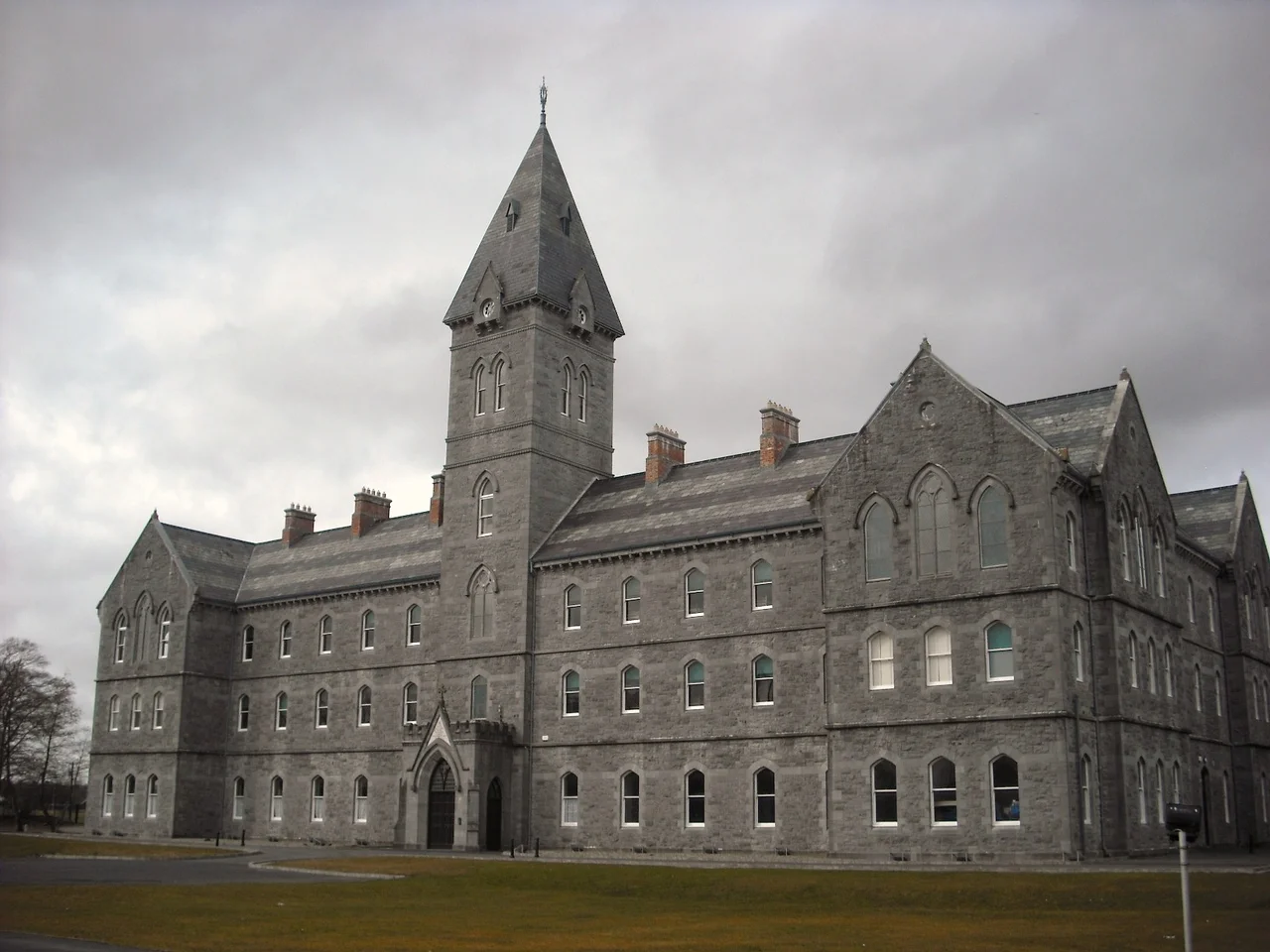

St Flannan's College
There is a clock tower at St. Flannan's College with no clock. The Gothic windows around it have plain uncarved label stops where ornate carving was supposed to go. These are not aesthetic choices; they are scars from a bankruptcy. When the original builder went broke during construction in the early 1880s, the diocese had to redraw the plans, cutting the decorative work and postponing the finishing touches indefinitely. The clock that was meant to fill the tower never arrived. A century and a half later, those omissions have become part of the school's identity. Students walk past them every day without noticing, the way you stop noticing the rough edges of any place you've lived in long enough.
Mr. Fitzsimons of Springfield
The story begins in 1846 at Springfield House, Ennis, where a Mr. Fitzsimons ran a private academy. The Diocese of Killaloe took him under its patronage, and Springfield became both a diocesan seminary and a Catholic boarding school for boys. The arrangement worked. By the early 1850s, Springfield was successfully poaching pupils from Erasmus Smith College on College Road. Springfield students won scholarships to the Queen's Colleges at Galway and Cork - the future University of Galway and University College Cork. In 1859, Fitzsimons added a new wing and affiliated the school with the newly founded University of London. Then financial difficulties caught up with him in 1862. He moved to Argentina, set up four schools in a matter of years, and died there in 1871 during a yellow fever outbreak.
The Diocesan Takeover
Under Fitzsimons's successor, Springfield broke with the University of London and affiliated instead with Newman's Catholic University in Dublin. By 1865 the diocese had had enough and established its own diocesan college completely under clerical control at #12 Bindon Street - now a solicitor's office. The institution was renamed St. Flannan's Literary Institute, after the 7th-century patron saint of the Dál gCais people who once held this part of Munster. The following year the diocese acquired the Springfield premises after Fitzsimons's old school closed. A search began for land big enough to build a proper college. Work started in 1879 on a site on the Limerick Road. The design was severely neo-Gothic. The execution was severely interrupted by the builder's bankruptcy. The school opened anyway, missing its clock and its window decorations and some of the cohesion of the original drawings.
Canon Kennedy and the Dáil Loan
Canon William Kennedy, president of St. Flannan's from 1919 to 1932, ran the college during the Anglo-Irish War. Under his leadership the school became a centre of separatist activity. The Canon personally organised the collection of the Dáil Loan in Clare - the bond drive launched by the new Dáil Éireann government to fund the independence movement - and letters from both Éamon de Valera and Michael Collins relating to this work are still preserved in the college. In July 1921, British forces arrested Canon Kennedy and interned him on Bere Island off the south Cork coast. The new Irish state that emerged after the Treaty was poorer than the colonial administration had been, and St. Flannan's had to fund most of its operations from its own resources. Physics arrived in the curriculum in 1937 as the only Leaving Certificate science available - the school would not offer a second science subject for decades.
Five Bishops, Four Hurlers, and a President
St. Flannan's alumni read like a partial census of post-independence Ireland. Five future Bishops of Killaloe attended - Michael Fogarty (1904-54), Michael Harty (1967-94), Joseph Rodgers (1955-66), Willie Walsh (1994-2010), and Denis Kelly (Bishop of Ross, 1897-1924). John McCarthy went further afield to become Bishop of Sandhurst, Victoria, Australia, from 1917 to 1950. Michael D. Higgins, the ninth President of Ireland, took his secondary education here. So did Michael O'Kennedy (Foreign Affairs, Finance, Agriculture minister and European Commissioner) and Tony Killeen (Defence minister). The hurling alumni form their own pantheon: Anthony Daly, the double All-Ireland winning Clare captain; Jamesie O'Connor, double All-Ireland winner and Sky Sports analyst; Davy Fitzgerald, All-Ireland winning goalkeeper and now Wexford manager; Ger Loughnane, the All-Ireland winning manager who transformed Clare hurling in the 1990s. The largest secondary school in Munster has produced more Irish public figures per square metre of neo-Gothic stone than nearly any other building in the country.
The Flood of 2009
On 19 November 2009, much of County Clare went underwater during the worst Atlantic storm cycle in living memory. St. Flannan's experienced severe flooding: the college grounds were submerged, and water breached the perimeter wall because of a small stream that runs underneath the campus. Photographs of the inundated school spread across Irish newspapers. The school had grown enormously by that point - from 370 pupils in 1962 with only 17 teachers, to over 1,000 students by 2004. The boarding portion closed in 2005. In 2002, the first co-educational classes began for First Year students; in 2003 a new wing added more than 20 rooms. By 2025-2026 enrolment had reached 1,276 students. St. Flannan's was ranked third in Ireland in a 2009 league table compiled by researchers at the University of Ulster and the Kemmy Business School at the University of Limerick. The school the diocese could not quite finish in 1879 still stands, slightly incomplete, slightly waterlogged, full to capacity.
From the Air
Coordinates 52.83°N, 8.98°W. St. Flannan's College stands on the Limerick Road on the southern edge of Ennis in County Clare. Shannon Airport (EINN) is 17 km southeast - the principal regional airfield. The college's distinctive neo-Gothic clock tower (without a clock) is visible from low altitude. The campus sits between the R458 (old Limerick Road) and the M18 motorway, near the River Fergus. From altitude the college's grey limestone Gothic Revival architecture contrasts visibly with the surrounding residential streets. Best viewed from 1,000-2,000 ft AGL.
Nearby Stories
- Kinvara 6.1 km away
- William Smith O'Brien 9.3 km away
- Newport, County Tipperary 13 km away
- Aran Islands 14 km away
- Portumna 15 km away
- Kilkee 19 km away
- Tipperary (town) 21 km away
- Kilflynn 25 km away