
St Helen's Church, Bishopsgate
Shakespeare came here. In the 1590s, when he lived in the parish of Bishopsgate, this was his church. He walked under the same broad medieval roof that still stands today, past the same Tudor tombs, past the worn stone where countless feet had passed before his. St Helen's Bishopsgate, tucked into a quiet courtyard off one of the City of London's busiest streets, is one of those buildings that ought not to exist. The Great Fire of 1666 obliterated the parish churches around it. The Blitz flattened streets within sight of its walls. Two IRA bombs in the early 1990s blew out its windows and cracked its masonry. Still it stands - the largest surviving parish church inside the old City walls, sometimes called the Westminster Abbey of the City because nowhere else outside the actual Abbey contains so many monuments.
Two Naves, Two Worlds
The church has a strange and revealing shape. Walk through the door and you find not one nave but two, side by side, separated by a row of arches. This is the architectural memory of a vanished community. In 1210, the Dean and chapter of St Paul's permitted the foundation of a Benedictine nunnery here, and the sisters built their own church wider and longer than the parish church already on the site. The parish church was extended to match. For more than three centuries, a screen divided the two spaces - laypeople on one side, nuns on the other, sharing the same outer walls but living parallel lives. When Henry VIII dissolved the priory in 1538, the screen came down. The two churches became one. The masonry that holds it all together has been in place since around 1300, which makes St Helen's one of the only buildings in the City of London where you can lay your hand on a wall that medieval pilgrims also touched.
The Monument Crowd
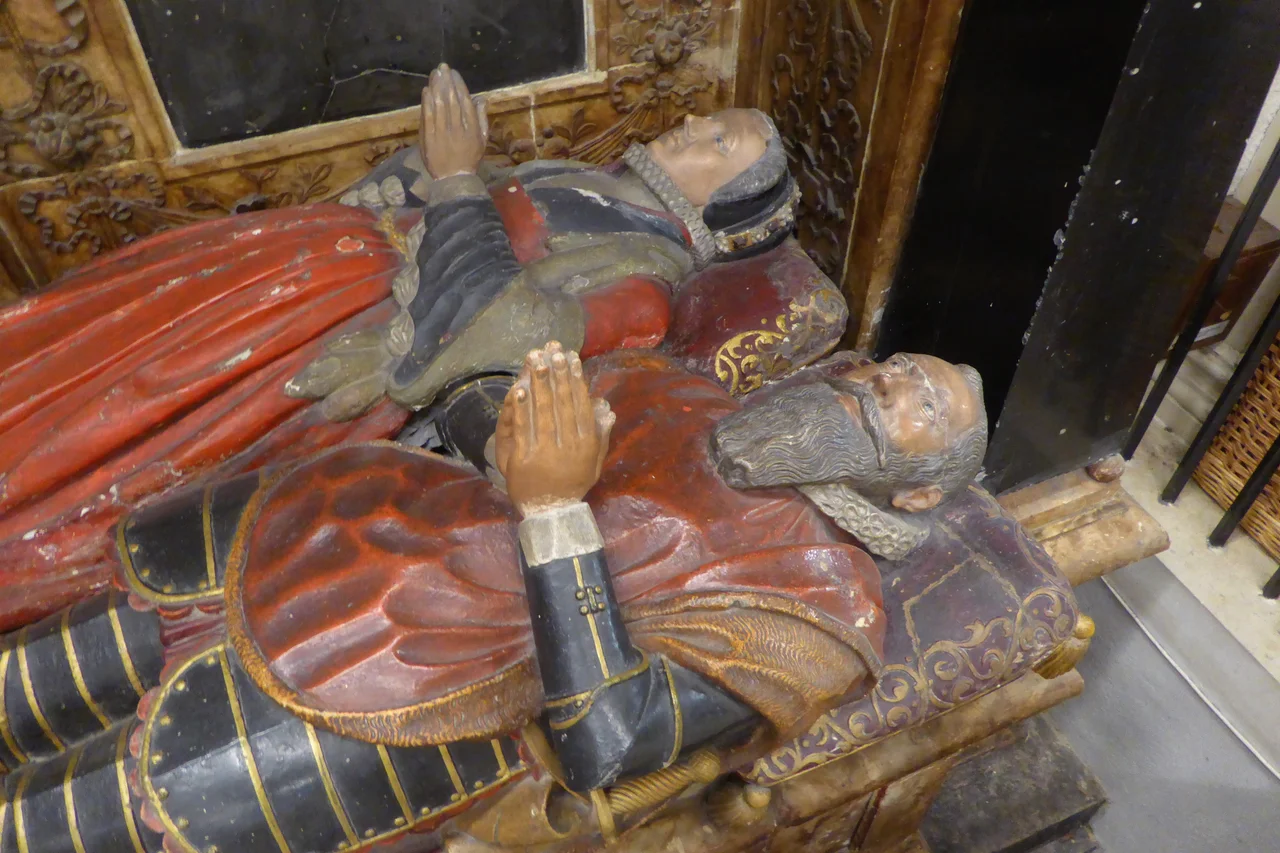
More monuments fill this church than any other in greater London apart from Westminster Abbey itself - and the cast of characters lying in stone is remarkable. Sir Thomas Gresham rests here: the merchant who founded the Royal Exchange and gave his name to Gresham's law about bad money driving out good. Sir John Crosby, builder of Crosby Hall, lies with his wife Agnes in an altar tomb topped with their recumbent figures. Sir John Spencer reclines under a stone canopy with his wife and his kneeling daughter from 1609. The Italian jurist Alberico Gentili, who helped invent the modern law of nations, is buried here too. And Robert Hooke - the brilliant, irascible polymath who saw cells through his microscope, drew the city after the Great Fire, and feuded with Newton over who deserved credit for the inverse-square law - was laid to rest at St Helen's in 1703. The Jacobean pulpit from 1615 still presides over them all, its dark wood polished by four centuries of preaching.
Surviving the Unsurvivable
St Helen's has a habit of escaping disasters that destroyed everything around it. When the Great Fire of London raged across the City in September 1666, it gutted St Paul's and consumed dozens of parish churches in its path. St Helen's stood. When the Luftwaffe bombed London night after night during the Blitz, the church again came through intact. Then, on a quiet Saturday in April 1992, the IRA detonated a massive truck bomb at the nearby Baltic Exchange. The blast shattered St Helen's windows and damaged its fabric. A year later, an even larger Bishopsgate bomb did more harm. Many would have given up. Instead, the architect Quinlan Terry led a sweeping restoration that returned the church to something closer to its Reformation-era arrangement, opening the interior into a single great room with the pulpit at its heart. Seating capacity doubled to a thousand. The Victorian rood screen was rotated ninety degrees. The 1742 organ by Thomas Griffin returned to its original position. The bombs that meant to wreck the church accidentally gave it a new lease of life.
City Church, City Congregation
St Helen's no longer sits in a residential parish. The City of London emptied of permanent residents long ago, replaced by glass towers and trading floors. So the church reinvented itself for the people who actually pass through these streets - bankers, lawyers, programmers, students, interns. Under Dick Lucas, who became rector in 1961 and stayed for nearly four decades, St Helen's became a centre of conservative evangelical Anglicanism with a reputation for muscular Bible teaching. Today four English-speaking Sunday services and one in Mandarin draw congregations that include young professionals from the surrounding office blocks and international workers a long way from home. Midweek lunchtime talks pull in suited workers from nearby firms. It is one of the unlikelier results of medieval foundation, Tudor dissolution, Stuart fire, Blitz survival, and Victorian disinterment - a thriving 21st-century church inside a 13th-century shell.
A Thousand Bodies Under the Floor
There is a story the church doesn't always advertise. During the 1891 Victorian restoration, when workmen began excavating the floor for a new arrangement of altar and chancel, the burials began to surface. Over the centuries more than a thousand bodies had been interred in vaults beneath the church, and the excavation released them. Work stopped for a year. Every set of human remains was carefully translated to Ilford Cemetery, and a concrete slab was laid between the new floor and what remained of the vaults. When you stand inside St Helen's now, the people who built this place are still under your feet in spirit, but not in fact - they were moved with the care that their long sleep deserved.
From the Air
St Helen's Bishopsgate sits at approximately 51.5148 degrees north, 0.0817 degrees west, tucked into a small courtyard between modern towers including the Cheesegrater and 30 St Mary Axe (the Gherkin). From altitude the church itself is hard to spot, but the surrounding cluster of City of London skyscrapers makes navigation simple. London City Airport (EGLC) is roughly six nautical miles east; London Heathrow (EGLL) about thirteen nautical miles west. Best viewing altitudes are 1,500-3,000 feet over the City. Visibility is best on clear mornings when the low sun catches the church's pale stone against the dark glass of its neighbours.
Nearby Stories
- Stevenage 5.7 km away
- Malling Abbey 5.7 km away
- 1952 Farnborough Airshow Crash 7.7 km away
- Ingatestone Hall 8.2 km away
- Hellfire Caves 9.1 km away
- The Carrington Event: The Solar Storm That Could Happen Again 9.8 km away
- Bletchley Park 16 km away
- Castle Hedingham 23 km away