
St James's Church, Piccadilly
Christopher Wren built more than fifty churches in London after the Great Fire, but almost all of them were squeezed onto medieval foundations, their footprints inherited from buildings that had stood there for centuries. St James's Piccadilly was different. Here Wren got to start with an empty lot. In 1662 the Earl of St Albans had been granted what was then open ground on the western edge of London for a new residential development, and he set aside land for a parish church. Wren took the commission in 1672 and produced something he considered a model of his own ideas about how an English Protestant church should work - a single broad space where every member of the congregation could see the preacher and hear the words, a light-filled box of red brick and Portland stone topped with galleries and a barrel vault. He later wrote that he thought it the most successful of all his designs.
Gibbons in Limewood and Marble
What makes St James's astonishing inside is what Wren entrusted to a young Dutch-born carver named Grinling Gibbons. Gibbons had been discovered by John Evelyn working in a Deptford cottage and brought to royal attention; he became the greatest decorative woodcarver in English history. At St James's he produced the marble font - a quietly extraordinary thing showing Adam and Eve at the Tree of Knowledge - and the limewood reredos behind the altar, a cascade of fruit, flowers, and foliage carved in such impossibly fine detail that the petals seem about to fall. William Blake was baptised at that font in 1757. So was Joseph Banks, the botanist who would sail with Captain Cook and gather a vast Pacific harvest of plants. So was Ottobah Cugoano, the Ghanaian abolitionist whose 1787 book Thoughts and Sentiments on the Evil of Slavery was one of the most influential anti-slavery texts of the era. In 2023, on the 250th anniversary of Cugoano's baptism, the church installed a series of murals by Trinidadian-British painter Che Lovelace - the first permanent artwork anywhere in the world to commemorate him.
The Bomb, the Rebuilding, the Garden
On the night of 14 October 1940 a German bomb tore through St James's. The rectory and vestry were destroyed; the church was gutted; the original spire collapsed. For years afterwards the building stood as a roofless shell while London tried to imagine its future. Restoration finally came under Sir Albert Richardson, completed in 1954, with the old lead-covered spire rebuilt in lighter fibreglass and a full new suite of pews and light fittings - a rare surviving Richardson interior. The churchyard became something more than a churchyard. Lord Southwood, the press baron, paid for it to be remade as a garden of remembrance to commemorate, in his own words, the courage and fortitude of the people of London. Queen Mary opened it in 1946. Today Southwood Garden hangs onto its place as one of the few green oases in the West End shopping district, where tourists overflow Piccadilly's pavements without realising what is just beyond the wall.
Keep It Open
By the late 1970s, like many central London churches surrounded by commercial buildings and bereft of permanent residents, St James's was fading. When Donald Reeves was offered the rectorship in 1980, the bishop's brief was said to be simply: I don't mind what you do, just keep it open. Reeves took that as a licence to reinvent. The church became progressive, campaigning, openly liberal - an early supporter of women's ordination, a sanctuary for asylum seekers, a partner of homeless services in the West End. The congregation rebranded itself as a community and built itself around what it called radical welcome. Successors Charles Hedley and, since 2010, Lucy Winkett have continued that line. The current St James's hosts labyrinth walks, an LGBT group, a Vagabonds discussion circle that meets in a local pub, and the occasional controversial event - including a 2023 drag show that drew complaints from some quarters. In 2024 the church became the first ever to mount a show garden at the Chelsea Flower Show, winning gold with a design called Imagine the World to be Different.
A Choirmaster Bound for Carnegie Hall
There is a small detail in the church's records that hints at how many remarkable lives have passed through this building. From 1902 to 1905 the choirmaster at St James's Piccadilly was a young man named Leopold Stokowski. He was twenty when he took the job. He would leave London for a similar position in New York, then move on to the Cincinnati Symphony, then to the Philadelphia Orchestra, where he became one of the most flamboyant and influential conductors of the twentieth century - the man who soundtracked Disney's Fantasia, who premiered Mahler's Eighth in America, who shook hands with Mickey Mouse on screen. The church where he taught choristers is also the church where Robert Graves married Nancy Nicholson in 1918 with George Mallory as best man - Mallory who would vanish on Everest six years later. The poets and painters and explorers move through these walls like ghosts.
What Concerts and Markets Bring
Wander past St James's on a weekday and you might find an antiques market in the forecourt; on Friday and Saturday it becomes an arts and crafts market. Step inside on any given evening and there might be a concert under way - the acoustics are warm and intimate, and the church regularly hosts contemporary performers from R.E.M. to Laura Marling to Devin Townsend. Wren's barrel vault carries voices and strings as well now as it did in 1684. The Grinling Gibbons organ case, gilded and elaborate, sits on the west wall containing - at the moment - no actual organ. A restoration project has been underway since at least 1982. The current plan is to install a new instrument inside the historic case. Until then, an electronic substitute carries the hymns, and Gibbons's carved birds and instruments wait patiently above for the day they hear pipes again.
From the Air
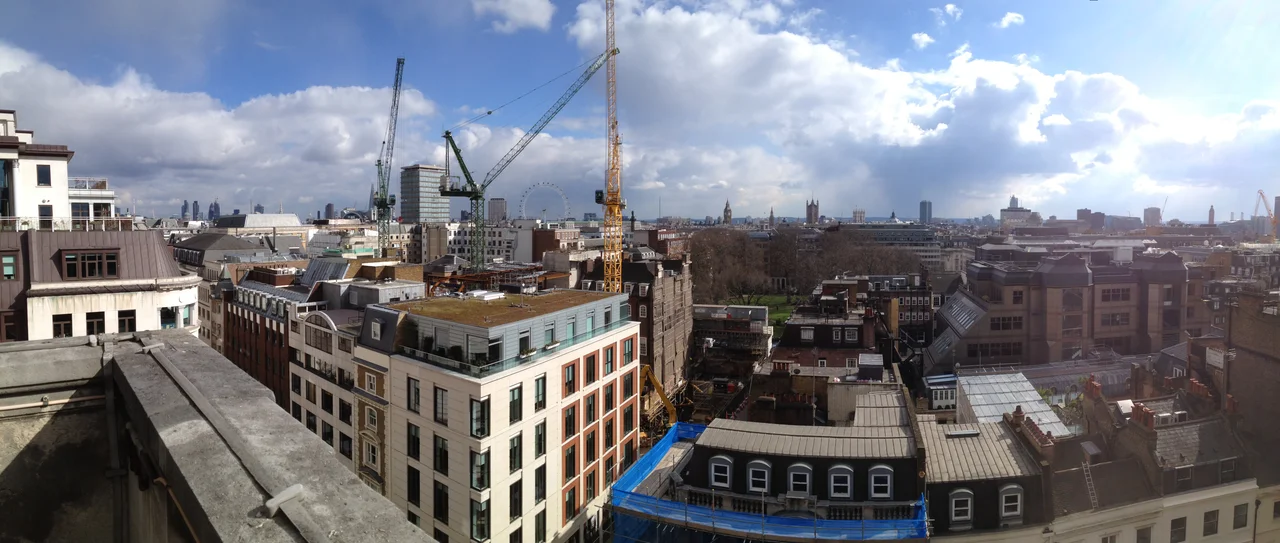
St James's Piccadilly sits at approximately 51.5086 degrees north, 0.1367 degrees west, on the south side of Piccadilly between Jermyn Street and the main road, midway between Piccadilly Circus and Green Park station. From altitude the church spire is a small feature among West End rooftops; the open patch of Southwood Garden and the green expanse of Green Park to the west are easier visual references. London Heathrow (EGLL) is about thirteen nautical miles west; London City (EGLC) about seven nautical miles east. Best viewing altitudes are 1,500-3,000 feet. The contrast between St James's brick and the surrounding Portland stone Georgian terraces is striking on a clear morning.
Nearby Stories
- Stevenage 5.7 km away
- Malling Abbey 5.7 km away
- 1952 Farnborough Airshow Crash 7.7 km away
- Ingatestone Hall 8.2 km away
- Hellfire Caves 9.1 km away
- The Carrington Event: The Solar Storm That Could Happen Again 9.8 km away
- Bletchley Park 16 km away
- Castle Hedingham 23 km away