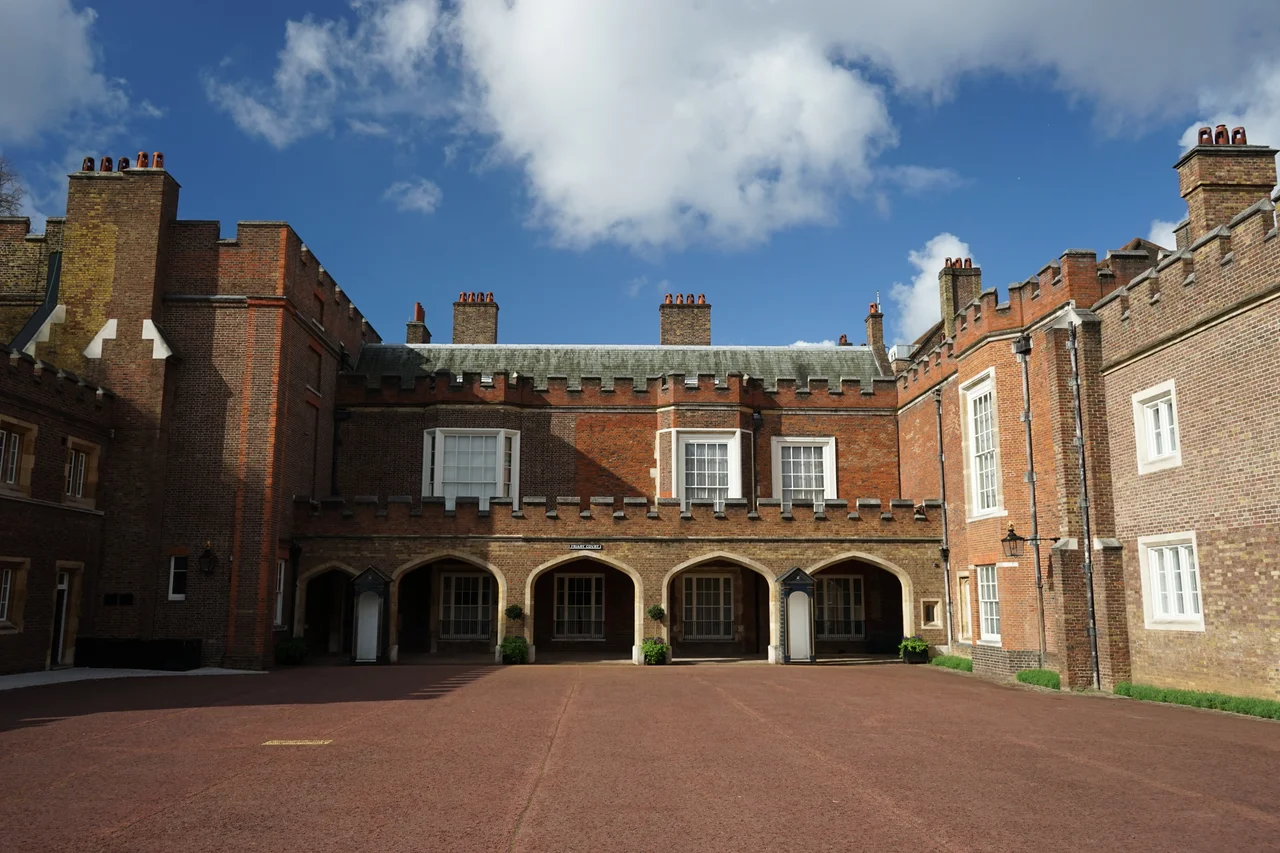

St James's Palace
Every ambassador to the United Kingdom is technically accredited not to Buckingham Palace, not to Westminster, but to the Court of St James's. That ancient designation refers to a Tudor brick complex on Pall Mall that hardly anyone ever sees from the inside. St James's is the senior royal palace in London - the formal head of the British royal household - and yet no monarch has lived here as a primary residence since 1837. It is a working palace without a sovereign in it, an administrative heart that beats inside red Tudor walls Henry VIII himself ordered up. The most recognisable feature is the north gatehouse facing Pall Mall, with its two octagonal crenellated towers framing a clock that has run since 1731. Stand close enough and you can pick out the worn carving of H and A above the entrance - the entwined initials of Henry and his second wife, Anne Boleyn, who was crowned queen the year before construction began.
Built on a Leper Hospital
The site St Henry VIII chose for his new palace in the 1530s was not glamorous. It was a remote spot on the western edge of London occupied by a hospital for women suffering from leprosy, dedicated to Saint James the Less. The hospital had stood there since the 12th century. Henry bought out the institution, demolished it, enclosed the surrounding land as a deer park - what is now St James's Park - and built himself a smaller and more private residence than the rambling Whitehall Palace where formal court life unfolded. Construction took place between 1531 and 1536. The plan is unusual for an English royal palace: four enclosed brick courtyards instead of one grand great court, arranged for relative privacy. Henry wanted somewhere he could escape his own court, hunt his own deer, and live some semblance of a normal aristocrat's life. The leper hospital women he displaced were given pensions; the deer he enclosed were chased by king after king for the next two centuries.
Births, Deaths, and One Final Night
Two future kings of England were born here. Charles II arrived in the palace on 29 May 1630, son of Charles I and his French queen Henrietta Maria. Three years later James II was born here too, on 14 October 1633. The palace stands as the setting for one of the most poignant nights in English history. On the eve of his execution at Whitehall in January 1649, Charles I spent his last night at St James's, where he had been confined under guard. He walked from here to his death the next morning, across St James's Park to the scaffold outside the Banqueting House. Henrietta Maria's mother, Marie de Medici - the deposed regent of France - had been given the palace as a refuge in 1638, and lived in it for three years until Parliament made clear how unwelcome a Catholic former queen of France was on English soil. She left for Cologne. Marie's gift to her son-in-law of her own art collection became the seed of what is now the Royal Collection.
Displaced by Buckingham
George III found the palace cramped, uncomfortable, and hemmed in by London's growth - by then the once-isolated site sat in the middle of an expanding city. In 1762 he purchased Buckingham House just down the Mall for his queen, Charlotte of Mecklenburg-Strelitz, and the royal household began to drift west. An 1809 fire destroyed parts of the palace, including the monarch's private apartments at the south-east corner. They were never rebuilt. The gap left by the fire is now Marlborough Road, separating the main palace from the Queen's Chapel built by Inigo Jones in the 1620s - which is why that chapel sits oddly isolated today. William IV was the last monarch to actually live at St James's, at least part of the year. Queen Victoria moved the household formally to Buckingham Palace in 1837 and St James's became what it has been ever since - a stage for ceremonies rather than a home. Yet Victoria still married Albert here in 1840, and the wedding of their daughter Princess Victoria to the future Frederick III of Germany took place in the palace in 1858.
The Voice from the Window
When a British monarch dies, there is a small balcony at St James's called the Proclamation Gallery that becomes briefly the most-watched window in the country. The Accession Council assembles inside the palace to formally proclaim the new sovereign. The Garter King of Arms steps onto the gallery overlooking Friary Court, the trumpeters with him, and reads the proclamation aloud to the crowds gathered below. Most recently this happened on 10 September 2022 when Charles III was proclaimed king two days after the death of Elizabeth II. The Proclamation Gallery isn't normally a usable balcony - the centre window is fixed shut. Palace workers removed it the day before the ceremony and installed a temporary door so the Garter King could step out into the bright September morning to make the announcement that begins every new reign.
A Working Palace Still
St James's today houses a sprawling complex of court offices and royal residences. Princess Anne keeps a London apartment here. So do Princess Beatrice and Princess Alexandra. York House next door was once home to Prince Charles and his sons; Lancaster House on the other side is used for government receptions; Clarence House, connected to the palace, is the London residence of King Charles III and Queen Camilla. The Chapel Royal inside the palace remains an active place of worship, though closed to the public. The King's Guards no longer post sentries on the public street outside on Pall Mall - that arrangement ended in December 2014 after a terrorist attack on the Canadian Parliament in Ottawa and the murder of British soldier Lee Rigby raised fears of lone-wolf attacks on exposed ceremonial guards. The sentries moved inside Friary Court, where you can still see them in their bearskins from the public street, but no longer reach out to touch them.
From the Air
St James's Palace sits at approximately 51.5047 degrees north, 0.1378 degrees west, on the north side of The Mall between Buckingham Palace and Trafalgar Square. From altitude its red Tudor brick contrasts sharply with the Portland stone of surrounding government buildings - look for the rectangular complex between Pall Mall and The Mall, with St James's Park spreading south-east. London Heathrow (EGLL) is roughly thirteen nautical miles west; London City (EGLC) about seven nautical miles east. The most striking aerial view is of the four enclosed courtyards arranged in a tight grid, with the Tudor gatehouse projecting north into Pall Mall. Best viewing altitudes are 1,500-3,000 feet.
Nearby Stories
- Stevenage 5.7 km away
- Malling Abbey 5.7 km away
- 1952 Farnborough Airshow Crash 7.7 km away
- Ingatestone Hall 8.2 km away
- Hellfire Caves 9.1 km away
- The Carrington Event: The Solar Storm That Could Happen Again 9.8 km away
- Bletchley Park 16 km away
- Castle Hedingham 23 km away