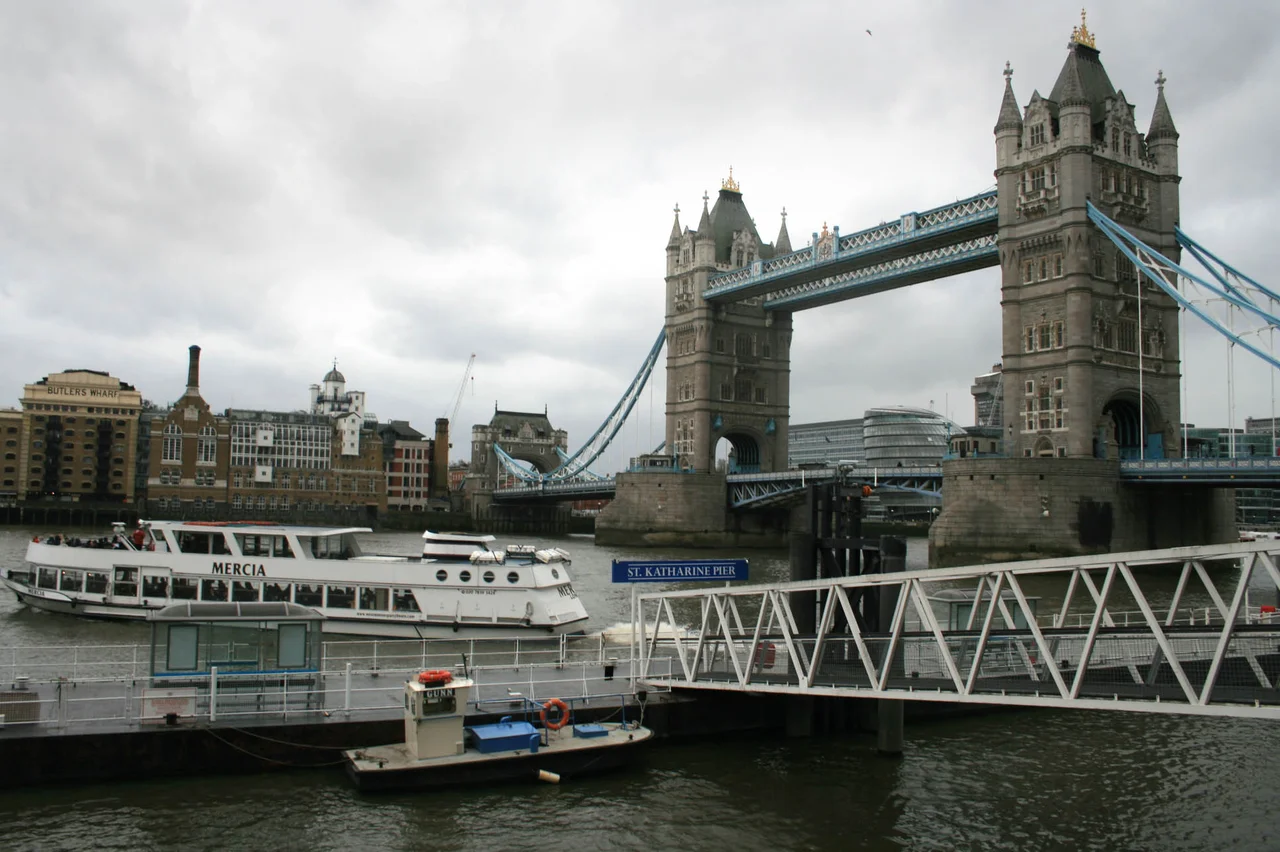

St Katharine Docks
On 1 January 1985, someone picked up a phone at St Katharine Docks and made history. Comedian Ernie Wise made the first public cellular telephone call in the United Kingdom from this spot over the new Vodafone network, dialling the Vodafone office in Newbury some 60 miles away. The dock had seen cargo ships, wartime bombs, decades of dereliction, and then a remarkable rebirth—and now it had witnessed the birth of mobile telecommunications. It was a fitting place for a landmark moment. St Katharine Docks has always been a site where things begin and end, often at tremendous human cost.
What Was Lost
Before the docks existed, a medieval hospital stood here. St Katharine's by the Tower had served London's poor since the 12th century. In 1827, Parliament decided the site was too valuable for charity work. An Act authorised the demolition of the entire precinct: 1,250 houses fell, the medieval hospital was razed, and around 11,300 people—mostly port workers living in tightly packed slums—lost their homes. The property owners received compensation. The residents received nothing. Construction began in May 1827 under the engineer Thomas Telford, whose only major London project this would be. By the time the docks opened on 25 October 1828, they had cost over £2 million. The displaced thousands had scattered across East London.
A Clever Design, an Imperfect Trade
Telford's engineering was inventive. He designed two linked basins—East and West—both reached via an entrance lock from the Thames. Steam engines designed by James Watt and Matthew Boulton kept the water level about four feet above the tidal river. He also pushed the warehouses, designed by architect Philip Hardwick, right to the quayside edge, so goods could be transferred directly from ship to store without the traditional clutter of intermediate handling. The innovation was elegant but the commercial reality was harsher: the docks could not accommodate the largest ships and were never enormously profitable. In 1864 they merged with the neighbouring London Docks. The Port of London Authority took over in 1909. By the 1930s, only the ships of the General Steam Navigation Company used the place regularly.
Destruction and Silence
German bombing during the Second World War struck hard. All the warehouses around the eastern basin were destroyed. The site lay derelict through the 1950s. The entrance lock was rebuilt in 1957, but commercial use ended entirely in 1968. London's great Victorian dock system was dying—cheaper container ports elsewhere were rendering the old riverside docks obsolete. What remained of St Katharine's after the bombs and the decline was a waterlogged void next to one of the most visited landmarks in Britain. Tower Bridge rose a few hundred metres away. The Tower of London stood just upstream. Something had to fill the space.
A Different Kind of Port
The transformation that followed became a template. Development around the eastern basin was completed through the 1980s and 1990s, turning the docks into a marina ringed by apartments, restaurants, and offices. Today sailing barges bob alongside Gloriana, the royal barge used at Queen Elizabeth II's Diamond Jubilee pageant, and MV Havengore, the vessel that carried Winston Churchill's coffin on the Thames in 1965. The Rolling Stones posed for album photographs here in May 1969. Filming crews have used the distinctive Victorian Ivory House for horror films, thrillers, and television dramas. What was once a place of hard labour and displacement has become one of London's most picturesque corners—though the 11,300 people whose homes were erased to build it are never quite as visible in the story as the yachts.
From the Air
St Katharine Docks lies at 51.507°N, 0.071°W on the north bank of the Thames in Tower Hamlets, directly east of Tower Bridge. From altitude the twin basins are clearly visible as rectangular water features immediately adjacent to the Tower of London—one of London's most recognisable landmarks. Nearest airports are London City (EGLC, about 4 miles east) and City of London Heliport nearby to the south. The nearest tube stations are Tower Hill and Tower Gateway DLR. The site sits at approximately 5 metres elevation. Approach from the south over the Thames for the clearest view of the docks in relation to Tower Bridge.
Nearby Stories
- Stevenage 5.7 km away
- Malling Abbey 5.7 km away
- 1952 Farnborough Airshow Crash 7.7 km away
- Ingatestone Hall 8.2 km away
- Hellfire Caves 9.1 km away
- The Carrington Event: The Solar Storm That Could Happen Again 9.8 km away
- Bletchley Park 16 km away
- Castle Hedingham 23 km away