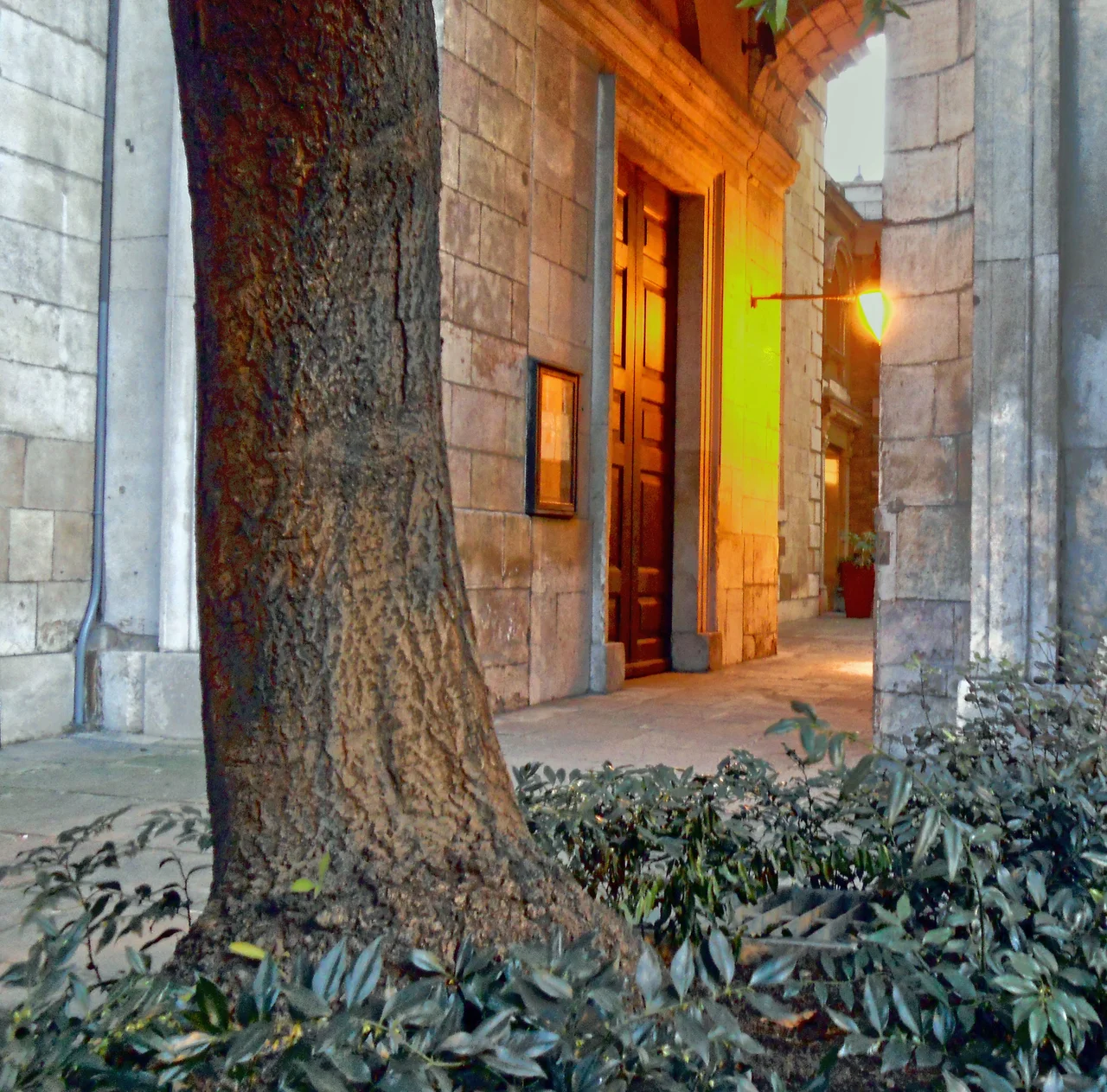

St Magnus the Martyr
For roughly six hundred years, anyone arriving in London from the south crossed the river at Old London Bridge and passed within a few feet of the west door of St Magnus the Martyr. The church stood at the north end of the bridge, on the alignment of Fish Street Hill, and its tower clock — a 1709 gift from Sir Charles Duncombe, the story goes, in fulfilment of a vow made one foggy morning when he could not find the hour — projected out over the roadway. T. S. Eliot, who knew the building well, called the interior in The Waste Land "inexplicable splendour of Ionian white and gold." He added in a footnote that it was, to his mind, one of the finest of Wren's interiors. Eliot was right about the building. He was right, too, that you had to come at it as a sinner to feel its full effect.
The Gateway to London
Until 1831 the only fixed crossing between the sea and Kingston-upon-Thames was here, where Peter of Colechurch's stone bridge — completed in 1209 — ran from the Surrey shore to the City. The bridge carried houses, shops, a chapel dedicated to Thomas Becket, and a steady churn of pilgrims, fishmongers, and country carts. St Magnus was their landfall. The parish had been founded in the eleventh century, soon after Alfred the Great's reoccupation of London, on a narrow strip of waterfront land south of Thames Street. Two thirds of the bridge fell within its parish boundaries. When pilgrims paused at the chapel of Becket and dropped offerings, a portion came annually to the church. When the Lord Mayor processed in state, St Magnus held a sword rest for his ceremonial blade. The building was, in every literal sense, where London began.
Which Magnus?
The dedication is contested. Since 1926 the church has been formally dedicated to St Magnus Erlendsson, Earl of Orkney, executed on Egilsay around 1117 for refusing to fight his cousin in a political dispute and later canonised. But the building predates Earl Magnus by roughly a century. Medieval English monasteries had collected relics of an earlier St Magnus — possibly a second-century Italian bishop of Anagni martyred under Decius, whose feast falls on 19 August — and the London church almost certainly took its name from that cult. In 1274 Edward I and his queen Eleanor were crowned on the Feast of Magnus, and the conduit in Cheapside ran red and white wine all day. The fishmongers, whose wharf lay directly south of the church, marched in solemn procession with a knight "representing St Magnus, because it was upon St Magnus' day."
The Fire and the Rebuilding
St Magnus stood less than three hundred yards from Thomas Farriner's bakehouse on Pudding Lane. It was one of the first buildings the Great Fire took, on 2 September 1666. Farriner himself, a former churchwarden of St Magnus, would be buried in the middle aisle four years later, perhaps within a temporary structure thrown up for services while the new church rose. Christopher Wren took on the rebuilding between 1671 and 1687, working through the master mason George Dowdeswell. At a final cost of nine thousand five hundred and seventy-nine pounds, nineteen shillings and tenpence, it was one of his most expensive churches. The lantern and cupola, modelled on a Jesuit church in Antwerp, were added between 1703 and 1706. The 1711 organ by Abraham Jordan was the first in England with a swell-box: a mechanism that let a player vary volume by opening and closing wooden shutters. Notices in The Spectator invited masters and performers to attend and hear it.
The Blitz and What Was Saved
Old London Bridge was demolished in 1831 when Sir John Rennie's new bridge opened upstream, and St Magnus ceased to be the gateway to London. The church kept its tower clock and its sword rest. It survived a serious fire in 1760 in an adjoining oil shop, escaped a 1920 demolition recommendation, and was patched and restored through the twentieth century. The Blitz scored direct hits on neighbouring buildings but the church itself came through. In the 1950s its rector noted that the interior of St Magnus had been "buried in the stink of Billingsgate fish-market, against which incense was a welcome antidote" — the fish wharf had been a parish landmark since the Middle Ages, and the Worshipful Company of Fishmongers still names St Magnus its guild church. The organ has been restored at least eleven times since 1760. The case, attributed to the Grinling Gibbons school of woodcarving, has never been replaced.
Ionian White and Gold
Step inside today, off Lower Thames Street, and the urban roar drops away. The chequered marble floor of the chancel, the freestone flags of the nave, the rails of Sussex wrought iron, the gilded organ case — all of it survives. The clock that Charles Duncombe gave so that no one would ever again have to wait on London Bridge wondering what time it was still keeps time. Two stones from the old bridge stand in the churchyard. The hymn tune called "St Magnus," written by Jeremiah Clarke in 1701 and named for this church, is still sung at Ascensiontide. Eliot's "inexplicable splendour" turns out to be quite explicable — the white plasterwork was added between 1782 and 1814 after Billingsgate's noise drove the rector to block up the north windows — but explicability does not diminish the effect. The light still falls the way the poet remembered it falling.
From the Air
St Magnus the Martyr stands at 51.5093 N, 0.0863 W on the north side of Lower Thames Street, immediately west of The Monument and just steps from the modern London Bridge approach. From the air the church sits in the dense Square Mile, with Tower Bridge a few hundred metres east and St Paul's Cathedral about half a mile north-west. The original alignment of Old London Bridge crosses the river roughly thirty metres east of the modern bridge. Nearest airports: London City (EGLC) five miles east, Biggin Hill (EGKB) eleven miles south-east, Heathrow (EGLL) sixteen miles west. The Monument to the Great Fire (1677) is the easiest landmark from the air — a single Doric column rising 202 feet, exactly the distance it stands from where the fire began.
Nearby Stories
- Stevenage 5.7 km away
- Malling Abbey 5.7 km away
- 1952 Farnborough Airshow Crash 7.7 km away
- Ingatestone Hall 8.2 km away
- Hellfire Caves 9.1 km away
- The Carrington Event: The Solar Storm That Could Happen Again 9.8 km away
- Bletchley Park 16 km away
- Castle Hedingham 23 km away