
St Mary-le-Bow
The name reveals everything. Built on Cheapside in 1080 with round stone arches—a novelty in Norman England—this church became *Sancta Maria de Arcubus*, Saint Mary of the Arches. Bow is simply an old word for arch. Before the Normans brought the technique from Normandy, nobody had built quite like this in London, and the building's distinctive feature gave it an identity that has lasted nearly a thousand years. Anyone born within earshot of its bells, according to tradition, is a true Cockney. The bells define the city's inner ring. In 1851 they could be heard as far as Hackney, Stratford, and Southwark. By 2012, traffic and building had reduced that range to the eastern edges of the Square Mile. The true Cockney, it seems, is an endangered breed.
A Turbulent First Century
The church began badly. In 1091, nearing completion after more than a decade of construction, it was struck by one of the most powerful tornadoes ever recorded in England. Roof rafters were hurled into the air and driven into the ground so hard that only their tips remained visible. The lower church—the undercroft of arches—survived; the upper structure was destroyed. The builders started again. In 1196, a fugitive named William Fitz Osbert hid in the tower, and to flush him out, supporters of the Archbishop of Canterbury set the church on fire. Fitz Osbert was stabbed as he fled. The mason's contract for reconstruction was signed less than two months later. The pattern of destruction and rebuilding was already well established. Nothing about this church would ever be allowed to stay wrecked for long.
Wren's Masterwork in Miniature
The Great Fire of 1666 destroyed the medieval church, leaving Christopher Wren to rebuild it from scratch. What he produced became, at a cost of over £15,000, his second most expensive commission after St Paul's Cathedral—and one of his finest. The tower and spire rise in four stages of Portland stone, topped with a winged dragon weathervane. The spire is the third tallest of any Wren church in London, surpassed only by St Paul's and St Bride's on Fleet Street. Inside, the geometry of those original Norman arches echoes through Wren's own structure. In 1950, while still a bombed-out shell following the Blitz, the building received Grade I listed status—the highest possible recognition. Even in ruins, it was irreplaceable.
Bow Bells and the Myth of Home
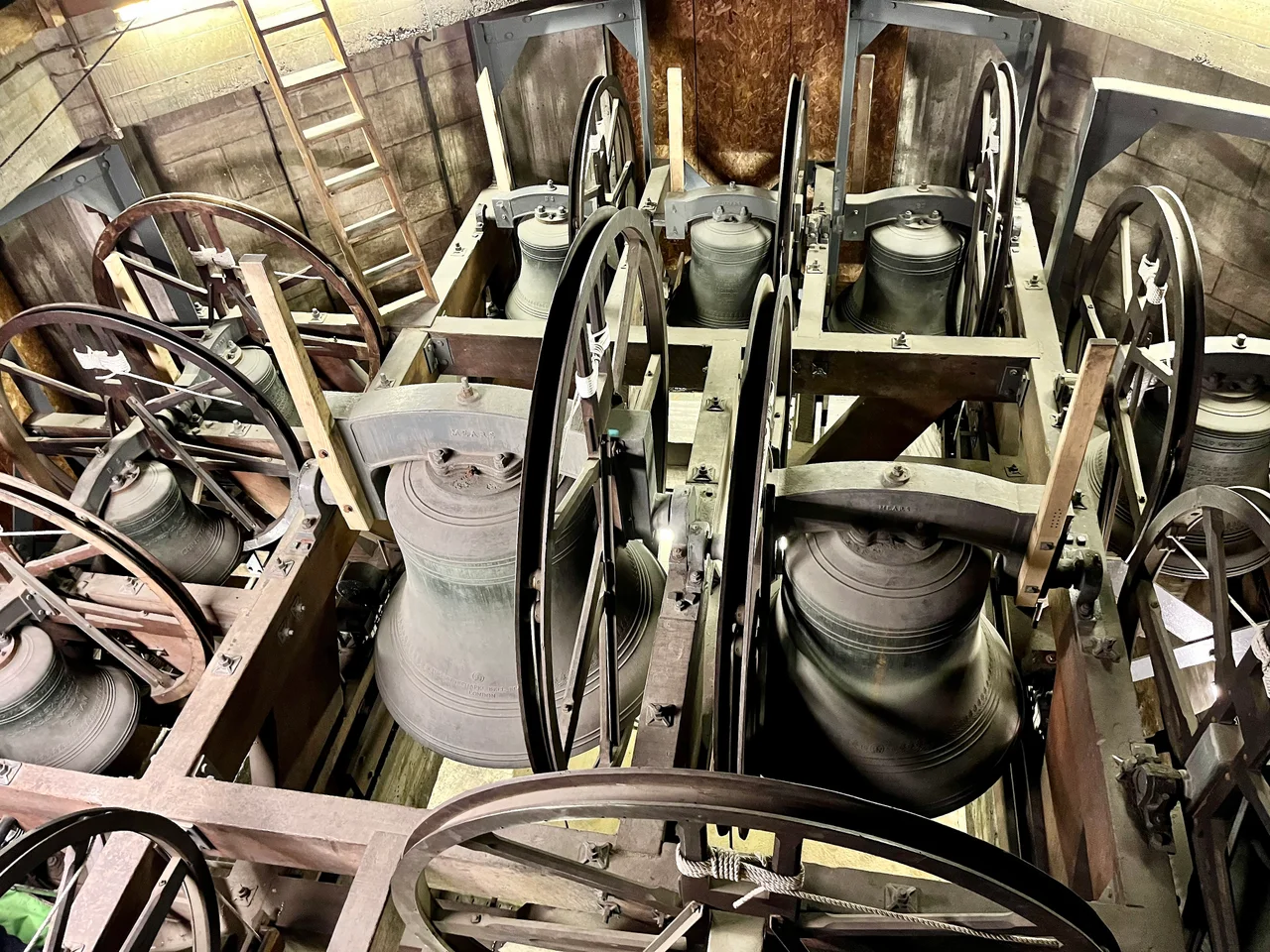
According to legend, Dick Whittington heard the bells of St Mary-le-Bow calling him back to London in 1392, having left the city in discouragement. The bells told him to turn around: 'Turn again, Whittington, Lord Mayor of London.' He returned and became Lord Mayor four times. The earliest written record of bells at the church dates to 1469, when the Common Council ordered a curfew bell to be rung here at nine each evening. In 1933, Harry Gordon Selfridge—the department store magnate—funded the restoration of the bells, which had fallen silent due to structural problems. Gillett & Johnston of Croydon did the work, finding multiple cracked bells and recasting them. The bells were rededicated by the Archbishop of Canterbury on 7 July 1933. Ringers from across the world still come to ring them.
A Church for the City
St Mary-le-Bow has an unusual rhythm for a London church: services run on weekdays rather than Sunday mornings, because the congregation is drawn from the financial industry and livery companies of the surrounding Square Mile. Traders, bankers, and insurers are more available at lunchtime on a Wednesday than on a Sunday morning. The church holds two sessions of prayer daily and two more formal services each week. It is a community church without a residential community—its parish is defined by work, not by where people sleep. The Blitz organ was removed for safekeeping during the bombing and the current instrument, completed in August 2010, was inaugurated by Thomas Trotter at a recital on 29 September of that year.
From the Air
St Mary-le-Bow stands at 51.514°N, 0.094°W on Cheapside in the City of London, roughly half a mile east of St Paul's Cathedral. The distinctive Portland stone spire is a recognisable landmark among the cluster of Wren church towers that punctuate the City's skyline. Nearest airports are London City (EGLC, about 6 miles east) and Heathrow (EGLL, about 17 miles west). The nearest tube station is Bank. The building sits at approximately 12 metres elevation. From altitude, locate St Paul's Cathedral first, then follow Cheapside eastward—the spire of St Mary-le-Bow is one of the tallest in the City and should be identifiable from low altitude in clear conditions.
Nearby Stories
- Stevenage 5.7 km away
- Malling Abbey 5.7 km away
- 1952 Farnborough Airshow Crash 7.7 km away
- Ingatestone Hall 8.2 km away
- Hellfire Caves 9.1 km away
- The Carrington Event: The Solar Storm That Could Happen Again 9.8 km away
- Bletchley Park 16 km away
- Castle Hedingham 23 km away