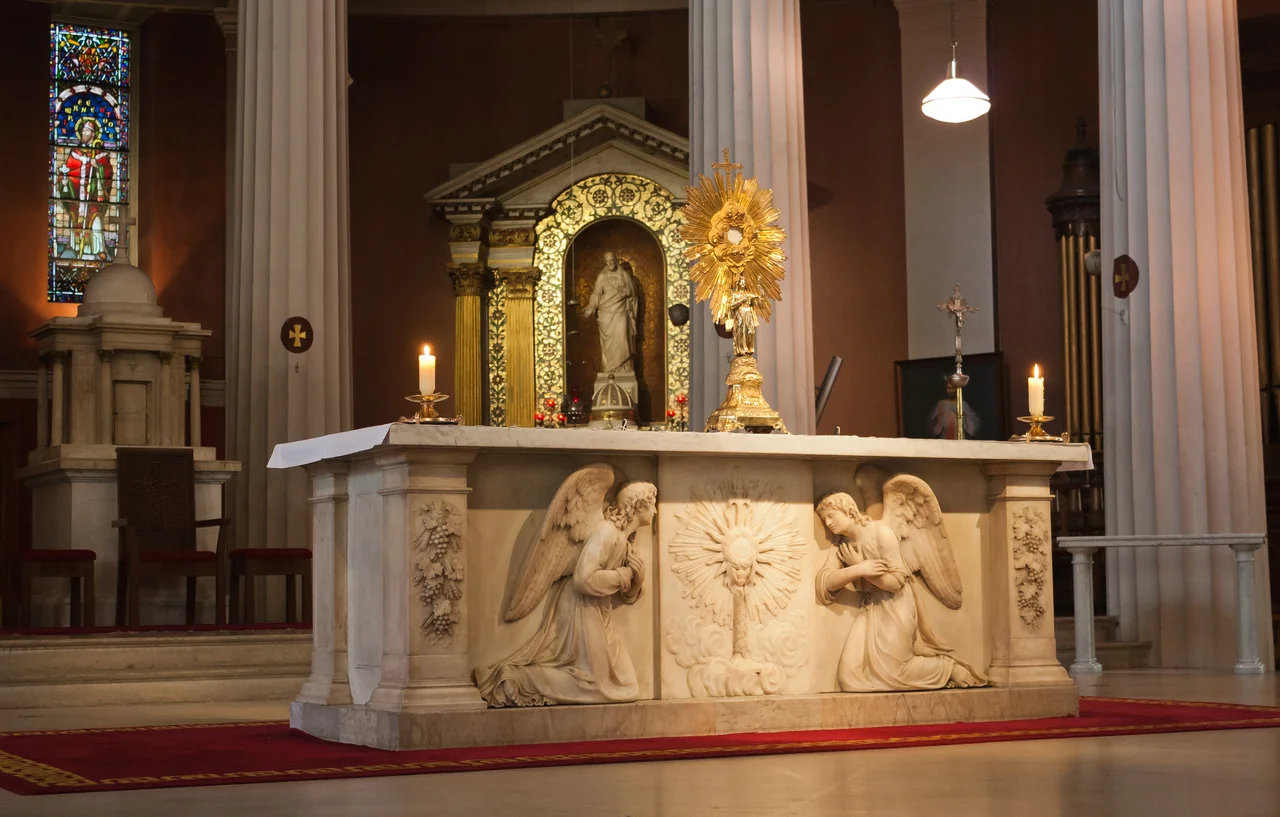

St Mary's Cathedral, Dublin
It was supposed to be temporary. When Archbishop John Thomas Troy's committee bought Lord Annesley's townhouse on Marlborough Street in 1803, the plan was always to build something grander, somewhere more prominent, as soon as the law and the money allowed. The replacement never came. The 'pro-cathedral' - the provisional cathedral - opened in 1825 on a back street that never quite became a front one, and served as Dublin's de facto Catholic cathedral for exactly two hundred years. Then, in November 2025, Pope Leo XIV quietly designated St Mary's the official Catholic Cathedral of Dublin - the first the city had possessed since the Reformation closed the medieval ones five centuries earlier.
A City With No Catholic Cathedral
The strange situation arose during the Reformation. The two medieval cathedrals of Dublin - Christ Church and St Patrick's - had been built by Catholic archbishops, and Christ Church had been formally designated the cathedral of the diocese by the pope at the request of St Laurence O'Toole in the twelfth century. After 1537, when Henry VIII's Reformation reached Ireland, both buildings passed to the new Church of Ireland and remained Anglican property. The Catholic majority - up to ninety percent of the population - was left with no cathedral in its own capital. The Penal Laws made building one practically impossible for centuries; Catholic churches that did get built tended to hide down narrow streets. So when Archbishop Troy's committee finally acted in 1803, they chose discretion - a side street near Sackville Street, a townhouse to demolish, a plan to call the new building 'pro-cathedral' until something better could be done.
Greek Outside, Roman Inside
Construction ran from 1816 to 1825. A public design competition produced a building of two minds. The exterior is austere Greek Revival - a Doric portico modelled on a temple, the kind of restrained classicism Dublin had been doing for half a century. The interior is something else entirely: a Renaissance basilica inspired by the church of Saint-Philippe-du-Roule in Paris, with side aisles, a curved apse, and an altar framed by stained glass of the Virgin Mary. Italian artisans were brought in to decorate the inside. The contrast between the cool grey portico on Marlborough Street and the warm, gilded sanctuary inside is the defining experience of walking into St Mary's. Daniel Murray, Archbishop of Dublin, celebrated the opening Mass on 14 November 1825, the feast of Dublin's patron saint Laurence O'Toole. The building was beautiful. The location remained quietly disappointing.
Daniel O'Connell's Cathedral
Catholic Emancipation arrived in 1829. Daniel O'Connell, the lawyer and political leader who had forced its passage through Parliament, attended a special thanksgiving High Mass in the still-new cathedral. He returned twelve years later as the first Catholic Lord Mayor of Dublin in centuries, processing in state from the Mansion House to 'the Pro' for High Mass. When O'Connell died at Genoa in 1847 his body was returned to Dublin and laid in state on a great catafalque in the cathedral before its burial at Glasnevin. Through the nineteenth century and into the twentieth, the cathedral became the focal point of Irish Catholic state ritual. Michael Collins's funeral was held here in August 1922 - the contemporary newspaper drawings show the old Turnerelli high altar, the canopy over the archbishop's chair, the soldiers of the Free State Army filing past. So were the state funerals of three former Presidents: Seán T. O'Kelly, Éamon de Valera, Patrick Hillery.
The McQuaid Plan and Other Dreams
Several archbishops tried to replace the pro-cathedral with a full one. W. T. Cosgrave, the first head of the Irish Free State Government, suggested in the 1920s that the burnt-out shell of the General Post Office on O'Connell Street - the site of the 1916 Easter Rising - be converted into a great national cathedral. The GPO was restored as a post office instead. In the 1940s Archbishop John Charles McQuaid bought the gardens at the centre of Merrion Square with the intention of building a cathedral there. Dubliners were horrified - they wanted to keep the gardens. McQuaid never broke ground. His successor handed Merrion Square to Dublin Corporation, and the park opened to the public. The Pro suggested that the Church of Ireland might consider returning Christ Church or St Patrick's; the Dean of St Patrick's offered to allow Catholic Masses there, but the offer was withdrawn under Anglican objection. The money raised over the years for a new cathedral was eventually spent on the dozens of new churches needed in Dublin's exploding twentieth-century suburbs.
The Palestrina Choir, and Finally a Cathedral
On 1 January 1903 a new choir was installed in the Pro - the Palestrina Choir, founded with funding from the playwright Edward Martyn to perform the polyphonic Renaissance sacred music that Pope Pius X had set as the standard for Catholic liturgy. From 1904 to 1905 a young Athlone tenor named John McCormack sang with the choir before going on to become one of the great voices of his generation. The Palestrina Choir still sings every Sunday morning at Solemn Latin Mass and at Friday Vespers; a girls' choir was added in 2009. Pope Francis visited in August 2018. And then, in November 2025, the long provisional title was retired. Pope Leo XIV designated St Mary's as the cathedral of the Archdiocese of Dublin - the first cathedral of the Catholic Church in the city since 1537. After two hundred years of pretending to be temporary, the Pro became simply the cathedral. The architecture did not change. Only the title.
From the Air
St Mary's Cathedral sits at 53.35°N, 6.26°W on Marlborough Street, one block east of O'Connell Street in central Dublin, on the north bank of the Liffey. From altitude it is partly hidden by surrounding buildings, with the Spire of Dublin visible just a block to the west and the General Post Office immediately beyond that. The river runs three blocks south. Dublin Airport (EIDW) lies 9 km north.
Nearby Stories
- Wicklow Mountains 12 km away
- Mornington 14 km away
- German submarine U-1051 16 km away
- Abbey of Kells 18 km away
- Irish Military Intelligence Service 20 km away
- HMS Manners (K568) 37 km away
- Templemore 42 km away
- Irish Sea Bridge 43 km away