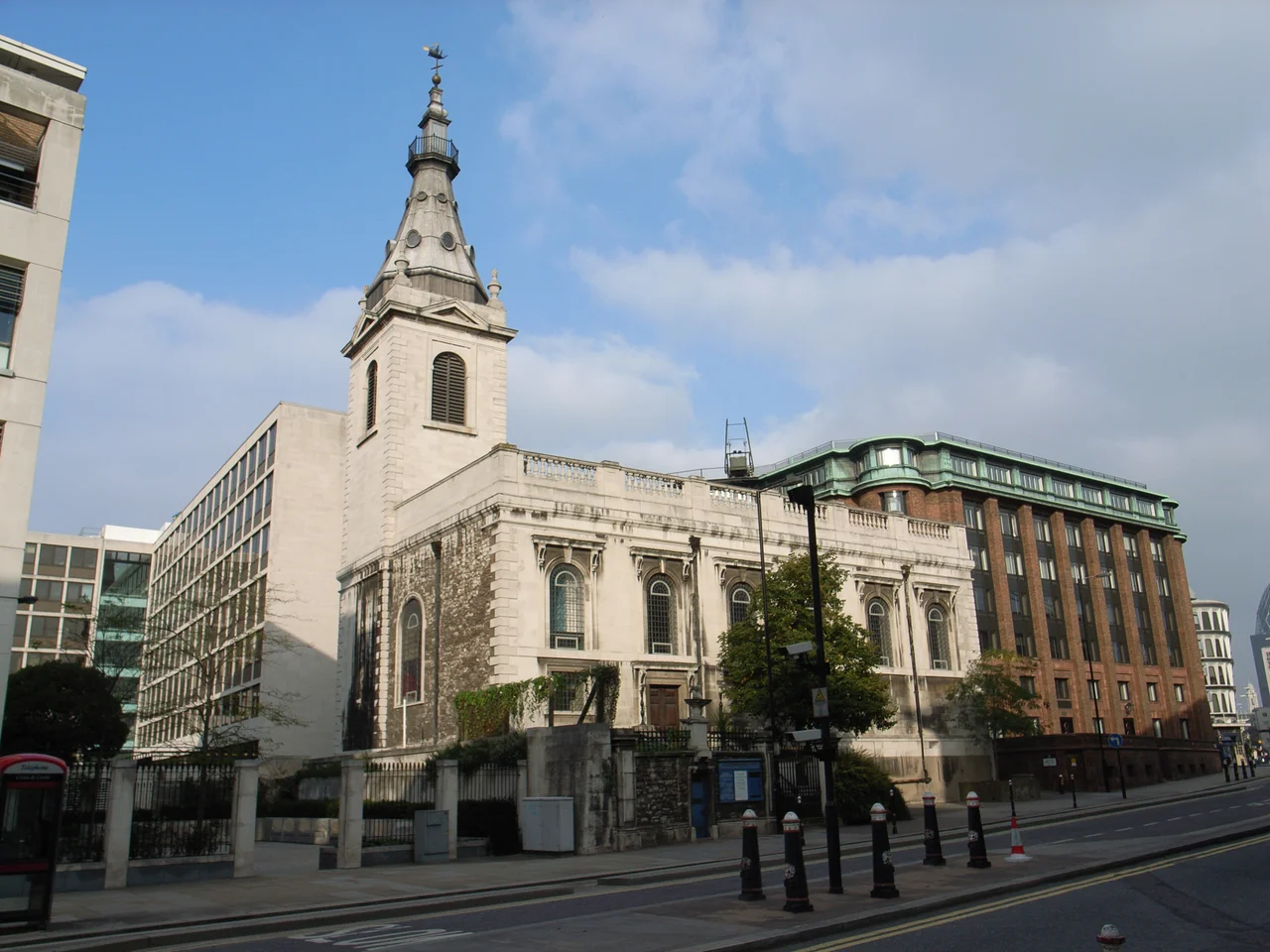

St Nicholas Cole Abbey
The name is a lie, sort of. There has never been an abbey here. The Cole part comes from coldharbour, a medieval word for a traveller's shelter, and somewhere along the line the colourful spelling collapsed into something that sounded like an old monastic foundation. The actual church is a small stone box on Queen Victoria Street in the City of London, dedicated to the 4th-century bishop Saint Nicholas of Myra - patron saint of children and, more relevantly to its medieval congregation, of fishermen. The earliest mention of St Nicholas Cole Abbey dates to a letter of Pope Lucius II in 1144 or 1145, which is older than St Paul's Cathedral as it stands today. By the 13th century the locals called it St Nick's behind Fish Street, because the medieval fish market clattered just outside its door. John Stow recorded that in Elizabeth I's reign a lead-and-stone cistern was set up against the north wall, fed from the Thames, for the care and commodity of the Fishmongers in and about Old Fish Street. The church was practical as much as holy.
The First to Rise
When the Great Fire of London began in a Pudding Lane bakery on the morning of 2 September 1666, St Nicholas Cole Abbey was directly in its path. Within three days the fire had consumed the church along with St Paul's Cathedral and around fifty other parish churches. King Charles II briefly considered handing the cleared site to London's Lutheran community for a German-speaking congregation, but lobbying killed that idea, and the parish was joined to the nearby St Nicholas Olave - another fire victim, never rebuilt. Christopher Wren's office took the commission and produced something modest but elegant. The work proceeded from 1672 to 1678 at a cost of 5,042 pounds. The building accounts are wonderfully specific: two pounds, fourteen shillings for dinner for Dr Wren and other Company; sixpence for half a pint of canary wine for Dr Wren's coachmen. Of all fifty-one churches lost in the Great Fire that would eventually be rebuilt, St Nicholas was the first to reopen its doors. It is a small triumph that the smallest, plainest of Wren's commissions got there ahead of the rest.
Parson Chicken and the Great Fire's Ironies
Even before the fire the church had collected a small library of strange characters. In August 1553, in the very month Mary I was crowned, the rector Thomas Sowdley said the first Mass celebrated in any London church under the new Catholic queen. He had previously married a wife during Edward VI's Protestant reign and lost his job for it. The diarist John Strype records what happened next: another priest called sir Tho. Snowdel - that is, Sowdley - whom they nicknamed Parson Chicken, was carted through Cheapside, for assoiling an old acquaintance of his in a ditch in Finsbury field; and was at that riding saluted with chamber-pots and rotten eggs. He somehow rode out the abuse and recovered his living once Elizabeth came to the throne. A century later, the patronage of the church passed into the hands of Colonel Francis Hacker, the Puritan officer who commanded the execution detail at the beheading of Charles I. Hacker would be hanged for that crime after the Restoration. The chain of ownership runs from a priest pelted with chamber pots to a regicide, all in two generations.
The Crow's Nest Spire
Look up at the church's exterior and the eye finds a strange weathervane. The northwestern tower rises 135 feet, capped with a lead spire shaped like an upside-down octagonal trumpet, and at the very top is a vane in the form of a three-masted barque sailing in the round. It didn't always sail there. The current ship came from St Michael Queenhithe, a Wren church demolished in 1876, and was added to St Nicholas in 1962 as part of the post-Blitz restoration. Beneath the ship is a small balcony resembling a crow's nest, ringed with stone lunettes - a maritime detail entirely appropriate for the church of the fishermen's saint. At each corner of the tower sits a small flaming urn. Smoke from underground trains so blackened the building in the late 19th century that Londoners nicknamed it St Nicholas Cole Hole Abbey. The grime is gone now, but the urns and the ship and the crow's nest all remain, an almost playful Wren detail that survived two fires and the worst night of the Blitz.
10 May 1941
London's worst single night of the Second World War came on 10 May 1941, when 1,436 people were killed in a single raid and great swathes of the City burned. Westminster Abbey was hit. The chamber of the House of Commons was destroyed. And St Nicholas Cole Abbey was reduced to a roofless shell. The Edward Burne-Jones stained glass that had filled the east wall was incinerated. For two decades the gutted church stood open to the sky on Queen Victoria Street, a silent reminder of what had happened to the City. It became, briefly, a star: in the 1951 Ealing comedy The Lavender Hill Mob, the burnt-out shell stood in for the scene of a gold-bullion heist. Restoration finally arrived under architect Arthur Bailey in 1961-62. The new east windows came from Keith New, who had worked on Coventry Cathedral; his three abstract panels in the manner of Marc Chagall depict the church as the centre of the world, the rock of Christ on four rivers, and seven lamps representing the spread of the church around the globe. The vestry's crazy paving is made from shattered medieval tombstones recovered after the bombing.
St Nick's Today
After decades of declining congregations and brief leases - including a long spell from 1982 to 2003 when the building belonged to the Free Church of Scotland - the church reopened in 2014 as a Centre for Workplace Ministry, supported by a coffee shop in the south aisle named The Wren. Sunday services started up again in 2016 under the name St Nick's Church, drawing congregations from the conservative evangelical tradition. Thursday lunchtime talks aim, in the parish's own words, to explain from the Bible the good news of Jesus Christ to those working nearby. Behind a panel near the south door, restorers found a medieval stone head during the rebuilding. It is still there, a small fragment of the church that stood here before Wren and before the Great Fire - watching the office workers who now come in for coffee in a building that has, by any reasonable measure, refused to give up.
From the Air
St Nicholas Cole Abbey sits at approximately 51.5119 degrees north, 0.0967 degrees west, on Queen Victoria Street between St Paul's Cathedral and the Thames. From altitude it is dwarfed by neighbours - look for the dome of St Paul's just to the north-west, then find the smaller octagonal-trumpet spire roughly 300 metres to the south-east. London City Airport (EGLC) is approximately five nautical miles east; London Heathrow (EGLL) about fourteen nautical miles west. The Millennium Bridge crossing the Thames south of the church is a useful navigation landmark. Best viewing altitudes are 1,500-3,000 feet over the City of London.
Nearby Stories
- Stevenage 5.7 km away
- Malling Abbey 5.7 km away
- 1952 Farnborough Airshow Crash 7.7 km away
- Ingatestone Hall 8.2 km away
- Hellfire Caves 9.1 km away
- The Carrington Event: The Solar Storm That Could Happen Again 9.8 km away
- Bletchley Park 16 km away
- Castle Hedingham 23 km away