.png)
St Pancras Old Church
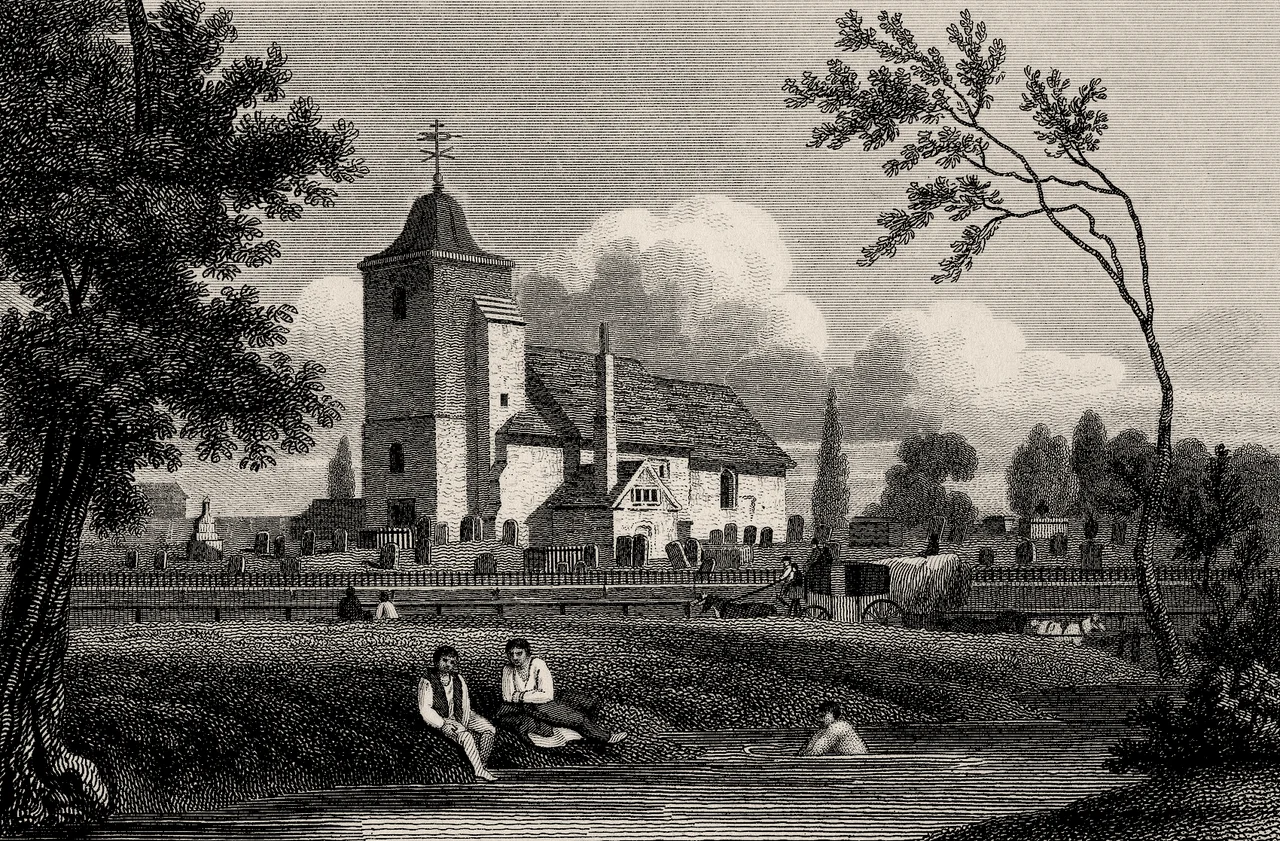
Some places in London were old before London was London. St Pancras Old Church, tucked behind a Victorian Gothic railway terminus on what was once a marshy floodplain of the River Fleet, may be one of them. Information panels outside the building today claim a site of prayer and meditation since 314 AD, in the late Roman period - a claim that earnest historians have spent two centuries either trying to prove or trying to debunk. What is certain is this: when the church was rebuilt in 1847, workmen pulled re-used Roman tiles out of the medieval tower walls, and an inscribed altar stone they uncovered has been dated to around AD 625. That puts the foundation, at the earliest, within a generation of Augustine of Canterbury's mission to convert the Saxons. Most parish churches in Britain claim to be ancient. This one, dedicated to a 14-year-old Roman boy executed for his faith under Diocletian, has an unusually strong claim to be among the oldest.
Older Than St Paul's
In 1593 the cartographer John Norden noticed something walking past the dilapidated little church and made a note of it in his Speculum Britanniae. The St Pancras building, he wrote, looked older than St Paul's Cathedral. Norden was right; old St Paul's, which the Great Fire would later destroy, dated back to around 1087 in Norman form. St Pancras Old Church had Norman columns, Saxon-era features, and reused Roman material baked into its walls. A vicar of the church claimed at some point before 1870 to have seen a document in the Vatican Library placing the foundation in the 4th century during the Roman period - the kind of unverifiable but suggestive provenance the Victorians loved. The truth is probably less spectacular but still extraordinary. Pope Gregory the Great sent Augustine of Canterbury to convert the English in 597 with relics of Saint Pancras among his cargo. The first church Augustine established at Canterbury was dedicated to that boy martyr. Some traditions ascribe the founding of this London church to the same mission, the same relics, the same handful of monks pushing northwards into the Middle Saxon kingdom.
The Last Mass and the French Refugees
By the early modern period the church had become unusual for a different reason. After the Reformation made Catholic worship illegal in England, St Pancras Old Church kept a quiet tradition - it was said that the last bell which tolled for the Mass in England was rung here. And St Pancras was one of only a small number of London graveyards where Roman Catholics could still be buried. That single fact transformed the churchyard into a destination for English Catholics throughout the persecutions of the 17th and 18th centuries, and then for the great wave of French Catholic refugees who poured into London during the Revolution. Émigré priests fleeing the Terror were buried here. So was the Chevalier d'Eon, the famous French spy who lived publicly as a woman for the second half of his life. Pasquale Paoli, the Corsican freedom fighter and friend of James Boswell, was interred here in 1807 before his remains were returned to Corsica. Johann Christian Bach, youngest son of Johann Sebastian Bach and a celebrated composer in his own right, lies in the graveyard. His father is in Leipzig; the son is in Camden.
Mary and Percy at the Grave
In the early summer of 1814, a young woman of sixteen named Mary Godwin began meeting in this churchyard with a married poet five years her senior. His name was Percy Bysshe Shelley. The grave they met beside belonged to Mary's mother - the philosopher Mary Wollstonecraft, who had died giving birth to her. Wollstonecraft's husband, the writer William Godwin, had buried her here in 1797 and would eventually be buried next to her. By Mary Wollstonecraft's headstone, the future Mary Shelley and Percy Bysshe Shelley planned the elopement that scandalised London. They left for the Continent in July of that year. Mary would soon begin writing Frankenstein at Lake Geneva. The Wollstonecraft and Godwin remains were later removed to Bournemouth to lie with Mary Shelley herself, but the spousal memorial stone still stands in the churchyard. Charles Dickens used the place in A Tale of Two Cities as the setting for grave robbery and body snatching - a real practice at this very churchyard, where doctors paid for corpses to dissect at the medical schools.
The Hardy Tree
In the mid-1860s, the construction of the Midland Railway's London terminus at St Pancras station required cutting through the northern end of the churchyard. The young man in charge of overseeing the disinterment of graves was a Dorset-born architectural assistant named Thomas Hardy. He was not yet a novelist. Faced with what to do with all the displaced headstones, Hardy arranged them in close concentric rings around the trunk of an ash tree, where they remained for the next century and a half. As the tree grew, its bark slowly absorbed and partly engulfed the stones. The Hardy Tree, as it came to be known, was one of London's strangest curiosities - half memorial, half organic sculpture - until it finally fell in December 2022, weakened by fungal infection. The stones it had held are still there. The architect John Soane is reputed to have designed the family tomb in this same churchyard whose distinctive dome would later inspire Giles Gilbert Scott's iconic K2 red telephone box. Soane's mausoleum still stands, Grade I listed. Across the churchyard a memorial bench marks where the Beatles posed for promotional photos on 28 July 1968, during their famous Mad Day Out shoot for Hey Jude.
Songs from a Small Church
The building you see today was rebuilt in 1847 by architect Alexander Dick Gough, who removed the old western tower, extended the nave, and built a new tower on the south side. Further restorations followed under Arthur Blomfield in 1888. The church is small inside - just a stone-walled rectangle with a chancel - and that intimacy has given it a new role in the 21st century. Since 2011 it has been one of London's most prized small concert venues, hosting acoustic sets by Laura Marling, Brian Eno, Sinead O'Connor, Sam Smith, Tom Odell, Agnes Obel, and many others. Sleep Token have played here. The medieval altar stone Carter Rendell argued in the 20th century could be 6th century still sits inside. The 7th-century Roman tiles are still embedded in the structure. Across the churchyard wall, Eurostar trains slip in and out of St Pancras International toward Paris. The little church where Augustine's relics may have come, and where Mary Shelley fell in love, and where French exiles were finally allowed to lie in peace, sits at the very modern junction of past and present.
From the Air
St Pancras Old Church sits at approximately 51.5349 degrees north, 0.1302 degrees west, on Pancras Road in Somers Town, immediately west of St Pancras International railway station. From altitude the giant Victorian Gothic facade of St Pancras station and the curved trainshed roof are unmissable; the small church is in the green churchyard just to the west of them. London City Airport (EGLC) is roughly six nautical miles east; London Heathrow (EGLL) about fourteen nautical miles west. The British Library lies just south of the church. Best viewing altitudes are 1,500-3,000 feet, with the cluster of railway termini at Euston, St Pancras, and King's Cross providing clear visual anchors.
Nearby Stories
- Stevenage 5.7 km away
- Malling Abbey 5.7 km away
- 1952 Farnborough Airshow Crash 7.7 km away
- Ingatestone Hall 8.2 km away
- Hellfire Caves 9.1 km away
- The Carrington Event: The Solar Storm That Could Happen Again 9.8 km away
- Bletchley Park 16 km away
- Castle Hedingham 23 km away