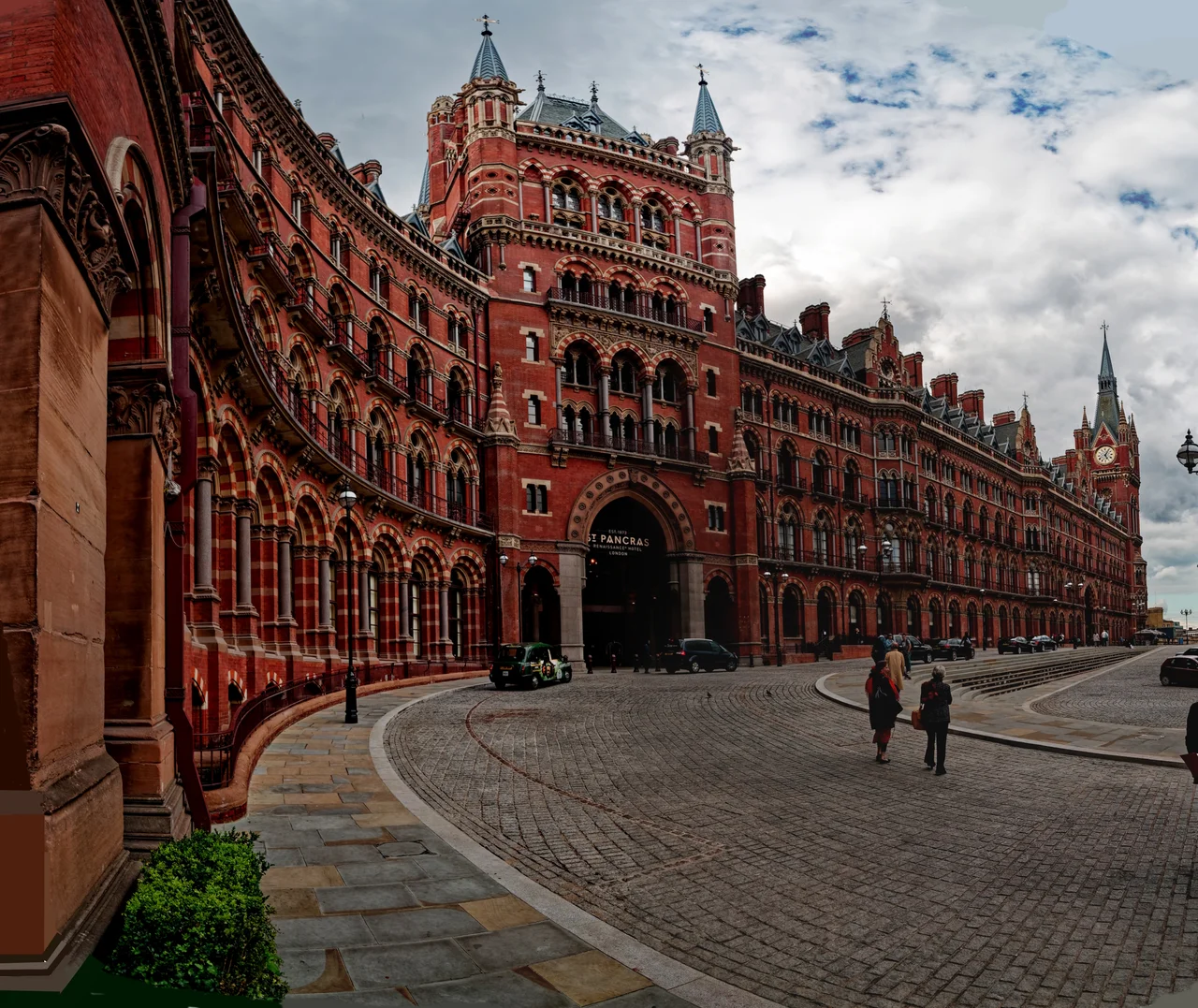

St Pancras Railway Station
There is a moment, walking into the train shed at St Pancras, when the brain has to recalibrate scale. The single-span wrought-iron arch overhead reaches 100 feet to its apex and 245 feet from wall to wall, with no piers and no supporting columns - just one enormous vault of glass and iron that, when William Henry Barlow's design opened in 1868, was the largest enclosed space in the world. The Victorians built it to ship coal and beer into London. The 21st century inherited it as a Gothic cathedral of the railways, the launching point for Eurostar trains that disappear east under the English Channel and emerge in Paris two hours and sixteen minutes later.
Built on Beer Barrels
The Midland Railway built St Pancras because it was tired of paying a one-shilling-and-ninepence toll to use the Great Northern's tracks into King's Cross. In 1863 Parliament authorised the company to cut its own line from Bedford and to build a London terminus on the muddy site of Agar Town, a notorious slum on the Euston Road. The genius of Barlow's design lay underneath. Because the platforms had to sit twenty feet above ground level to clear the Regent's Canal, the area below the trains became a vast undercroft. The Midland decided to use that space to store beer - specifically, the dark Burton ale being railed in from Burton upon Trent. The columns and girders of the undercroft were laid out on a grid spaced by the dimensions of a beer barrel. For a century the floor beneath the platforms was a warehouse for ale. Today the same undercroft holds the Eurostar departure lounge, the shops, the champagne bars, and the famous Olivier Award-winning installation of Paul Day's nine-metre bronze statue of two embracing lovers.
George Gilbert Scott's Gothic Fantasy
The architect of the train shed was an engineer. The architect of the building that fronts it on Euston Road was something else entirely. George Gilbert Scott was a high Victorian Gothic enthusiast who had recently lost a competition to design the new Foreign Office in Whitehall - the government had insisted on a classical building instead. Scott, undeterred, took his rejected Gothic vision and adapted it for the new Midland Grand Hotel that would form the public face of St Pancras. The result, opened in 1873, is a riot of red brick and Ancaster stone, with pointed arches, soaring towers, ornate carvings, and a hundred-foot clock tower. The Midland Grand Hotel was the most fashionable address in London when it opened - the first hotel in Britain with a ladies' smoking room, with a Gothic grand staircase that floats unsupported, and with revolving doors and electric bells. By the 1930s, however, its rooms had no en-suite bathrooms and it had become hopelessly outdated. It closed in 1935 and stood largely vacant for seventy years.
The Battle to Save It
By the late 1960s, British Rail looked at the underused Victorian giant and saw an obvious candidate for demolition. The Euston Arch, the great Doric portico that had announced Euston station for over a century, had been smashed up in 1962 over the protests of conservationists, and many in the rail industry assumed St Pancras would follow. What they didn't reckon with was the Victorian Society and a determined administrator named Jane Hughes Fawcett, whom British Rail officials irritably nicknamed the Furious Mrs Fawcett. Poet Laureate John Betjeman lent his enormous public voice to the campaign, writing impassioned letters to The Times and standing for photographs in front of the threatened facade. The campaign won. Grade I listed status was awarded to the entire complex in November 1967, just ten days before demolition was due to begin. A bronze statue of Betjeman, looking up in wonder at the train-shed roof, now stands on the upper concourse - life-size, slightly stooped, clutching his hat, gazing exactly where his eyes turned when he saved this place.
The Channel Crossing
When the Channel Tunnel Rail Link finally chose its London terminus in the late 1990s, after years of indecision, the choice fell on St Pancras. The 800-million-pound restoration that followed extended the train shed northwards with a flat-roofed addition to accommodate the 400-metre Eurostar trains, opened up the undercroft for shops and restaurants, refurbished the Midland Grand Hotel as the St Pancras Renaissance, and reinstalled an exact replica of the original station clock by Dent of London. Queen Elizabeth II reopened the station on 6 November 2007 with Prince Philip beside her, watched by the Royal Philharmonic Orchestra and the singer Katherine Jenkins. There is a small footnote here. The original 18-foot Dent clock had been sold in 1978 to a wealthy American collector for 250,000 pounds, but it was accidentally dropped during removal and shattered on the platform below. A retiring train guard named Roland Hoggard bought the pieces for 25 pounds, carried them in batches to his Nottinghamshire farm, and patiently reassembled them in his barn, where the rebuilt clock kept good time for decades. When Dent recreated the new clock for the 2007 opening, they used Hoggard's resurrected original as their template. He was invited to the reopening to watch the new clock take its place exactly where the old one had stood.
Bilingual Signage and the Lovers Statue
St Pancras feels different from other London termini. The signs are bilingual in English and French, which is unusual for an English station. Passengers cleared by French border police on the upper concourse step from London directly into the Schengen zone without further checks at the Paris end. Paul Day's 30-foot Meeting Place statue stands beneath the station clock, two enormous bronze lovers locked in greeting or farewell - a piece many Londoners initially loathed and have since reluctantly grown fond of. A 95-key piano sits on the upper concourse, free for anyone to play, and people do; some of them have turned out to be Elton John, who showed up one morning in 2016 and sat down at the keys. Outside the building's western flank, the British Library houses the largest collection of books in the world. To the north and east stretches the redeveloped King's Cross Central, once a wasteland of derelict railway lands, now home to Google's UK headquarters and a public square called Granary Square that throws fountains in summer. Behind the western wall of the station the old Midland Grand Hotel reopened as a five-star hotel in 2011. Scott's red-brick spires still rake the London sky. The Furious Mrs Fawcett would be pleased.
From the Air
St Pancras International sits at approximately 51.5308 degrees north, 0.1252 degrees west, on the north side of Euston Road in the London Borough of Camden. From altitude the Gothic Revival hotel facade is unmistakable - look for a red-brick block with a 100-metre clock tower, immediately west of King's Cross station and its more modern semi-circular concourse. London City Airport (EGLC) is roughly six nautical miles east; London Heathrow (EGLL) about thirteen nautical miles west. The British Library lies immediately south-west of the station, with the Eurostar tracks emerging eastwards toward Stratford and the Channel Tunnel. Best viewing altitudes are 1,500-3,000 feet.
Nearby Stories
- Stevenage 5.7 km away
- Malling Abbey 5.7 km away
- 1952 Farnborough Airshow Crash 7.7 km away
- Ingatestone Hall 8.2 km away
- Hellfire Caves 9.1 km away
- The Carrington Event: The Solar Storm That Could Happen Again 9.8 km away
- Bletchley Park 16 km away
- Castle Hedingham 23 km away