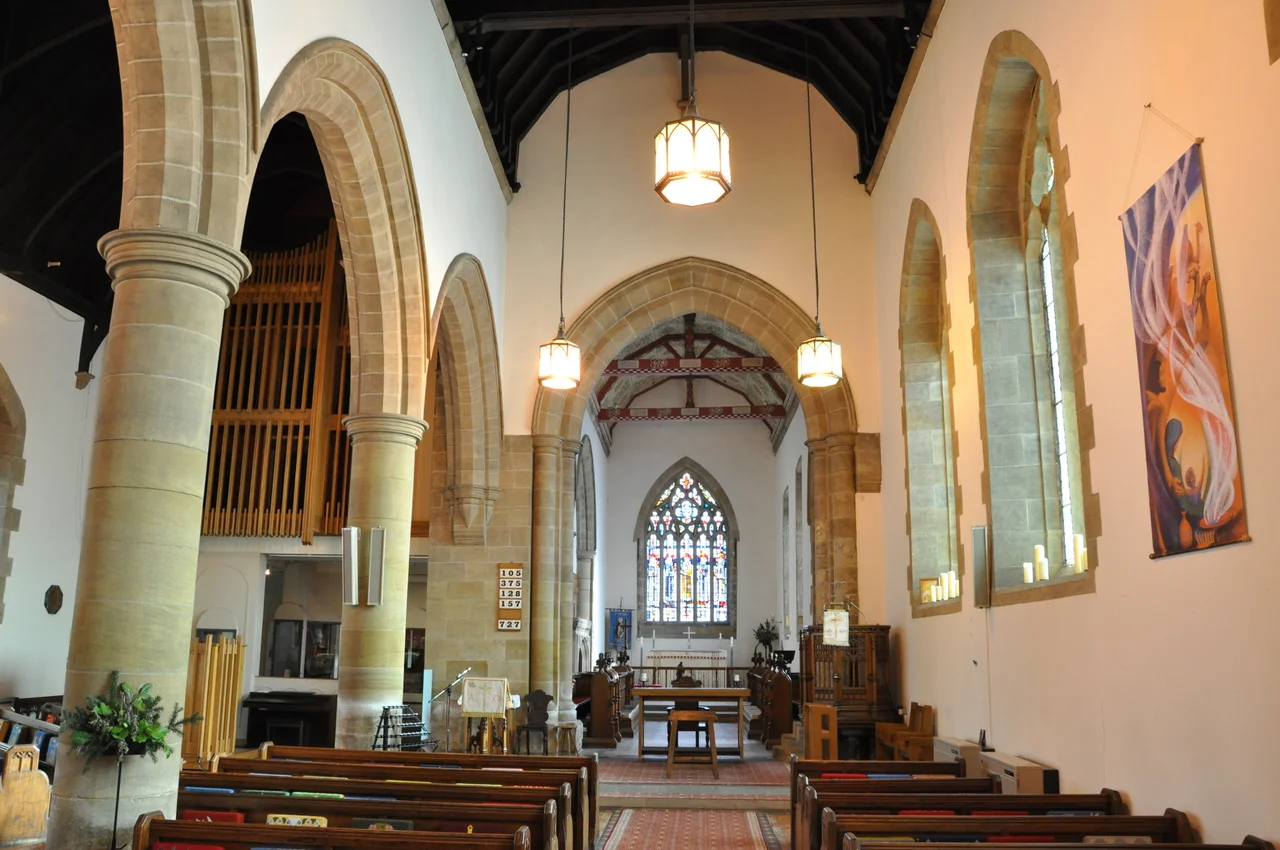

St Peter's Church, Monkwearmouth
Benedict Biscop wanted his church built in stone, and stone was a problem. In 674, Anglo-Saxon England didn't know how to quarry it properly, didn't know how to glaze a window, didn't know how to mortar a wall that would last. So Biscop sailed to Gaul and brought the masons back with him. The west porch he commissioned still stands at Monkwearmouth, on a low rise above the north bank of the River Wear. Walk through that doorway today and you cross a threshold that has been a threshold for thirteen and a half centuries.
Biscop's Improbable Church
Benedict Biscop was a Northumbrian noble who had renounced his rank to become a monk, then made the journey to Rome six times when most Anglo-Saxons never went anywhere. He returned with books, with relics, with ideas about what a Christian community should look like. King Ecgfrith of Northumbria gave him land at the mouth of the Wear, and in 674 he founded the Monastery of St Peter. A second house at Jarrow followed in 682, the two linked across the Tyne as a single double monastery. The masons and glaziers Biscop fetched from Gaul built something Anglo-Saxon England had not seen: a church of cut stone, with coloured glass in its windows. The west wall and porch of that original building are still there. The barrel-vaulted ground floor, the elaborate outer arch decorated with stone reliefs of beasts and interlaced patterns - the same arch Biscop's masons cut from sandstone in the 670s.
The Boy Who Became Bede
In 680, a child of about seven was given to the monastery by his family. He never left. He learned Latin and Greek, read every book Biscop had brought back from Rome, and over a long life of writing he produced the works that taught medieval Europe how to think about its own past. His name was Bede. Without him, almost nothing would be known about the conversion of Anglo-Saxon England, the kingdoms before Alfred, the dates of Easter, the very concept of dating history Anno Domini. Bede wrote his Ecclesiastical History within the walls of the Monkwearmouth-Jarrow community. He told us, in a passage that has survived him by twelve hundred years, that Biscop brought the stonemasons from Gaul to build this church - which is why we know who built the walls you can still touch.
Layer Upon Layer
What you see at St Peter's now is an archaeological book with most of its pages still legible. Biscop's west wall and porch, late 7th century. A second storey and side porticus added around 700, creating the squat westwork that anchors the building. By the end of the 10th century, more storeys had been stacked on top to form the present tower. The north aisle came in the 13th century, the five-light east window in the 14th. Victorian restoration in 1875-76 swept some of that away and rebuilt other parts. Then in 1984, fire damaged the interior. The roof and inner fabric were rebuilt in about 1985. Through all of it, the porch Biscop commissioned has stood where it was set, the oldest continuously occupied piece of architecture in the city, and one of the most important Anglo-Saxon survivals in Britain.
The Monastery That Changed Everything
Monkwearmouth and Jarrow together produced the Codex Amiatinus, the oldest complete Latin Bible in the world, hand-copied around 700 and carried as a gift toward Rome. The community ran a scriptorium of European reputation. Then in the 8th and 9th centuries, the Vikings came - and the monastery they raided was the one Bede had lived in. The site faded, was refounded, faded again, and eventually became an ordinary parish church for the suburb that grew around it. But the stone Biscop chose, the walls his Gaulish masons set, the arch they carved - these endured. Three Anglo-Saxon kingdoms have risen and fallen on this island since this porch was new. St Peter's is older than the idea of England.
From the Air
St Peter's Church, Monkwearmouth sits at 54.913N, 1.375W on the north bank of the River Wear in central Sunderland. From cruising altitude the squat west tower and adjoining churchyard are visible as a small green island surrounded by terraced housing, with the Stadium of Light just west and the river curving south of the site. Nearest major airport is Newcastle International (EGNT), about 14 miles north-northwest. Durham Tees Valley (EGNV) lies 27 miles south. Recommended viewing altitude 1,500-3,000 ft AGL for the urban texture of Sunderland and the older Monkwearmouth grid around the church.
Nearby Stories
- Seaton Carew 2.7 km away
- HMS Unity (N66) 6 km away
- George Stephenson's Birthplace 6.1 km away
- Raby Castle 9 km away
- Cragside 15 km away
- Whitby Abbey 21 km away
- German submarine U-2367 46 km away
- Alexander L. Kielland (Platform) 277 km away