
St Saviour's Church, Dartmouth
On the south porch of St Saviour's Church in Dartmouth there is a door that has been opening and closing for more than six hundred years. Two iron leopards face each other across its surface, hammered out by some unknown 14th-century blacksmith and surrounded by curling iron leaf scrolls. People have leaned on the door, pushed it, latched it, slipped through it on wet mornings, generation after generation, since before England had a national language anyone today would recognise. The leopards have not moved.
Built by a Three-Time Mayor
The church was dedicated in 1372 as a chapel of ease to the older parish church of St Clement at Townstal, on the hill above the town. Dartmouth was growing fast - it was one of the great medieval English ports, the harbour from which Crusaders had sailed for the Holy Land - and the people of the lower town needed somewhere closer to worship. Much of the money to build it came from John Hawley, a Dartmouth ship owner, naval captain, and fourteen-time Mayor of the town. Hawley died in 1408 and was buried in the church he had largely paid for. Some scholars believe he was a model for Chaucer's Shipman in The Canterbury Tales. His brass remains in the chancel, the metal face worn smooth by centuries of curious fingers.
A Screen That Survived the Reformation
The most remarkable surviving piece of the medieval church is the rood screen, installed in 1496. It is a single span of carved oak that runs across the church between the nave and the chancel, painted with figures of saints and apostles in the elaborate colours of the late medieval Devon school. Most English rood screens were torn out or whitewashed during the Reformation and the Civil War, when reformers regarded the screens as idolatrous. The Dartmouth screen, somehow, was spared. It is still there, the paint faded but the figures still recognisable, one of the finest examples in the West Country of what most English parish churches once looked like before iconoclasts went through them with chisels and lime.
Bells, Organ, Clock
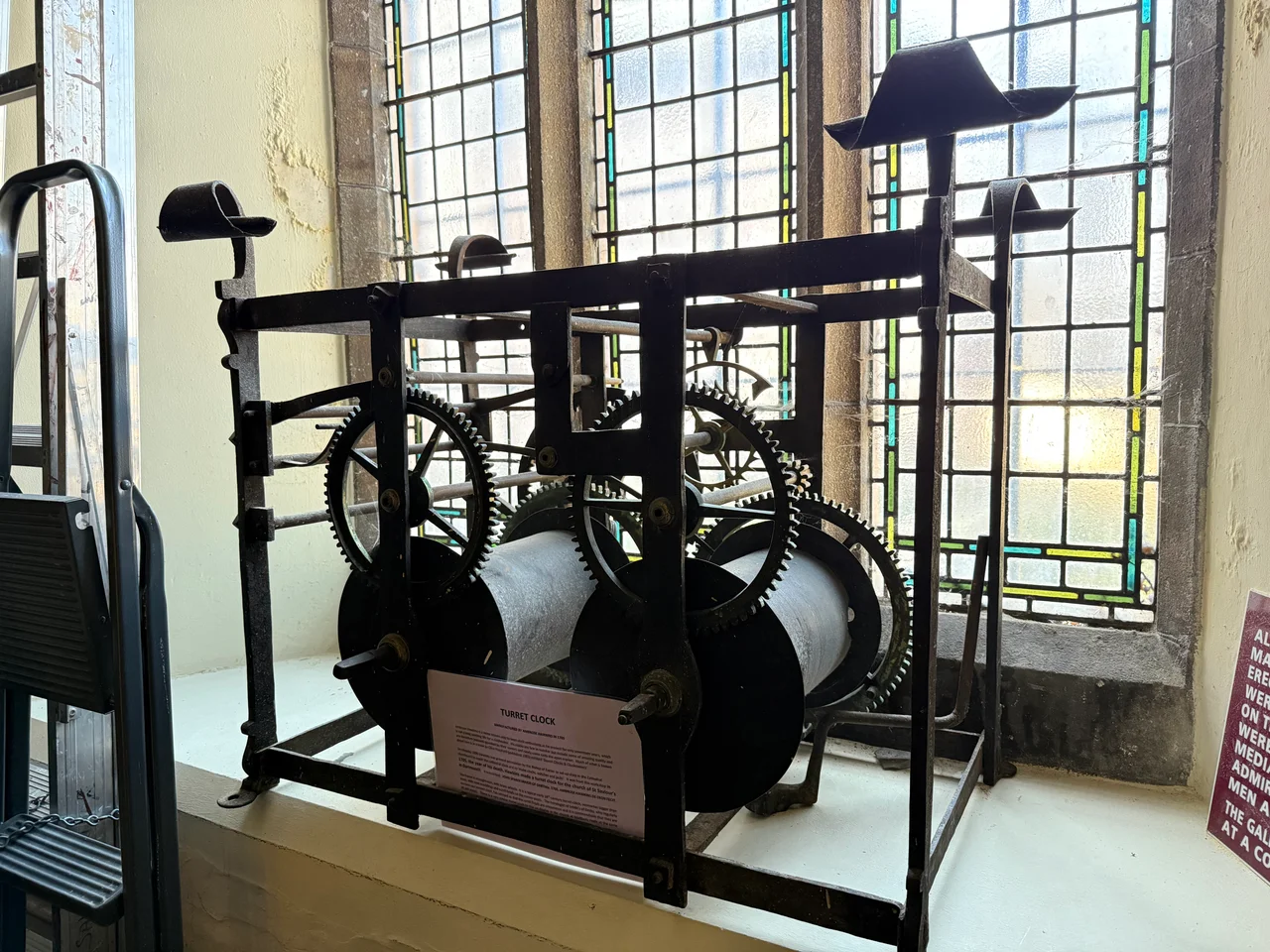
Look up in the tower and you find more than six centuries of fixtures and rebuildings. Church records from 1434 already mention an organ. The current organ began in 1789 as an instrument by Paul Micheau, was enlarged in 1889 by Bryceson Brothers of London at a cost of £600 into a three-manual instrument of 29 stops and 1,708 pipes, and was restored again in 1996 by Michael Farley. The ring of eight bells - some of them cast in 1732 by Ambrose Goodling of Plymouth, some by Wm. Parnell of Cullompton in 1826 - was recast in 1938 by John Taylor & Co of Loughborough in the key of E flat, with a tenor of 946 kg. And in 1705 Ambrose Hawkins of Exeter built the church a turret clock with a wrought-iron frame and brass wheels. A new clock with a gravity escapement replaced it in 1906, but the 1705 mechanism survives. It is displayed at the back of the church - more than three centuries of gears, still beautiful, still capable of telling time.
John Flavel and the Long Roll Call
On a board on the church wall is the list of every vicar of the parish since 1316 - Richard de Wydecomb, Henry Priour, Thomas de Coleton, names that fade through the centuries into more familiar English forms. One name on that list stands out for what happened after he held the post. John Flavel became the lecturer at St Saviour's in 1653, in the years when Cromwell ruled England as Lord Protector. When the monarchy was restored in 1660 and the Act of Uniformity in 1662 forced Anglican conformity, Flavel was ejected. He spent the rest of his life as a Nonconformist preacher in and around Dartmouth, often risking arrest, drawing crowds to hidden meetings in barns and on Devon moorland. He wrote dozens of theological works that are still read by Reformed Christians today. The parish that ejected him keeps his name on its wall, as it does the names of the conforming Anglicans who preceded and followed him. The board does not take sides. It just records who was here.
From the Air
Coordinates 50.351 N, 3.579 W. St Saviour's stands in the heart of Dartmouth's lower town, just back from the inner harbour and a few hundred yards north of Dartmouth Castle. Best viewed at 1,500-2,500 ft AGL - look for the medieval tower rising from a cluster of pastel cottages and Edwardian terraces on the steep slope above the Dart estuary. Exeter (EGTE) is 25 nm to the north-northeast. The Dartmouth side of the estuary faces Kingswear directly across the water.
Nearby Stories
- St Germans Priory 7.6 km away
- Launceston, Cornwall 9.6 km away
- Castle Drogo 12 km away
- HMS Formidable (1898) 17 km away
- Siege of Lyme Regis 19 km away
- Battle of Plymouth (1652) 40 km away
- German Submarine U-672 48 km away
- Goonhilly Satellite Earth Station 69 km away