
Where Incense Meets Incantation
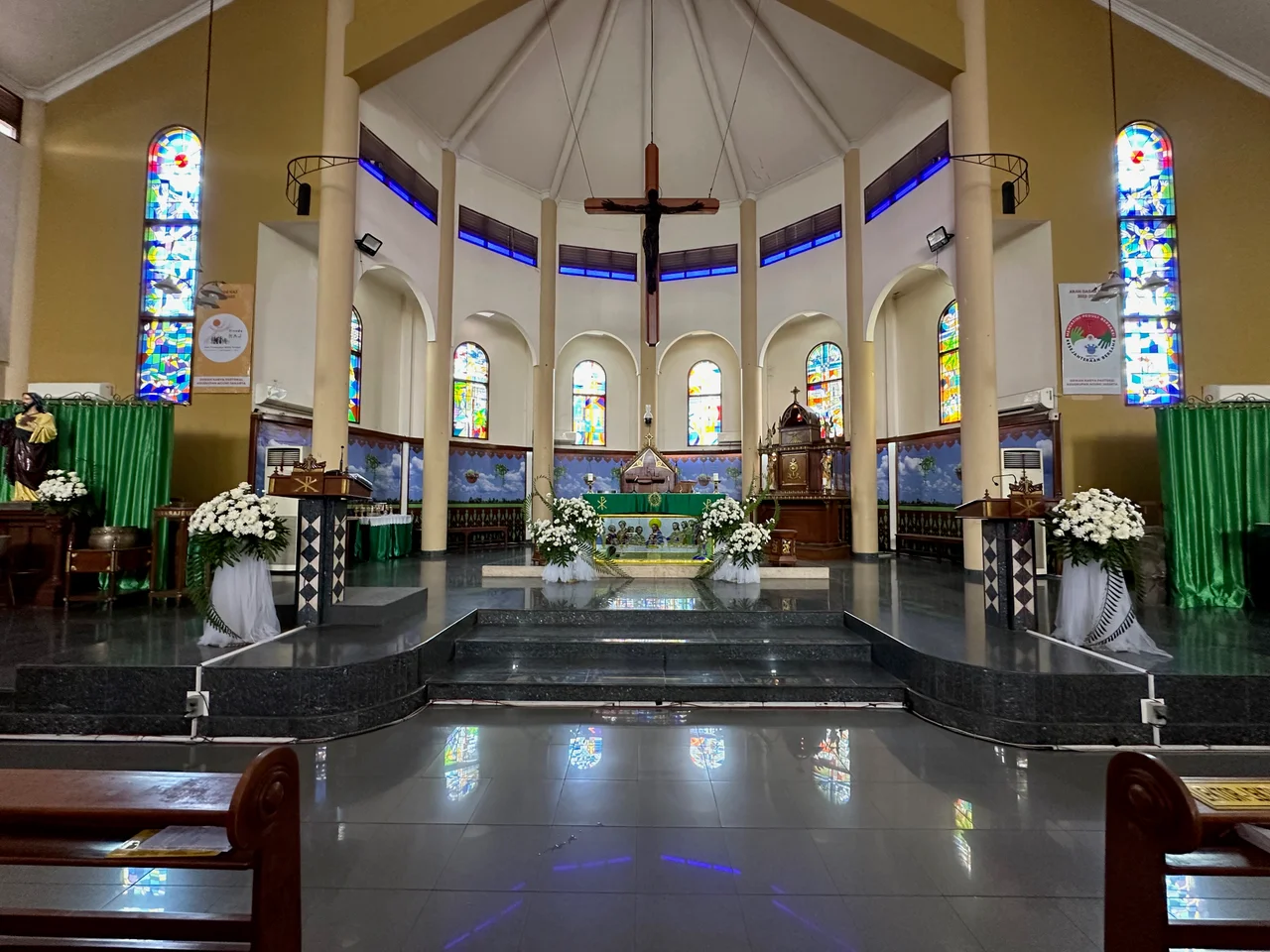
Some parishioners still recite the Lord's Prayer in Betawi when they pass through places they consider haunted. It is not a translation sanctioned by any bishop. It is older than that -- a survival from the days when a Dutch Protestant named F. L. Anthing walked into Kampung Sawah and decided that Christianity here would speak the local tongue or not speak at all. The Catholic Church of St. Servatius, in this village on the border between Bekasi and East Jakarta, is the inheritor of that experiment. Walk through its doors on May 13 and you will find something no European parish offers: a Mass that ends with the congregation stirring a cauldron of dodol, tapping it three times, and tossing the batch into a river if it refuses to set.
A Congregation Born from a Firing
Christianity arrived in Kampung Sawah through F. L. Anthing, a Protestant Dutchman who built a congregation by weaving local mystical practices -- what the Betawi call ngelmu -- into Christian worship. It worked, for a time. But accusations of syncretism eroded the experiment, and by 1895 the congregation had splintered into three factions. One followed a teacher named Laban in the western part of the village. Another gathered around Yoseh in the east. The third was led by Guru Nathanael, an assistant teacher who had been fired from his position at the Protestant church. Stung by his dismissal, Nathanael walked to Jakarta Cathedral on Banteng Square and asked the Catholic Church to send a priest to Kampung Sawah. Pastor Schweitz came, baptized 18 children, and October 6 became the birthday of the Kampung Sawah Catholics. What began as one man's grievance became a parish that has endured for over a century.
The Ritual Before the Ritual
Long before any church stood in Kampung Sawah, the Betawi practiced bebaritan. It was an animist rite: residents gathered food from their own harvests, arranged it on wide banana leaves at a site considered haunted, and lined up while a ritual leader chanted incantations to the denghaeng and dedemit -- the spirits and guardians of the place. After the chanting, everyone ate together, accompanied by traditional Betawi dances and music. The last bebaritan in its original form took place around 1963 or 1964. By then the ritual had already begun modernizing; its final iteration featured dangdutan, the popular Indonesian music style. But the impulse behind it -- gratitude for the harvest, respect for the unseen -- did not disappear. It migrated into the church.
Seven Hours of Stirring
In 1936, Pastor Oscar Cremers blessed the rice harvest at St. Servatius for the first time, and the sedekah bumi -- earth almsgiving -- became a Catholic ritual held every May 13. At its simplest, the ceremony involves blessing the harvest and sharing a portion with the penderep, the workers who help landowners reap their crops. Church members bring coconut, durian, jackfruit, rambutan, cassava, and rice to the altar during Mass. But the centerpiece is the dodol. Before dawn on the day of the festival, the cooking begins. For seven hours, the sticky confection must be stirred continuously. The rules are precise and pre-Christian in origin: tap the cauldron three times to request that the dodol set within the allotted time. If it refuses, throw the entire batch into a flowing river. Only the eldest person present may taste the kole, the half-finished dodol. The fuel must be rambutan wood or coconut fronds, because they produce little ash. The fire must stay small and must never go out.
Betawi in the Pews
On May 13, 1996, the church formalized what had been happening informally for decades. Six Betawi men and six women were appointed as members of the Saint Servatius kinship, a confraternity that revived the Catholic tradition of expressing faith through outward cultural forms. The men wore black songkok caps, komprang pants, white sadaria shirts, red sarongs, and carried machetes. The women wore white veils, batik sarongs, and white kebaya. For the first time, a tanjidor music corps -- the brass-heavy Betawi ensemble whose origins trace to Portuguese colonial influence -- played during the service. The hymns were recomposed in Betawi melodies, mostly by a parishioner named Marsianus Balita. After Mass, the congregation gathered for a communal meal in the churchyard and at the Servas warung across the street. Benyamin Sueb songs filled the air -- the beloved Betawi comedian and singer whose music is as much a part of Jakarta's identity as the city's traffic.
One Roof, Many Faiths
Kampung Sawah is not solely Catholic. The village is known across Jakarta for something increasingly rare in a world of religious polarization: families in which Muslims, Christians, and Buddhists share the same household. The phrase "living with different religions under one roof" is not a metaphor here; it describes the literal domestic arrangements of many families. St. Servatius exists within this ecosystem of coexistence, its rituals shaped as much by Betawi identity as by Roman doctrine. The Our Father in Betawi, the dodol stirred before dawn, the tanjidor at communion -- none of these are concessions to local culture. They are local culture, wearing vestments. In a megacity of over 30 million people, this village parish remains small enough that everyone knows the oldest person who gets to taste the kole. That intimacy, as much as any theology, is what holds the place together.
From the Air
St. Servatius Church sits at 6.32S, 106.94E in Kampung Sawah, on the boundary between Bekasi and East Jakarta. From the air, the area appears as dense low-rise settlement amid Jakarta's sprawling eastern suburbs. Halim Perdanakusuma Airport (WIHH) lies approximately 5 km to the west. Soekarno-Hatta International Airport (WIII) is 40 km to the northwest. Best viewed at 1,500-2,500 feet AGL to distinguish the church compound and surrounding village from the urban fabric.
Nearby Stories
- Battle of Kalijati 9.1 km away
- The Ciliwung: A River That Built and Broke a Capital 23 km away
- Lion Air Flight 610 24 km away
- The Crossing at Silebu 33 km away
- The Cruiser That Wouldn't Stop Fighting 45 km away
- Battle of Tjiater Pass 59 km away
- Ujung Kulon National Park 134 km away
- The Islands That Vanished from Sight 313 km away