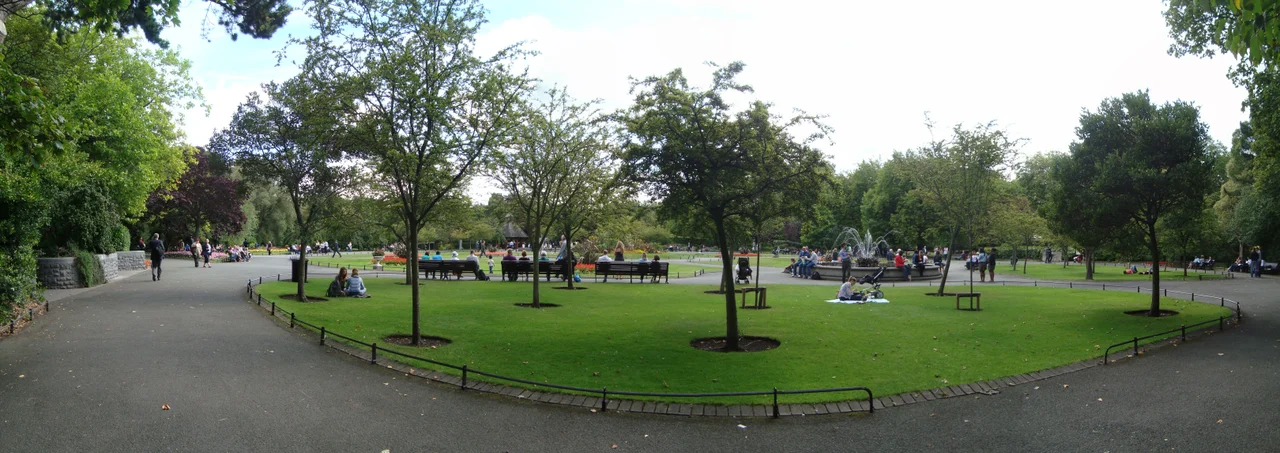

St Stephen's Green
On Easter Monday 1916, Constance Markievicz stood beside Commandant Michael Mallin in the bandstand at the centre of St Stephen's Green and watched her Irish Citizen Army volunteers dig defensive trenches in the lawns. Two hundred and fifty rebels. Confiscated cars at every gate. It was a brilliant tactical idea executed in the wrong terrain. By Tuesday morning, British soldiers had climbed to the upper floors of the Shelbourne Hotel on the north side and were firing down into the trenches with rifles and machine guns. The Citizen Army was forced to withdraw across the road to the Royal College of Surgeons. The grass closed over the trenches within months. The Green has been a garden again for over a century, but underneath, the outline of those trenches is still there.
From Common to Square
Until 1663 St Stephen's Green was a marshy common on the edge of Dublin, used for grazing cattle. The name came from a medieval leper hospital dedicated to Saint Stephen on nearby Stephen Street (now the site of Mercer's Hospital). In 1663 Dublin Corporation, in need of revenue, enclosed the centre of the common, surveyed the surrounding land into 96 building plots, and sold them off. The new park was walled in 1664. By the 1750s the surrounding plots had grown into a square of Georgian townhouses, and by the late eighteenth century the Green had become a resort for the better-off of the city. The early houses on the south and north sides still survive - identifiable by their narrow fronts and lower height - while the east side shows a dramatic later upgrade in scale, with grander Georgian houses, many by the developer-architect Gustavus Hume.
Lord Ardilaun Opens the Gates
Until 1877 the Green was strictly private - access restricted to the householders around its perimeter, who maintained the park through a commission. That year Parliament passed an Act, at the initiative of Sir Arthur Edward Guinness - Lord Ardilaun - opening the park to the public. Ardilaun was a great-grandson of Arthur Guinness the brewer; he lived at St Anne's Park in Raheny and at Ashford Castle in County Mayo. He paid for the complete redesign of the Green by the Dublin landscape designer William Sheppard, working with engineer A.L. Cousins. Ardilaun himself supervised the importation of exotic trees and plants. The redesigned park opened on 27 July 1880. By way of thanks, the city commissioned a seated bronze statue of Ardilaun on the western side of the Green, facing the Royal College of Surgeons - another institution he had funded. When Queen Victoria had earlier suggested renaming the park 'Albert Green' after her late husband and putting a statue of Albert in the centre, Dublin Corporation refused with such indignation that the Queen never forgave them.
1916: A Tactical Misjudgement
When Easter Monday came in 1916, the Citizen Army's decision to occupy the Green and dig trenches rather than seize buildings around it cost them dearly. The British position at the Shelbourne - five storeys overlooking the open lawns - meant every rebel trench was within direct sight of British machine guns. There is a story, possibly apocryphal but recorded in multiple sources, that during the fighting both sides observed a daily ceasefire so that the elderly park-keeper could feed the ducks on the lake. After Mallin and Markievicz pulled their force across to the College of Surgeons on Tuesday, the trenches were abandoned. After the Rising Mallin was executed. Markievicz, sentenced to death, had her sentence commuted because she was a woman - a verdict she famously protested. She went on to become the first woman elected to the British House of Commons, the first woman cabinet minister in Western Europe, and a Minister for Labour in the First Dáil. Her bust now sits on the south side of the central garden, looking back over the lawns she once defended.
The Statues
The park's monuments read like a syllabus of modern Irish history. The Fusiliers' Arch at the Grafton Street corner, erected in 1907, commemorates the Royal Dublin Fusiliers who died in the Second Boer War. Inside the Leeson Street gate stands the Three Fates fountain - a 1956 bronze by Joseph Wackerle, given by the German people in gratitude for Operation Shamrock, the postwar Irish foster-care programme that took in up to five hundred German refugee children after the war. There are memorials to Theobald Wolfe Tone, leader of the 1798 rebellion (with a famine memorial behind it by Edward Delaney); to the Fenian Jeremiah O'Donovan Rossa; to W.B. Yeats, with a Henry Moore sculpture in his garden; to James Joyce, facing the front of his old university; to Robert Emmet, across from his demolished birthplace at No. 124; and to Rabindranath Tagore, the Bengali poet, added in 2011. The bust of the Great War poet Thomas Kettle, killed at Ginchy in 1916, took twenty-one years and considerable nationalist opposition to be placed - and was finally installed in 1937 without an official unveiling, the controversy of remembering an Irishman in British uniform never quite resolved.
Twenty-Two Acres in the Centre
The park covers 22 acres, the largest of Dublin's main Georgian garden squares, larger than nearby Merrion Square and Fitzwilliam Square. The Office of Public Works manages it now. The Luas Green Line stops on the western side; the entire west pavement is the front of the Stephen's Green Shopping Centre, opened October 1988 with a glass conservatory facade designed to face the Green. The Shelbourne Hotel still stands on the north side, Dublin's only surviving Victorian hotel, its upper windows still the same ones that British soldiers fired through in 1916. Iveagh House on the south, formed from the joining of two earlier townhouses by Benjamin Guinness in the 1860s, was given to the Irish state in 1939 and is now the Department of Foreign Affairs. The park itself is open every day, free, full at lunchtime, quiet in the rain. The ducks on the pond have outlasted every government, every Rising, and every statue around them.
From the Air
St Stephen's Green sits at 53.34°N, 6.26°W, immediately south of the central retail core of Dublin and at the head of Grafton Street. From altitude the 22-acre rectangle of green is a clear pause in the surrounding dense Georgian and Victorian streetscape, with Merrion Square's green a few hundred metres to the east. The Spire of Dublin is visible 1 km to the north on O'Connell Street; the Grand Canal runs 600 m to the south. Dublin Airport (EIDW) is 9 km north.
Nearby Stories
- Wicklow Mountains 12 km away
- Mornington 14 km away
- German submarine U-1051 16 km away
- Abbey of Kells 18 km away
- Irish Military Intelligence Service 20 km away
- HMS Manners (K568) 37 km away
- Templemore 42 km away
- Irish Sea Bridge 43 km away