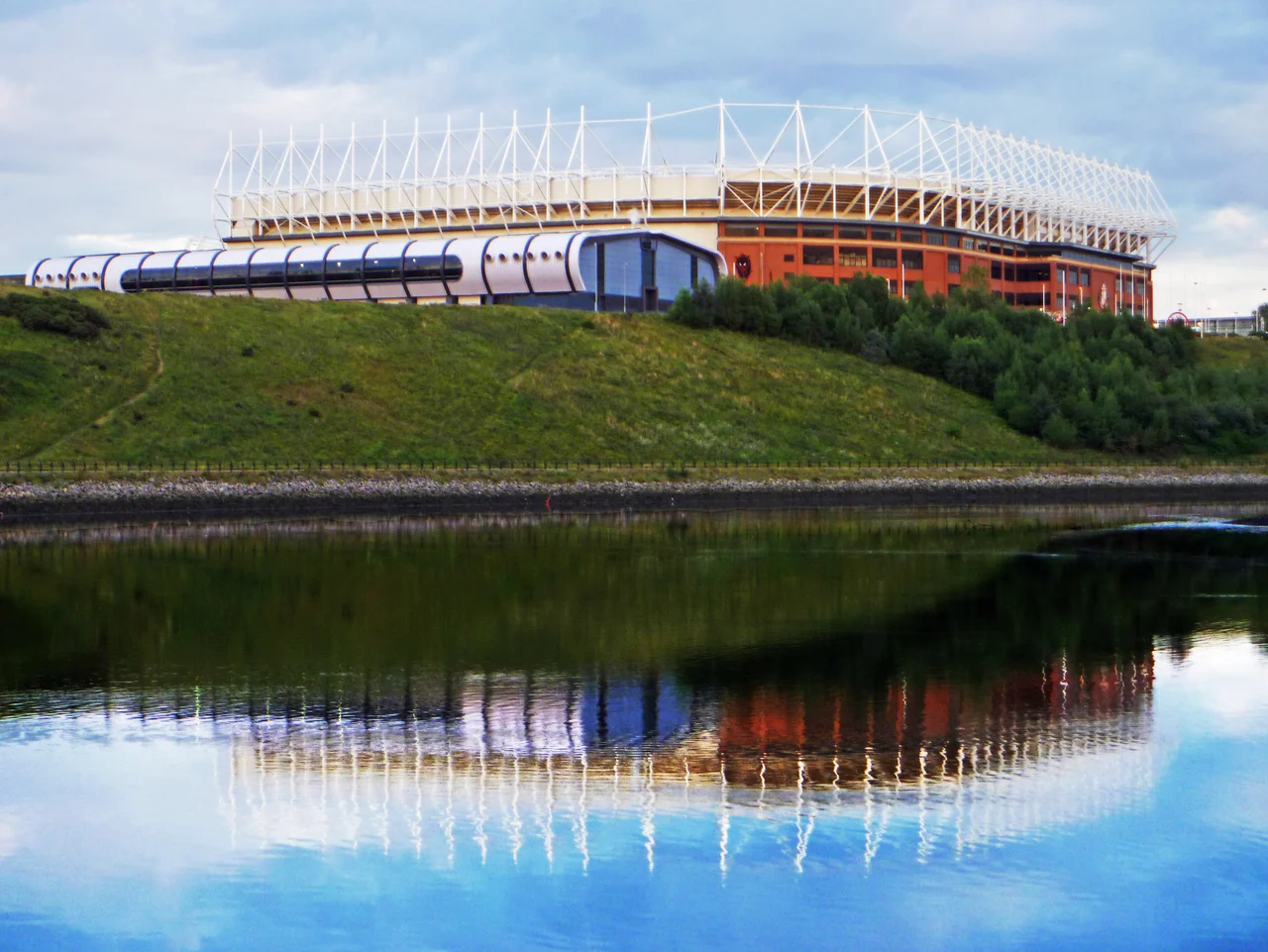

Stadium of Light
Bob Murray named the stadium for a lamp. Not a metaphorical light, not a vague hopeful idea - an actual brass and iron Davy lamp of the kind miners had clipped to their belts at Monkwearmouth Colliery, which had closed in 1993 and whose pithead had stood almost exactly where the stadium now stands. "For many years," Murray said at the naming ceremony on 30 July 1997, "miners at Wearmouth Colliery carried with them a Davy lamp as part of their working lives. Reflecting this tradition, the name allows the image of this light to shine forever." A statue of a miner's lamp sits outside the ticket office. The stadium isn't named after Benfica's ground in Lisbon. It is named after the men who worked in the dark beneath it.
Goodbye Roker Park
For 99 years, Sunderland AFC played at Roker Park. The ground was beloved, intimate, mostly terraced, and after the Taylor Report it would not survive as a top-flight venue. Converting Roker to all-seater would have shrunk it. So in 1996 the club committed to building new, on the closed colliery site north of the river. Ballast Wiltshier - the contractor who had just built the Amsterdam Arena - constructed the new ground at an initial cost of £15 million, and Sunderland opened the doors on 30 July 1997 for a friendly against Ajax that finished goalless. The original capacity was 42,000, making it at the time the largest stadium built in England since the Second World War. Fans called it the Wembley of the North. The North Stand was extended in 2000 to bring capacity to 49,000. Peter O'Toole, lifelong Sunderland fan, said publicly that he wasn't quite as enthusiastic now that the team had left Roker. Playwright Tom Kelly wrote a one-man play, I Left My Heart at Roker Park, about a fan who couldn't follow them across the river.
The Pink Seat Years
The original seats were red. Then sunlight got to them. Sections of the stadium faded into a salmon pink that opposition fans noticed, photographed, and lampooned - the FIFA video game even rendered the bleached patches with archival fidelity. When Stewart Donald bought the club in summer 2018, replacing the pink seats came up so often in conversations with supporters that he made it a personal mission. In June he announced that he had purchased 31,500 new seats and asked Sunderland fans to volunteer to help fit them. Hundreds turned up. Phase one was complete by July, phase four by autumn - 10,000 seats in the south and west stands swapped out by ordinary supporters working alongside club officials and players. The corners came back in white, the sides stayed red, the HA'WAY THE LADS lettering remained on the North Stand in the Mackem dialect that means come on.
The Sensory Room and the Quiet Innovations
In 2015 Sunderland became the first football club in the world to open a sensory room inside a stadium. It was built after Nathan Shippey's parents petitioned the club; Nathan was autistic, and ordinary match-day environments overwhelmed him. The Nathan Shippey Sensory Room is soundproofed, padded, calibrated for sensory regulation, and allows autistic supporters to watch Premier League football in a space designed for their nervous systems. The model has since been copied by clubs around the world. Sunderland opened a second sensory room in 2018. Other quiet firsts followed: the Centre for Light opened in 2004 as an in-stadium learning facility, hosting up to 120 children a day. Fragments of Archibald Leitch's iconic latticework from old Roker Park were salvaged and used as partitions in the Western Car Park. The Roker End south stand was renamed after a 2018 fan poll, restoring a name that had stood for nine decades.
International Stage
England have played at the Stadium of Light three times during Wembley's redevelopment - beating Belgium in 1999, Turkey in a Euro 2004 qualifier in 2003, and Australia in May 2016 when Marcus Rashford scored on his international debut alongside Wayne Rooney. The women's national team came in November 2021 for a World Cup qualifier against Austria. In June 2022, Ed Sheeran set the stadium's all-time attendance record at 60,000. In 2025, the Stadium of Light hosted the opening game of the Women's Rugby World Cup. Across the bowl on a match day you can read the city's history in the seats: the red and white, the Mackem dialect lettering, the Bob Stokoe statue commemorating the 1973 FA Cup Final manager who ran across the Wembley turf in a raincoat. Underneath all of it, deeper than the foundations, the seams the Wearmouth miners worked. The Davy lamp at the gate says what Bob Murray wanted said. The light comes from below.
From the Air
The Stadium of Light sits at 54.914N, 1.388W on the north bank of the River Wear, occupying the former site of Monkwearmouth Colliery. From cruising altitude it appears as a distinctive square bowl with the river curving south of it and the Wearmouth and Queen Alexandra bridges visible downstream. The Aquatic Centre and Beacon of Light cluster sit to the north of the ground. Nearest major airport is Newcastle International (EGNT), 12 miles north-west. Durham Tees Valley (EGNV) is 27 miles south. Recommended viewing altitude 2,000-4,000 ft AGL to capture the stadium alongside the Wearmouth Bridge and the city centre across the river.
Nearby Stories
- Seaton Carew 2.7 km away
- HMS Unity (N66) 6 km away
- George Stephenson's Birthplace 6.1 km away
- Raby Castle 9 km away
- Cragside 15 km away
- Whitby Abbey 21 km away
- German submarine U-2367 46 km away
- Alexander L. Kielland (Platform) 277 km away