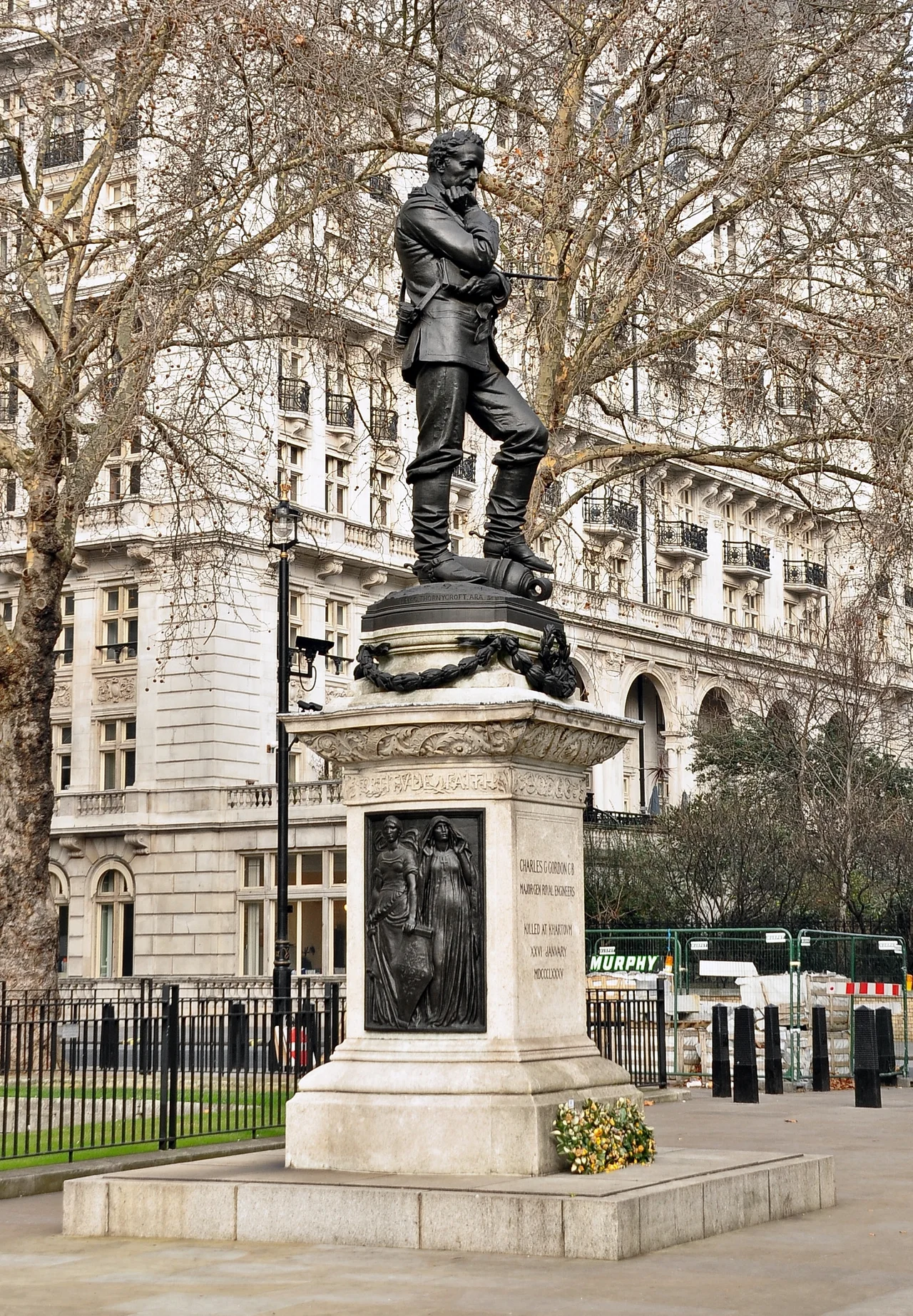

Statue of General Gordon
He is leaning into thought. The bronze figure on the Victoria Embankment stands a little larger than life, dressed in army uniform with a Bible in one hand and a cane in the other, his head propped on his raised right palm as if listening for something just out of earshot. His left foot rests on a broken cannon. The pose is unusual for a Victorian war memorial - not heroic, not commanding, just contemplative - and that was the choice of the sculptor Hamo Thornycroft, prompted by a specific request from the dead man's brother. Sir Henry Gordon wrote to Thornycroft in 1887 asking him to minimise the military character of the statue and to emphasise instead Charles Gordon's strength of mind, love, kindness and affection. The bronze that resulted captures perhaps the only Victorian war hero whose family wanted him remembered for gentleness.
Khartoum, January 1885
Charles George Gordon was the kind of man Victorian Britain wove into myth. A Major-General of the Royal Engineers, he had fought in the Crimean War, fortified the Thames defences at Gravesend, led the Ever Victorious Army during the Taiping Rebellion in China - where he won battles at Kunshan and Suzhou - and served as Governor-General of Equatoria in southern Sudan. He earned the nickname Chinese Gordon along the way. By the early 1880s the Mahdist forces under Muhammad Ahmad were sweeping through Sudan, threatening the Anglo-Egyptian garrison in Khartoum. The British government sent Gordon to organise an evacuation. He chose instead to stay and defend the city. The siege of Khartoum lasted 317 days. On the morning of 26 January 1885, Mahdist forces stormed the city. Gordon was killed at the palace steps. A British relief expedition under Lord Wolseley arrived two days later. The country went into mourning. Prime Minister William Gladstone, blamed by the public for the delay in sending relief, lost his nickname GOM (Grand Old Man) and was rebranded MOG (Murderer of Gordon). Thornycroft began his statue two years later.
From Trafalgar Square to the Embankment
The completed statue was unveiled in Trafalgar Square on 16 October 1888, without a formal ceremony. It stood halfway between the two fountains, atop an 18-foot pedestal that lifted Gordon's contemplative figure above the heads of the crowd. There it remained for fifty-five years. Then in 1943, during the disruptions of the Second World War, the statue was removed from Trafalgar Square and shipped out of London to the grounds of Mentmore Towers, the Rothschild country house in Buckinghamshire. The square stood Gordon-less for a decade. In May 1948, Winston Churchill - then Leader of the Opposition - rose in the House of Commons to ask why the statue had not been returned. He thought it ought to stand again where Londoners could see it. It came back in 1953, but not to Trafalgar Square. Instead, the planners installed it on a much shorter plinth about half a mile to the southeast, in the Victoria Embankment Gardens between the new Ministry of Defence building and the Thames, just south of Horse Guards Avenue. There it has stood ever since, low enough now that pedestrians can read every inscription.
The Inscriptions Around the Stone
The Portland stone plinth carries the basic facts. CHARLES G. GORDON C.B. MAJOR-GEN. ROYAL ENGINEERS reads the front. KILLED AT KHARTOUM XXVI JANUARY MDCCCLXXXV follows beneath. Walk slowly around the base and the other inscriptions trace the arc of Gordon's career: CRIMEA 1855 to the south; N CHINA 1864 with QUINSAN and SOOCHOW next to it, marking the Kunshan and Suzhou victories of the Ever Victorious Army; SOUDAN and KHARTOUM on a third face; GRAVESEND for his Thames defence work; EQUATOR for his governorship of Equatoria. The bronze plaques on the two flanks pair allegorical figures in classical relief. FORTITUDE stands with shield and sword, beside a hooded FAITH. CHARITY appears with two children, beside JUSTICE, blindfolded with scales and sword. The shield of Fortitude carries the legend RIGHT FEARS NO MIGHT. It is a high Victorian funerary vocabulary, virtues in stone, transmitting one man's death into something the empire could process as moral example.
Brothers in Bronze Across the World
The London statue is not the only one. An identical Thornycroft casting was installed in 1889 at Gordon Reserve in Melbourne, on a triangle south of the Victorian Parliament House, facing the Old Treasury Building. It still stands on its original tall pedestal, the one London surrendered. Edward Onslow Ford produced an entirely different memorial that shows Gordon on a camel, which stands at Brompton Barracks in Chatham, home of the Royal School of Military Engineering. A second cast of the camel statue went to Khartoum itself in 1904, where it stood for over fifty years on the spot the British believed Gordon had fallen. After Sudan won independence in 1956, the statue was removed - quietly, by mutual arrangement - and shipped to England in 1959. It now stands at Gordon's School near Woking, a school the Victorians had founded in his memory. Further memorial statues survive in Aberdeen, in Gravesham where he had fortified the Thames, and in Southampton. One Victorian general; six bronzes across three continents. The British Empire kept its martyrs visible.
The Quiet Man on the Embankment
Stand in front of the London statue today and the figure feels strangely small. The shortened plinth puts Gordon close to street level, his bronze face only a little above the heads of the office workers walking past from Westminster toward Embankment Tube. The Thames flows behind him; the Ministry of Defence building looms above. Tourists rarely stop. Some pass without noticing it at all. The statue rewards the visitor who pauses - the way his eyes lower toward the ground in front of him, the way the cane and Bible balance each other in opposite hands, the way the broken cannon at his foot speaks of resignation rather than triumph. Gordon was a deeply religious man, an evangelical Christian who took the Bible with him everywhere. He had refused all titles and most honours. He had spent much of his life trying to abolish the Sudanese slave trade. The image Thornycroft made of him is not a conquering general but a thinker contemplating loss - which, in the end, was the truer picture of the man who died holding a city he had been told to leave.
From the Air
The General Gordon statue sits at approximately 51.5045 degrees north, 0.1238 degrees west, in the Victoria Embankment Gardens beside the River Thames, just south of Horse Guards Avenue and immediately east of the Ministry of Defence Main Building. From altitude the statue itself is far too small to spot; navigate by the curve of the Thames here, the Whitehall government buildings to the west, and the bronze sphinxes flanking Cleopatra's Needle a short way north on the same Embankment. London City Airport (EGLC) is roughly six nautical miles east; London Heathrow (EGLL) about twelve nautical miles west. Best viewing altitudes are 1,500-3,000 feet, with the Houses of Parliament an unmistakable nearby landmark.
Nearby Stories
- Stevenage 5.7 km away
- Malling Abbey 5.7 km away
- 1952 Farnborough Airshow Crash 7.7 km away
- Ingatestone Hall 8.2 km away
- Hellfire Caves 9.1 km away
- The Carrington Event: The Solar Storm That Could Happen Again 9.8 km away
- Bletchley Park 16 km away
- Castle Hedingham 23 km away