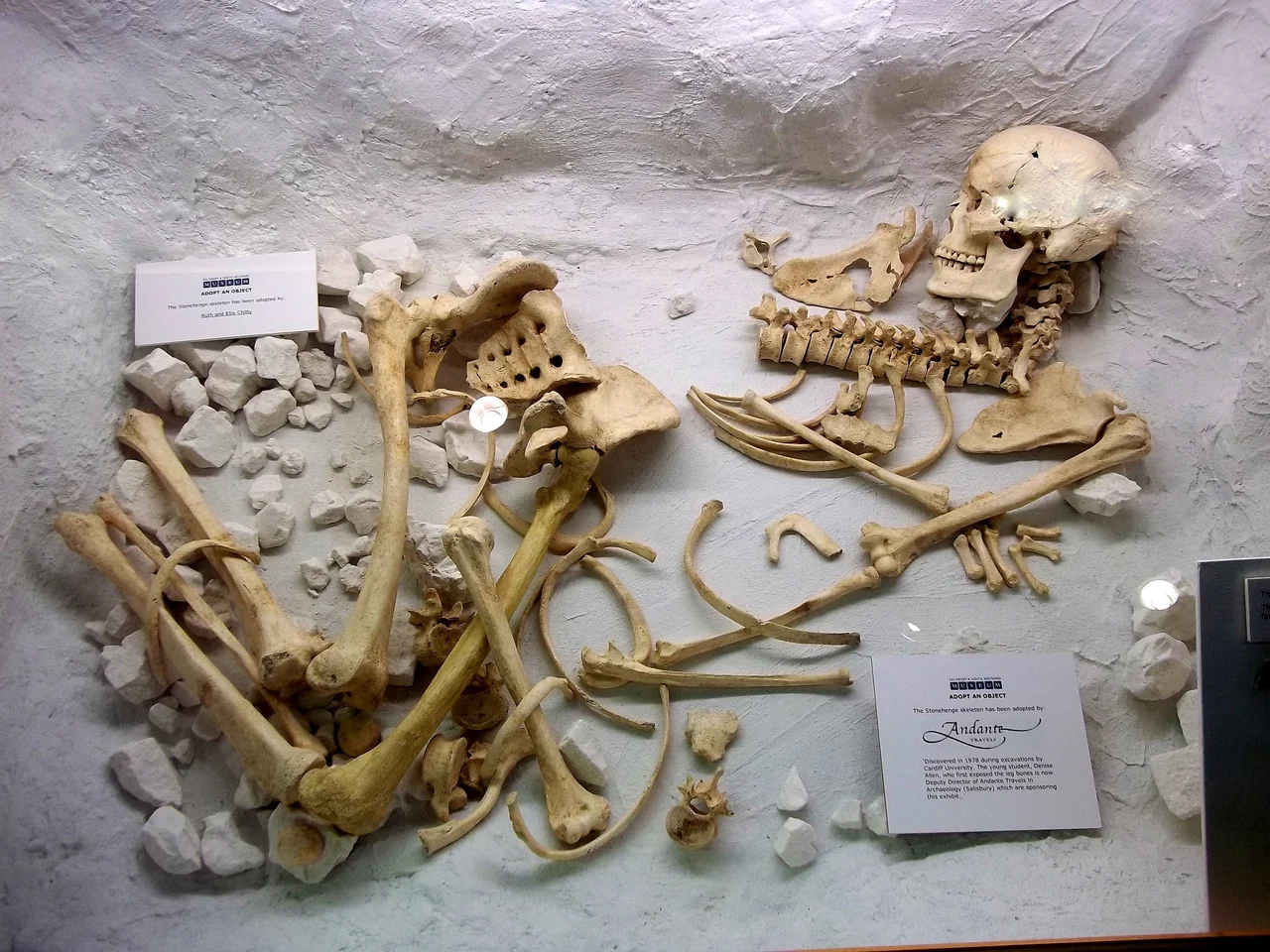

Stonehenge Archer
Sometime between 2330 and 2300 BC, a young man was killed by arrows fired at close range and buried inside the ditch that encircles Stonehenge. Flint arrowheads were still embedded in his body when archaeologists finally lifted his remains out of the chalk in 1978. He is the only complete prehistoric burial ever found at the monument, and the most direct evidence we have that Stonehenge - already a sacred precinct by the time of his death - could also be a place of violent killing. We do not know his name. We do not know whether he was an enemy, an offering, or an honoured warrior. We know only that he was buried in the most charged piece of ground in Bronze Age Britain.
A Body in the Ditch
The archers of his era, sometimes called the Beaker people, had arrived in Britain a generation or two earlier from continental Europe, bringing with them metal-working, distinctive bell-shaped pottery, and a culture in which archery had high status. The Amesbury Archer, buried about two miles away around 2300 BC, was found with the richest array of Beaker grave goods ever discovered in Britain. The Stonehenge Archer was buried with less, but the arrowheads still lodged in his bones tell a different story. They were fired at close range. They came from in front and behind. Whether he was the victim of a fight, an execution, or a ritual killing, the men who shot him then placed him inside the bank-and-ditch enclosure of a monument that had been standing in some form for more than seven centuries.
Excavated, Then Forgotten, Then Studied Again
The burial came to light in 1978 when archaeologists Richard Atkinson and John G. Evans were re-examining an older trench that had been cut through the Stonehenge ditch and bank decades earlier. The earlier excavators had passed within inches of the bones without noticing them. Atkinson and Evans worked carefully, lifting the skeleton with the flint points still in place. The remains went to the Salisbury Museum, where they are housed today alongside finds from the Amesbury Archer, the Boscombe Bowmen, and the rest of the prehistoric collections that have been pulled out of the chalk around Stonehenge over the past two centuries. The Salisbury Museum sits across the cathedral close from a much later monument, eight miles down the road from where the Archer was killed.
Why Stonehenge?
Stonehenge at 2300 BC was not what visitors see today. The great sarsen trilithons were already in place, raised about three centuries earlier. The bluestones from the Preseli Hills in Wales had been moved at least once. The site was, by then, an ancient place - older to him than medieval cathedrals are to us. The Beaker burials cluster around it not by accident: the people of that era were drawn to a landscape already saturated with the work of their predecessors. The Stonehenge Archer's burial in the ditch suggests something deliberate. Bodies were not simply abandoned at random; they were placed, with intent, in the architecture of the monument itself. Whatever he was - rival, ritual victim, sacrificed companion - his death was part of a ceremony the archaeologists who would dig him up four millennia later cannot fully reconstruct.
What He Tells Us
The Archer is the only complete prehistoric human skeleton ever recovered from Stonehenge itself, which makes his bones a small revelation in the long, frustrating study of who used the monument and how. Isotope analysis of similar burials in the area has shown that Beaker-period people travelled remarkable distances; the Amesbury Archer himself probably grew up in the Alps. The Stonehenge Archer's place in that broader story is still being worked out. His grave is a reminder that Stonehenge was never a simple temple. It was a place where the living buried the dead - and sometimes the dead were killed first. He lies now in a museum case in Salisbury, his flint arrowheads kept with him: a young man whose violent death, by the strange grace of being buried at exactly the right place, has become one of the most important archaeological finds from prehistoric Britain.
From the Air
Stonehenge sits at 51.18 N, 1.83 W on Salisbury Plain - the Archer was buried inside the monument's ditch, recorded at the article's coordinates 51.06 N, 1.80 W. The nearest airfield is Old Sarum (EGLS), 7 nm south-southeast; Boscombe Down (EGDM) is 4 nm southeast. The Stonehenge site itself is within restricted military airspace; observe NOTAMs and the surrounding Boscombe Down MATZ. From 2,000 to 3,000 feet, the stone circle is clearly visible on the chalk grassland with the A303 road running just south of it. The Salisbury Museum, where the Archer's remains are kept, lies in the city of Salisbury, 8 nm south.
Nearby Stories
- Winchester Castle 6 km away
- Newbury, Berkshire 9.9 km away
- 1988 Poole Explosion 10 km away
- Norris Castle 10 km away
- West Kennet Long Barrow 11 km away
- Maiden Castle, Dorset 12 km away
- Glastonbury Festival 13 km away
- Bristol Temple Meads 16 km away