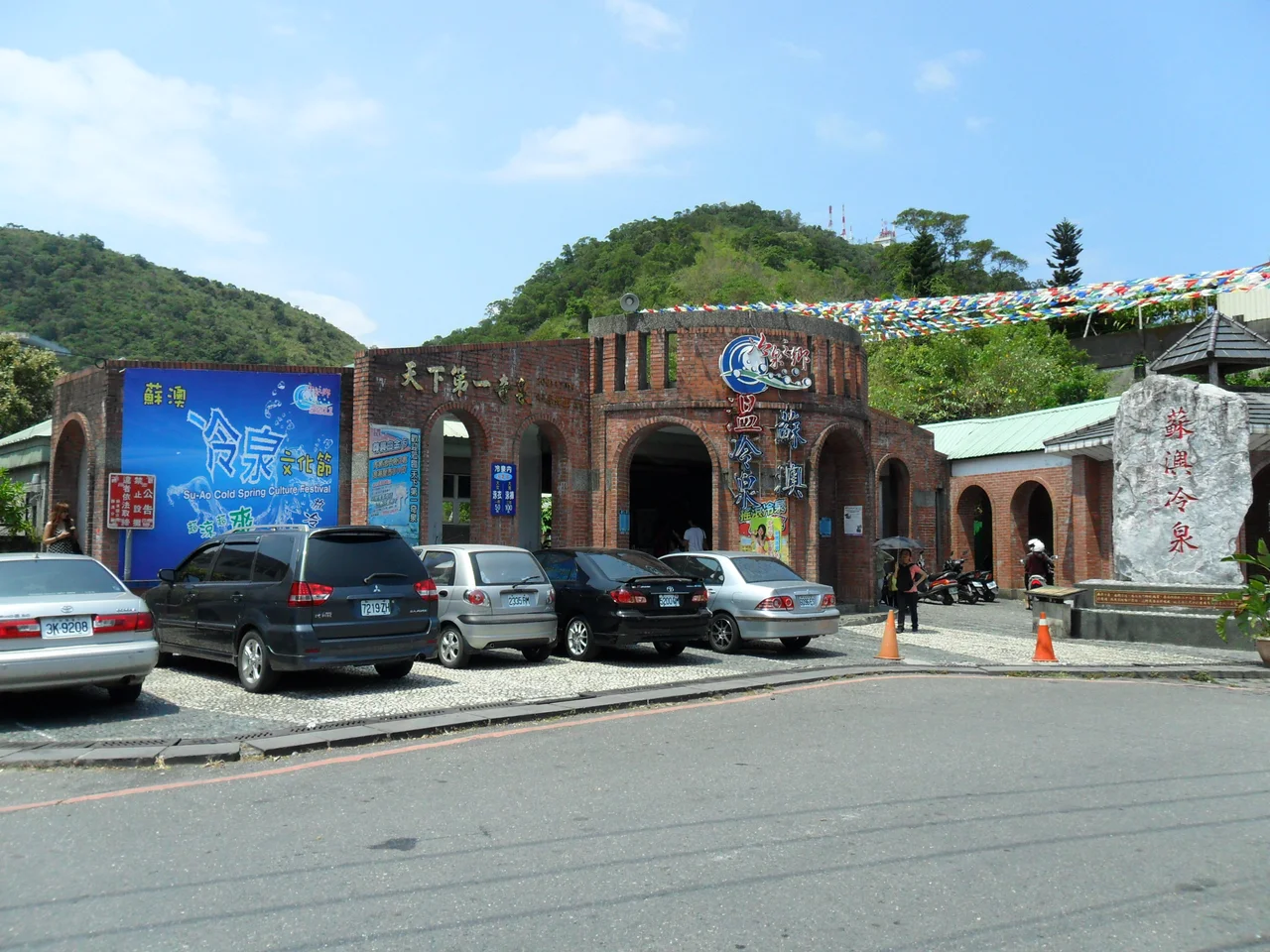

Su'ao Cold Spring
Somewhere in the geology beneath Su'ao Township, carbon dioxide seeps up through limestone and dissolves into groundwater — and what emerges at the surface is something genuinely rare: a naturally carbonated cold spring, effervescent and cool, in a part of the world where hot springs are commonplace and cold ones are almost unheard of. When Japanese army surveyors stumbled upon it in 1928, they knew they had found something unusual. Taiwan has springs by the hundreds. This one fizzes.
A Spring That Doesn't Behave Like the Others
The chemistry here is the story. Su'ao Cold Spring maintains a year-round temperature of 22°C — warm enough to bathe in comfortably, cool enough to feel refreshing in Taiwan's humid summers. Its pH sits at 5.5, lightly acidic, with carbonic ion concentrations measured at 68 parts per million — the highest recorded of any spring in Taiwan. That carbon dioxide is what gives the water its signature tingle, the gentle fizz against your skin as you ease into a pool. Geologists classify it as a calcium hydroxy carbonic spring, and it is the only one of its kind in Taiwan. Elsewhere on the island, geothermal heat drives springs to scalding temperatures. Here, the water rises cool and bubbling, carrying the faint mineral taste of the mountains behind Yilan.
Soda Water from the Source
The discovery did not go to waste. After 1928, Japanese engineers recognised the commercial potential of water that carbonated itself. A retired Japanese soldier named Takenaka established what became Taiwan's first soda factory near the spring, bottling the naturally fizzing water in Codd-neck marble bottles — the same style used for Japanese Ramune drinks. Locals still remember those early soda bottles, the marble trapped inside the glass neck that you push down to open. The factory is long gone, but the spring that fed it has outlasted every enterprise built around it. Today the water flows into public bathing facilities where visitors can soak in open-air pools or private indoor rooms, and a tap in the main area lets you drink it straight — cool, lightly sparkling, tasting faintly of minerals and deep stone.
Arriving at the Edge of Yilan
Su'ao sits at the southern end of Yilan County, where the coastal plain pinches between the Central Mountain Range and the Pacific. The Taiwan Railway Yilan Line stops at Su'ao Station, and the spring is an easy five-minute walk from the platform — close enough that travellers passing through on the way to Hualien make it a deliberate detour. The main cold spring park charges a modest entrance fee; inside, covered open-air pools let bathers watch clouds roll over the mountains while the water fizzes around them. A second, quieter facility — the Alishin Spring — sits a short walk further along the same road, less visited and less formal. Both draw from the same geological source beneath the town.
Su'ao Beyond the Spring
The town around the spring has its own personality. Su'ao is a working port — fishing boats come in with crab, lobster, filefish, and shrimp, and the seafood restaurants near the harbour are a reason to linger beyond the spring itself. Baimi Clog Village, on the outskirts of town, sells wooden clogs in both traditional and modern styles, a craft that has persisted through changing fashions. The spring park anchors the town's tourist identity, but Su'ao has never quite become a resort destination — it remains a place with its own industry and its own rhythm, where visitors are welcome but the town was not built for them. That quality is part of what makes an afternoon here feel unhurried.
What the Fizz Feels Like
Travel writers have tried to describe it: the sensation of bathing in naturally carbonated water is distinct from anything produced artificially. The bubbles are finer, more persistent, and they cling to skin rather than streaming past it. At 22°C the water is cooler than body temperature — refreshing rather than warming — and the mild acidity leaves skin feeling smooth afterward. On hot summer weekends the pools fill with families from Taipei and Hualien, the children especially delighted by water that appears to be alive. In quieter seasons, on a weekday morning, you can have a pool largely to yourself, listening to the mountain wind come through the roof, and feel the carbon dioxide working its quiet, geological patience against your hands.
From the Air
Su'ao Cold Spring sits at 24.597°N, 121.851°E in Su'ao Township, Yilan County, on Taiwan's northeastern coast. From the air, the town is visible where the Central Mountain Range meets the Pacific — look for the port facilities on the coast and the compact town grid just inland. The nearest major airport is Taipei Songshan (RCSS), approximately 75 kilometres to the northwest. Flying approach from the north follows the Yilan coastal plain; from the south, the Su-Hua Highway corridor is visible clinging to the cliffs. Best viewed at 2,000–4,000 feet in clear conditions, when the contrast between the forested mountains and the coastal settlement is sharpest.
Nearby Stories
- Shihmen Dam 5.3 km away
- Jiaoxi 6.1 km away
- Mount Dabajian 6.9 km away
- Hehuanshan 8.5 km away
- Qingshui Cliff 13 km away
- Sinking of MV Sewol 1105 km away
- Yellow Sea 1167 km away
- Sibuyan Island 1317 km away