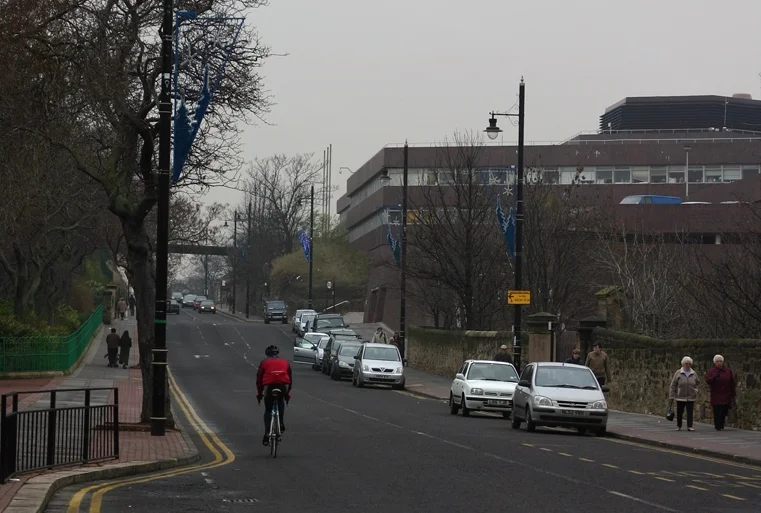

Sunderland Civic Centre
Princess Margaret opened it on 5 November 1970, a damp Bonfire Night in Wearside. The architects had given Sunderland something startling for a Tyne-and-Wear municipal building: two interconnected hexagons in red brick, banded with continuous glass, the council chamber jutting south-west like the prow of a ship. Fifty-three years later, in June 2023, the bulldozers finished what they had started the previous October. The Civic Centre is gone. In its short life it had won a Royal Institute of British Architects gold award, a Civic Trust Award, and a place on the Guardian's 2021 list of British Brutalist buildings most at risk of demolition. Sunderland watched it come down in real time on the local news.
A New Civic Idea for a New Decade
By the 1960s, the old Sunderland Town Hall had become too small for an expanding local authority. Civic leaders wanted something modern - a building that would announce a forward-looking Sunderland and consolidate scattered departments under one roof. They chose a site in Burdon Road that had been a residential area called West Park. The commission went to Basil Spence, working through his practice Spence Bonnington & Collins - the architect who had given Coventry its new cathedral after the war. Construction began in January 1968. The building cost £3.4 million, used red brick in unusual abundance for its style, and arranged itself as two connected hexagons on a north-south axis with continuous glazing on each floor sandwiched between bands of brickwork. The civic suite, containing the council chamber, jutted out to the south-west and gave the council its own small architectural emphasis.
Royal Visits, Stained Glass, and a Coat of Arms
The building drew royalty. Princess Margaret opened it in 1970. After Sunderland received city status in 1992, Queen Elizabeth II and the Duke of Edinburgh visited on 18 May 1993 to unveil the new city's coat of arms. Then, on 5 March 2010, a more local kind of consecration took place. David Hopper, general secretary of the Durham Miners' Association, unveiled a large stained glass window above the entrance to the council chamber. The window had been designed by Dan Savage to mark 25 years since the UK miners' strike of 1984-85. In a city whose surrounding coalfield had defined its economy for two centuries and whose pits had all closed by the early 1990s, the window was a piece of civic memory built into the civic building.
The Demolition Argument
Two strands of opinion fought over the Civic Centre's last years. The Council said it was simply too big and too expensive to maintain - a 1970s building with 1970s heating, 1970s glazing, and a sprawling floorplate that no longer fit a slimmed-down local authority. They proposed knocking it down and using the site for housing. The 20th Century Society and the wider architectural conservation movement said this was exactly the kind of loss Britain kept making and regretting. In January 2021 The Guardian put the Civic Centre on its list of Brutalist buildings most at risk of demolition. Simon Phipps included it in Brutal North, his photographic survey of post-war modernism in northern England. The Council went ahead anyway. Construction of a replacement City Hall, on the former Vaux Breweries site, had begun in October 2019.
What Replaced It
Demolition began in October 2022 and ran to June 2023. By then Sunderland City Council had already moved to its new home, an architecturally less ambitious but functionally tighter City Hall, on the site of the brewery that had defined Sunderland's beer trade until its 1999 closure. The Civic Centre site is being redeveloped for housing - 265 new homes, according to the Sunderland Echo's coverage of the early demolition. The argument the building's defenders had made - that you cannot replace what you lose, only build something else in its place - now plays out as the new houses go up where the hexagons used to stand. The David Hopper stained glass window was preserved and removed before demolition. The miners' memorial survives, even if the council chamber it once illuminated does not.
From the Air
The site of Sunderland Civic Centre sits at 54.901N, 1.382W on Burdon Road in central Sunderland, immediately west of Mowbray Park. From the air, the cleared site is now a construction zone giving way to new housing; the surrounding street grid - Mowbray Park to the east, the museum and library complex to the south-east - remains intact. Nearest major airport is Newcastle International (EGNT), 13 miles north-west. Durham Tees Valley (EGNV) is 26 miles south. Recommended viewing altitude 1,500-3,000 ft AGL to take in the Mowbray Park area, Sunderland Minster, and the new City Hall complex on the former Vaux site north-west of here.
Nearby Stories
- Seaton Carew 2.7 km away
- HMS Unity (N66) 6 km away
- George Stephenson's Birthplace 6.1 km away
- Raby Castle 9 km away
- Cragside 15 km away
- Whitby Abbey 21 km away
- German submarine U-2367 46 km away
- Alexander L. Kielland (Platform) 277 km away