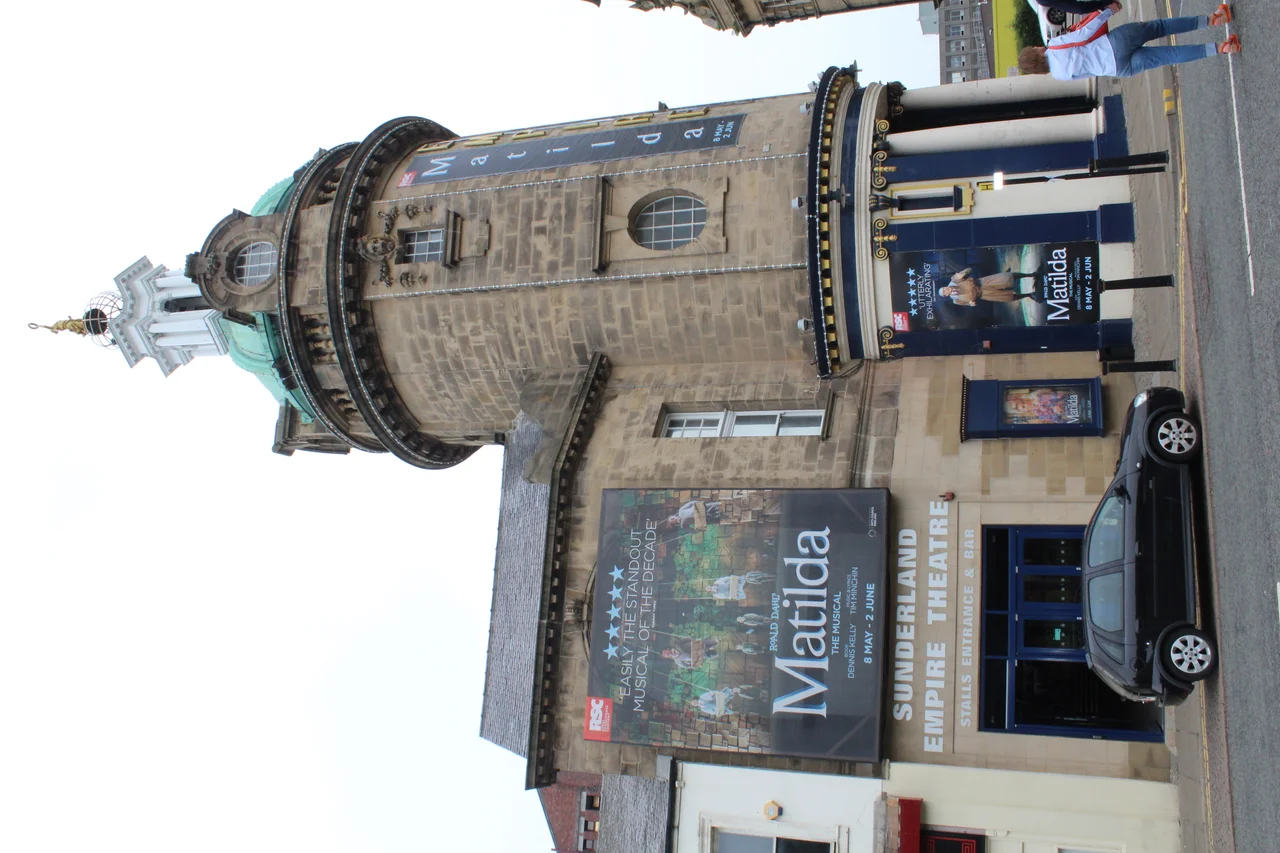

Sunderland Empire Theatre
On 26 April 1976, Sid James was playing Sam in a comedy called The Mating Season at the Sunderland Empire. He had been on stage for about three minutes when he collapsed. The audience thought it was part of the act - James was famous for the dirty laugh and the timing, and this could conceivably have been a bit of business. It wasn't. He had suffered a heart attack and he died on the way to hospital. Backstage staff said his ghost stayed in the dressing room he had occupied that night. Years later, after his own troubling experience there, the comedian Les Dawson refused ever to play the Empire again. It is the kind of story that fits the building - a four-tier Edwardian variety house with a revolving statue of the Muse of dance on top of its dome.
The Empire Palace, 1907
Richard Thornton built the Empire after dissolving his partnership with the great theatre magnate Edward Moss. He wanted his own variety house in the booming shipbuilding city, and he commissioned it on a grand scale. On 29 September 1906 the vaudeville star Vesta Tilley - the most famous male impersonator of her age, who routinely played to royalty - laid the foundation stone. On 1 July 1907 she came back to open it. The theatre had 1,860 seats, and 2,200 if standing was allowed. The auditorium had four tiers - Orchestra Stalls, Dress Circle, Upper Circle, Gallery - one of the very few in the UK still to keep that vertiginous arrangement. On the 90-foot tower above the front entrance, a revolving sphere carried a statue of Terpsichore, the Greek Muse of dance and choral song. During the Second World War, a bomb fell nearby and rocked the building. The statue and revolving sphere were taken down for safety. The original Terpsichore now stands at the top of the main staircase; a replica revolves again on the dome.
Variety, Cinema, the Beatles, and a Comic Graveyard
The Empire flourished as variety theatre for two decades, then ran into the same headwinds every variety house faced - radio first, then talking pictures. A projection box was added in 1930 and the Empire began screening films. On 5 November 1956 a young Tommy Steele made his stage debut there, heading a variety bill. He was billed simply as Britain's first rock and roll singer, and he would go on to become one of the world's leading song-and-dance men, returning to the Empire many times. The Beatles played the Empire on their first national UK tour, in November 1963. But Sunderland audiences had a reputation for being hard. Comics called the Empire 'a comic graveyard' for the partisan reception they got. The theatre closed in May 1959 as cinema and television siphoned away the audience, and would have stayed shut had Sunderland Council not bought it and reopened it in 1960.
Ghosts and the Lost Stage Manager
The Empire has the ghost stories you would expect of a theatre that has stood since 1907 and seen a famous death. Sid James is said to haunt backstage. Vesta Tilley, who opened the place, is said to haunt the front of house. So is Molly Moselle, a stage manager who worked on Ivor Novello's The Dancing Years during its 1949 run at the Empire. One evening Moselle left the theatre to post a letter. She walked into a nearby alley. She was never seen again. No body, no explanation, no resolution. Whatever happened to her, the Empire still claims her spirit. Helen Mirren made her professional stage debut at the Sunderland Empire as a young actress, long before the Oscars and the playing of queens. She survived the comic graveyard. Many didn't.
The Refurbishment That Brought the West End North
In 2004, after a nine-month £4.5 million project that expanded the stage and raised the fly tower, the Empire reopened on 9 December with Starlight Express. The point of the work was to make the theatre big enough technically to host the very largest West End touring productions - shows that simply could not fit on the stage of the Newcastle Theatre Royal, the region's other grand Victorian house. Miss Saigon followed in early 2005. Chitty Chitty Bang Bang opened its first ever touring production there on 13 December 2005. The 2007 centenary brought Starlight Express, The Producers, Footloose, South Pacific, and a Cinderella pantomime starring Mickey Rooney. Today the Empire is a receiving house for Wicked, Matilda, War Horse, Miss Saigon - the touring scale of a London production landing on Wearside. Birmingham Royal Ballet treats it as their North East base. On the dome above the entrance, the LED-lit Terpsichore still revolves above High Street West.
From the Air
Sunderland Empire Theatre sits at 54.906N, 1.389W on High Street West in central Sunderland, immediately south-east of the Wearmouth Bridge. From cruising altitude the distinctive domed tower with its revolving statue is a recognisable city-centre landmark; the surrounding High Street West retail core spreads east and west along the south bank of the Wear. Nearest major airport is Newcastle International (EGNT), 12 miles north-west. Durham Tees Valley (EGNV) is 27 miles south. Recommended viewing altitude 1,500-3,000 ft AGL to take in the Empire, Sunderland Minster, and the river bridges in a single frame.
Nearby Stories
- Seaton Carew 2.7 km away
- HMS Unity (N66) 6 km away
- George Stephenson's Birthplace 6.1 km away
- Raby Castle 9 km away
- Cragside 15 km away
- Whitby Abbey 21 km away
- German submarine U-2367 46 km away
- Alexander L. Kielland (Platform) 277 km away