.jpg)
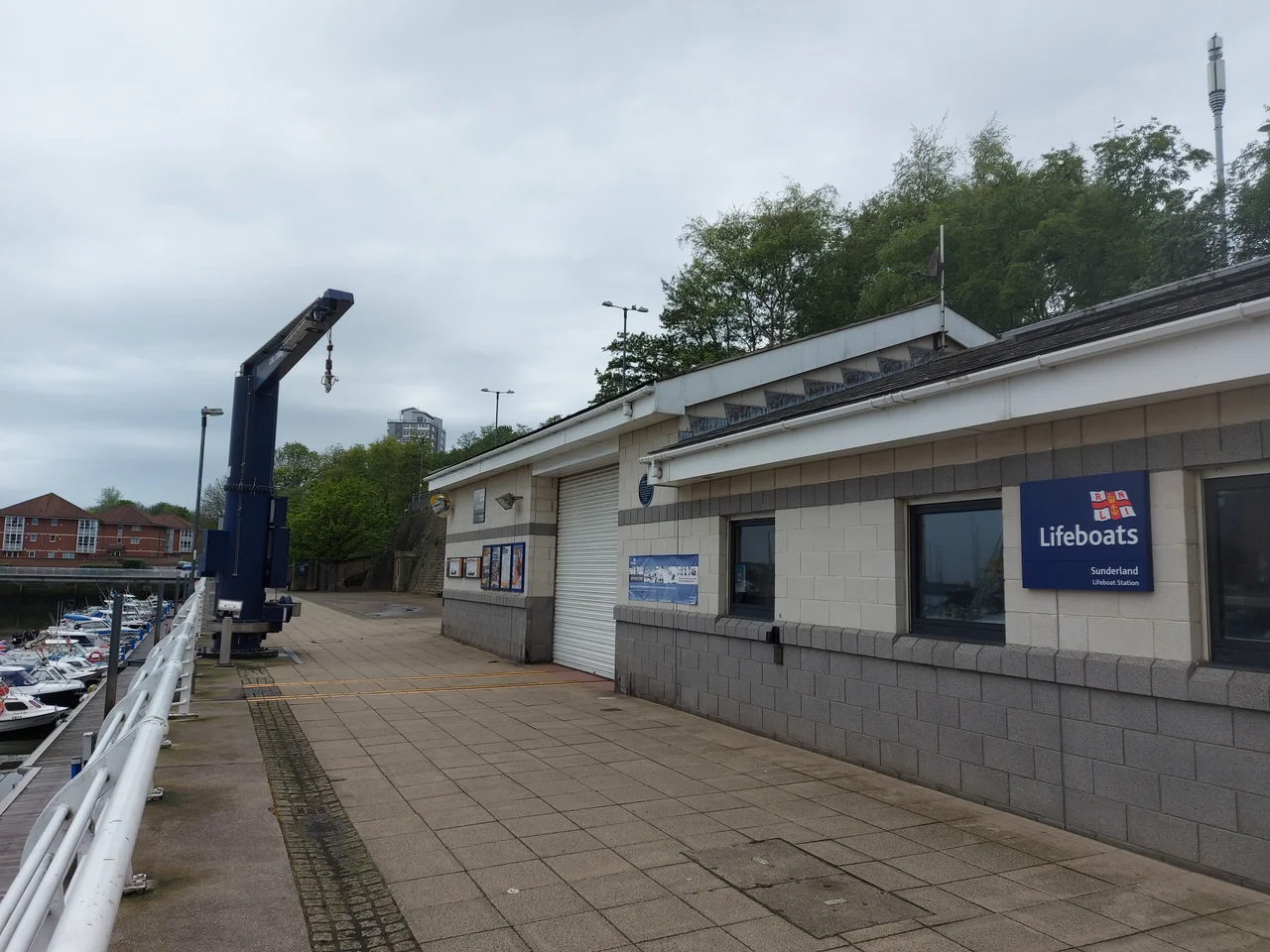
Sunderland Lifeboat Station
The Ajax went down on her maiden voyage just north of Sunderland harbour. She was a new ship, the rescue was difficult, and the Wearside men who watched it from the headland decided that what their port needed was a dedicated boat for going out to wrecks. Lord Dundas raised the money. In 1800 the Sunderland Lifeboat Committee placed a 27-foot non-self-righting lifeboat on the north side of the docks at Roker. That single boat began what would become the most tangled lifeboat history in the entire 238-station network of the Royal National Lifeboat Institution. Researchers still cannot fully untangle which boat was at which station in which year.
Thirteen Stations, Thirty-Five Boats
The RNLI's own historical office admits Sunderland is the worst record they have. Starting from that first 1800 lifeboat, there have been thirteen different lifeboat stations at Sunderland and thirty-five different boats - the names changed, the numbering changed, the operating bodies changed. For most of the 19th century, Sunderland's lifeboats were operated not by the RNLI but by competing private organisations: the Sunderland Lifeboat Committee, the Sunderland Harbour Authority, the Sunderland Shipowners Association, and the Sunderland Seamen's Lifeboat Association. Each ran its own boats from its own slipway. The RNLI did not take overall control until 1871. Boats moved between stations as ports rebuilt. The Goodwill became the Mary in 1882, was withdrawn in 1887. The South Side No.2 station opened in 1850, closed in 1864 to make way for Hendon Dock. North Side No.2 followed in 1866. The North Dock station, with its £1,100 roller-slipway, opened in 1900 to house the new George Woodfindin.
The Wreck of the Orion
On 21 January 1913, the steamer Orion of Flensburg left South Dock outbound. She struck White Shell Rocks just outside the harbour. Her rudder and propellers were torn away. The crew of nineteen Germans were stuck on a sinking ship in a winter sea off Wearside. The George Woodfindin launched from North Dock. The volunteer crew - local Sunderland men, fishermen and dock workers, rowing and sailing because the boat was Pulling and Sailing rather than motor - reached the Orion and took all nineteen of her crew off alive. The rescue was a clean success. What followed was strange. The wrecked Orion remained where she had struck, and her remains stayed visible at low tide for the next seventy years. Generations of Sunderland children grew up looking out across the rocks at the ribs of a German steamer. In a city whose business was the sea, the wreck was a permanent local landmark - and a permanent reminder of why the lifeboat existed.
The Boathouse That Lifted Boats Up and Down
By 1916 the RNLI needed a new boathouse at Sunderland and chose an unusual design. The varying tidal range at the harbour - several metres between low and high water - made the conventional slipway problematic. The new building near the South Side Ferry Landing used a pulley system that lifted the boat on a cradle up and down to whatever water level was available. Only two of these were ever built; the other was at a different RNLI station. In 1918 the motor lifeboat Henry Vernon (ON 613) arrived. In 1935 another new station was built at the north end of the south pier on reclaimed land near the current Pilot Lookout Tower. It had a deep-water roller-slipway and a much larger boat, also called Henry Vernon (ON 778). It would serve for 55 years. Pieces of its slipway can still be seen at the harbour entrance.
North Dock Marina, Today
The all-weather lifeboat was withdrawn in 2004. The station now operates two inshore boats from North Dock Marina: the Seagil (B-945), an Atlantic-class twin-hulled rigid inflatable on station since 2024, and the Thee Andy Cantle (D-879), a smaller D-class inflatable on station since 2023. The Thee Andy Cantle was named after a former Sunderland volunteer - the kind of name that only makes sense in the world of the RNLI, where boats are named after donors, dead volunteers, and the people who raised the money for the next one. Sunderland has been launching lifeboats into the North Sea continuously for 225 years. Thirteen stations have come and gone along this stretch of coast. The current crew still go out in weather that the rest of Wearside is happy to stay indoors for. The Ajax went down somewhere north of here, in 1800, and the volunteers have not stopped since.
From the Air
Sunderland Lifeboat Station sits at 54.919N, 1.368W at North Dock Marina, on the north side of the River Wear immediately inside the harbour entrance. From cruising altitude the parallel piers of Roker (north) and South Pier (south), the harbour entrance, and the marina basin define the geography. Old wreck-marker buoys and the Pilot Lookout Tower are visible to the south. Nearest major airport is Newcastle International (EGNT), 13 miles north-west. Durham Tees Valley (EGNV) is 27 miles south. Recommended viewing altitude 1,500-3,000 ft AGL to see the harbour entrance, marina, and adjoining coastline north toward Roker Pier.
Nearby Stories
- Seaton Carew 2.7 km away
- HMS Unity (N66) 6 km away
- George Stephenson's Birthplace 6.1 km away
- Raby Castle 9 km away
- Cragside 15 km away
- Whitby Abbey 21 km away
- German submarine U-2367 46 km away
- Alexander L. Kielland (Platform) 277 km away