.jpg)
Sunderland Minster
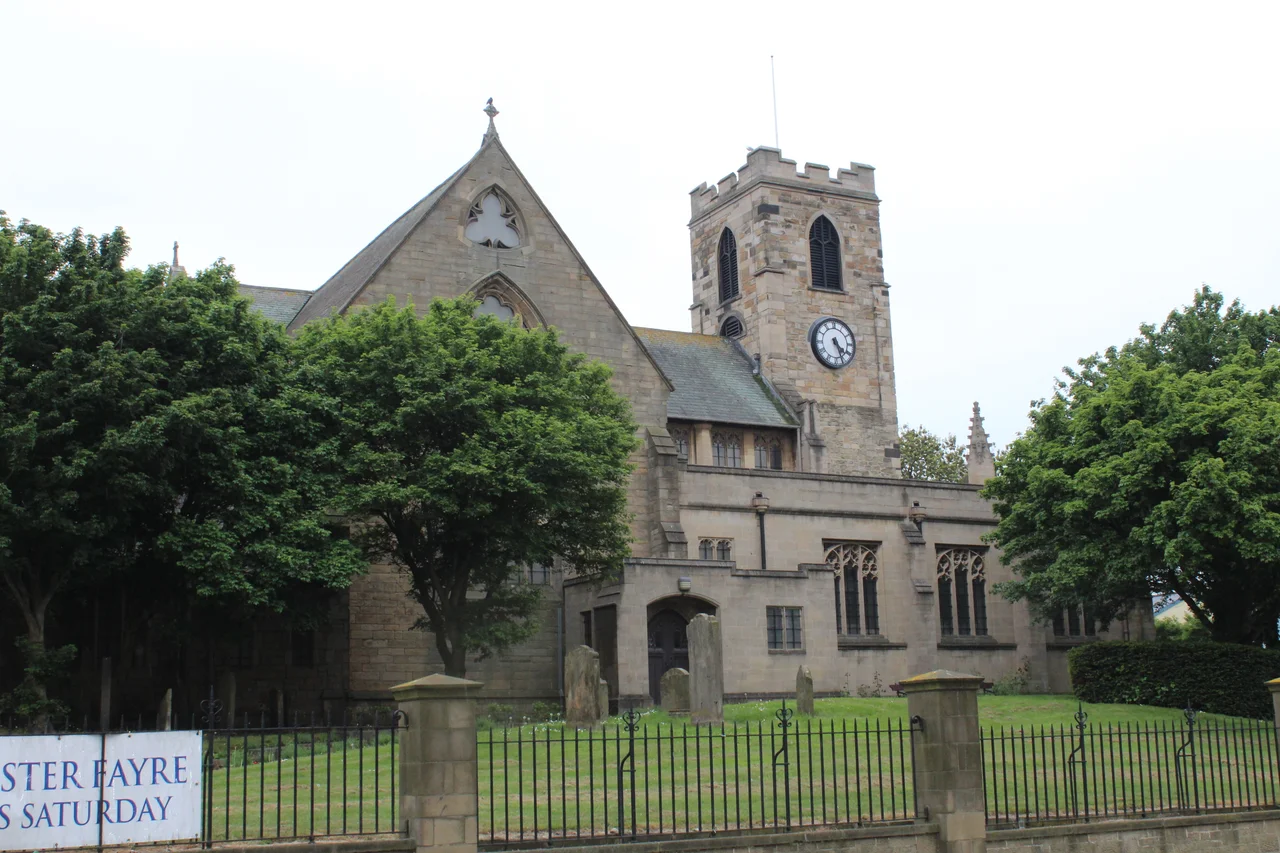
A 1930s excavation in the foundations of St Michael's Church found Saxon stones - cut blocks, no later than the 11th century, possibly older. The church above them had been rebuilt almost beyond recognition in the early 20th century because colliery subsidence from the pits under Bishopwearmouth had cracked its walls. But the Saxon stones underneath were proof of what the local clergy had always claimed: that a church had stood here for a thousand years, since around 940 AD, dedicated to St Michael and All Angels. In January 1998, after Sunderland became a city in 1992, the parish church was redesignated as the Minster of Sunderland - only the second minster created in England since the Reformation, after Dewsbury Minster in West Yorkshire in 1994.
Bishopwearmouth's Old Church
The Bishopwearmouth parish was founded around 940 AD, in the late Anglo-Saxon period when the kingdom of Northumbria still meant something and the lands south of the River Wear belonged to the Bishop of Durham. A stone church went up shortly after - the church whose foundations gave up Saxon-cut stones a thousand years later. For most of its life it was simply Bishopwearmouth Parish Church, ministering to a village on the south side of the Wear opposite the older Anglo-Saxon double monastery of Monkwearmouth-Jarrow founded by Benedict Biscop in 674. As Sunderland grew through the 18th and 19th centuries into a coal-shipping port and shipbuilding centre, Bishopwearmouth was swallowed into it. The parish church became the city's principal Anglican building. By the early 20th century the structure was failing - the Wearmouth Colliery seams ran beneath central Sunderland, and the subsidence broke the church's medieval fabric so badly that almost the whole building above ground had to be replaced.
The Second Minster Since the Reformation
In English ecclesiastical use, a minster is a major mother-church - the kind of large church that has authority over a city or region, often with a college of clergy attached. The title had been mostly disused since the Reformation of the 16th century, when the great monastic foundations like Westminster and York had kept theirs but new minsters had not been created. In 1994 Dewsbury became the first new English minster in centuries. In 1998, four years later, the redesignation of St Michael & All Angels' Church as Sunderland Minster followed. The trigger was civic - Sunderland had received city status in 1992 - and the title carried the message that this church now served the whole city. The Bishop of Durham approved the change in January 1998. It remained a parish church serving Bishopwearmouth as well as a minster serving the wider city until May 2007, when the parish role transferred to the parish churches of St Nicholas and St Ignatius and the Minster became an Extra Parochial Place.
Adopting Benedict Biscop
In the same May 2007 reorganisation, the church added Benedict Biscop to its dedication. The full official name is now the Minster Church of St Michael and All Angels and St Benedict Biscop. The choice was theological as much as civic. Benedict Biscop, born around 628, was the Northumbrian noble who founded the monastery of St Peter at Monkwearmouth in 674 - the church whose original west porch still stands two miles north on the other bank of the Wear. Bede was a child of seven when he entered Biscop's monastery in 680. By adopting Biscop as Sunderland's patron, the Minster joined the city's modern self-understanding to its oldest documented history. The two churches - St Peter's at Monkwearmouth, founded by Biscop in 674, and Sunderland Minster, founded around 940 - now bookend more than a millennium of Christian worship on either side of the River Wear.
A Church for the Whole City
Sunderland Minster is a Grade II* listed building, part of the Greater Churches Group of England's largest non-cathedral churches. It hosts services of remembrance for the city, chaplaincies for the retail and industrial workforces in the centre, and the University of Sunderland's chaplaincy. The 1907 to 1930 rebuilding gave it most of its current external character - a building that looks late Victorian but contains Saxon stones in its base. Since 2007 the Minster has described itself simply as 'a church for the whole City', a phrase that captures the trajectory the building has taken: parish church for a Wearside village, parish church for a town, minster for a city, civic church for whatever Sunderland next decides to become. The bells ring, the services run, the city goes about its business around it. A thousand years in, the church has not lost the habit of being here.
From the Air
Sunderland Minster sits at 54.906N, 1.389W on High Street West in central Sunderland, near the south end of the Wearmouth Bridge. From cruising altitude its tower is a recognisable city-centre marker, close to the Empire Theatre. Mowbray Park is south-east; the river Wear curves north past the Stadium of Light. Nearest major airport is Newcastle International (EGNT), 12 miles north-west. Durham Tees Valley (EGNV) is 27 miles south. Recommended viewing altitude 1,500-3,000 ft AGL to take in the Minster, Empire Theatre, and the Wearmouth and Queen Alexandra bridges in one sweep.
Nearby Stories
- Seaton Carew 2.7 km away
- HMS Unity (N66) 6 km away
- George Stephenson's Birthplace 6.1 km away
- Raby Castle 9 km away
- Cragside 15 km away
- Whitby Abbey 21 km away
- German submarine U-2367 46 km away
- Alexander L. Kielland (Platform) 277 km away