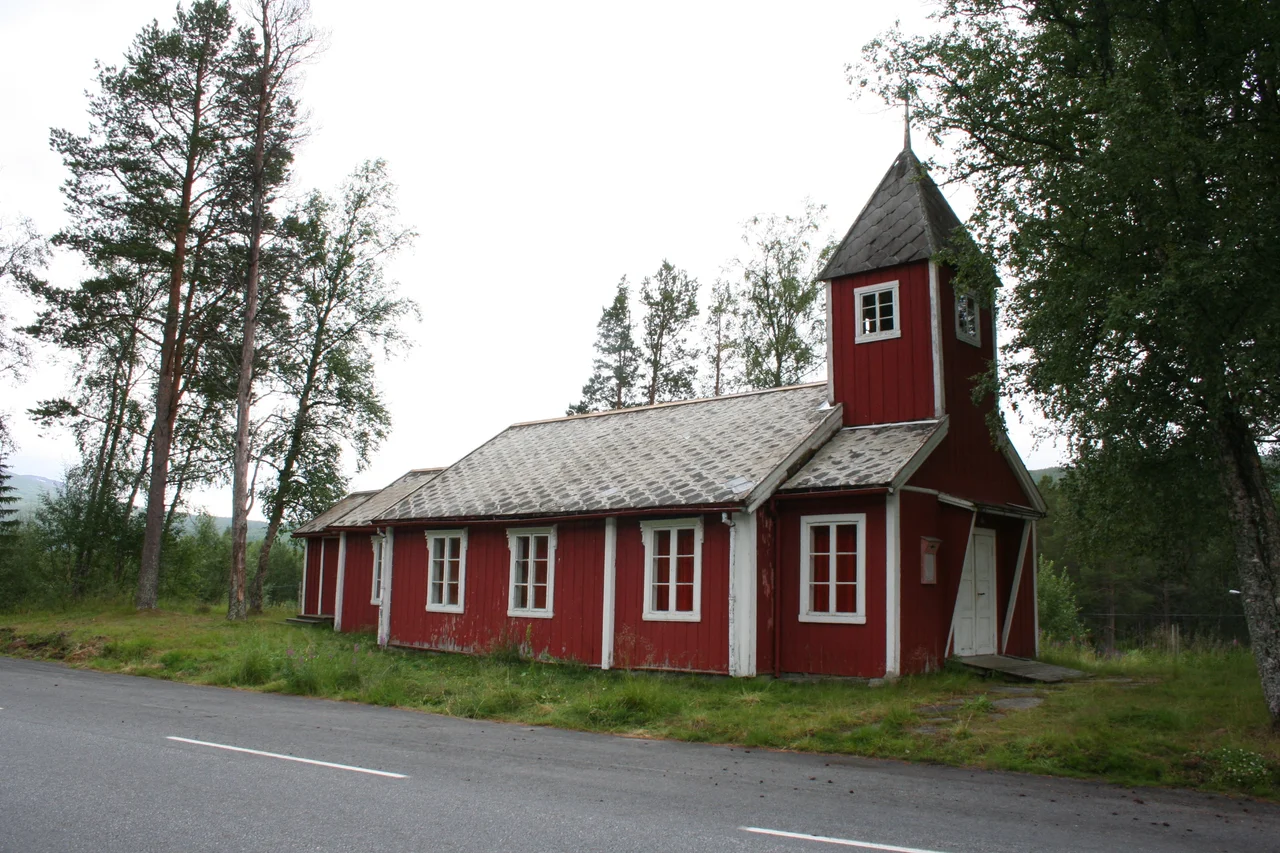

Susendal Church
In 1998 the bishop came to Svenskvollen and the verdict was blunt. The chapel in the Susendal valley had stood since 1916 — red-painted, seating about seventy, known locally as the school chapel — and by the time Øystein Ingar Larsen made his visitation the building had decayed past rescuing. What was agreed that day was to deconsecrate it and carry the church silver out through the door. In most places that is where the story of a small rural chapel ends. In Susendal it was the beginning of one. The valley decided to build its own replacement, and three years later the same bishop came back to consecrate what they had made.
Built on Dugnad
The word for it in Norwegian is dugnad — unpaid collective work for a shared purpose, the mechanism by which small Norwegian communities have historically got everything done that no authority was going to do for them. Susendal Church was raised on dugnad by the people of the valley, with help from local businesses and from Hattfjelldal Municipality, to plans by the architect Jim Inge Bøasæter.
What they built is a long church of notched log timber, brown rather than white, seating about 150 — more than twice the capacity of the chapel it replaced, in a valley whose population was not growing. Bishop Larsen consecrated it on 14 October 2001. The building was not finished on that date, and nobody pretended it was. Work carried on afterwards in the same manner it had started: the altarpiece was consecrated in March of the following year, and the pews went in later still. A church a community builds itself gets finished at the pace the community can manage.
Sower, Manger, Harvest
The altarpiece is a triptych of three paintings by Karl Erik Harr, one of Norway's best-known painters of northern landscape and coastal life, born in Kvæfjord in Troms in 1940 and made a knight of the Order of St. Olav in 2001. The subject he chose speaks directly to the room it stands in.
On the left panel is the sower, from the parable in which the word of God is scattered like seed on ground of varying quality. In the centre is the birth at Bethlehem. On the right, a woman holds out the crop that the sower's work produced. Susendal is a farming valley — agriculture is its principal livelihood — and this is one of the rare cases where a church's central image and its congregation's working year describe the same thing. People who spent the summer sowing and the autumn bringing in a harvest look up at a picture of sowing and harvest.
A Hundred Metres Apart
The 1916 chapel was never torn down. It still stands barely a hundred metres from the church that replaced it — the two buildings within easy sight of one another, one holding services, one holding its shape. Hattfjelldal Museum looks after the old chapel now, along with the Gammelbutikken, the old shop at Kroken further along the valley.
There is something honest in the arrangement. The valley did not pretend the chapel had never existed, and it did not sentimentalise it either. The building was worn out and was said so plainly by a bishop; the community accepted the judgment, kept the structure, and put up a better one alongside. Susendal Church is one of three in the Hattfjelldal parish, with the main church at Hattfjelldal itself and services also held at Varntresk.
The Valley That Hums
Susendal — Såvsoenvuemie in Southern Sámi — is a valley in Hattfjelldal Municipality, close to the Swedish border, with Børgefjell National Park for a neighbour. Local explanation of the name points at the river: wherever you stand in the valley, people say, you can hear the Susna running.
That river starts where Tiplingelva and Harvassbekken meet, runs the full length of Susendal, and is joined at Hattfjelldal by the Unkerelva, at which point it stops being the Susna and becomes the Vefsna — at 163 kilometres, the largest river in Nordland, bound north for the fjord at Mosjøen. The valley remains busy for its size, with its own kindergarten and village school and a handful of local firms. It is a place that has kept the habit of doing its own building.
From the Air
Susendal Church sits at 65.3970°N, 14.0116°E in the village of Svenskvollen, in the Susendal valley of Hattfjelldal Municipality, close to the Swedish border. The setting is a narrow, farmed valley floor with high ground on both sides and Børgefjell National Park immediately south — Kvigtinden, the high point of the massif, reaches about 1,699 m (5,574 ft), so 8,000 ft is a safe transit level and 2,000–3,000 ft AGL gives the best view of the valley. Navigate by the Susna river running the length of the valley northwest toward Hattfjelldal village, where it joins the Unkerelva and becomes the Vefsna. The brown log church and the small red 1916 chapel stand about 100 m apart, an unusual paired landmark from the air. Access on the ground is by the road from the municipal centre, itself reached by National Road 73 from Trofors. Nearest airport is Mosjøen Airport, Kjærstad (ENMS) to the west; Mo i Rana (ENRA) lies to the north and Namsos (ENNM) well to the south. Expect rapid weather changes over the border mountains and very limited daylight in midwinter.
Nearby Stories
- Børgefjell National Park 3.6 km away
- Røsvatnet 7.2 km away
- Vefsn Municipality 8 km away
- Stekenjokk 14 km away
- Actions in Nordland 17 km away
- Joesjö 29 km away
- Hemavan 32 km away
- Namsskogan (village) 33 km away