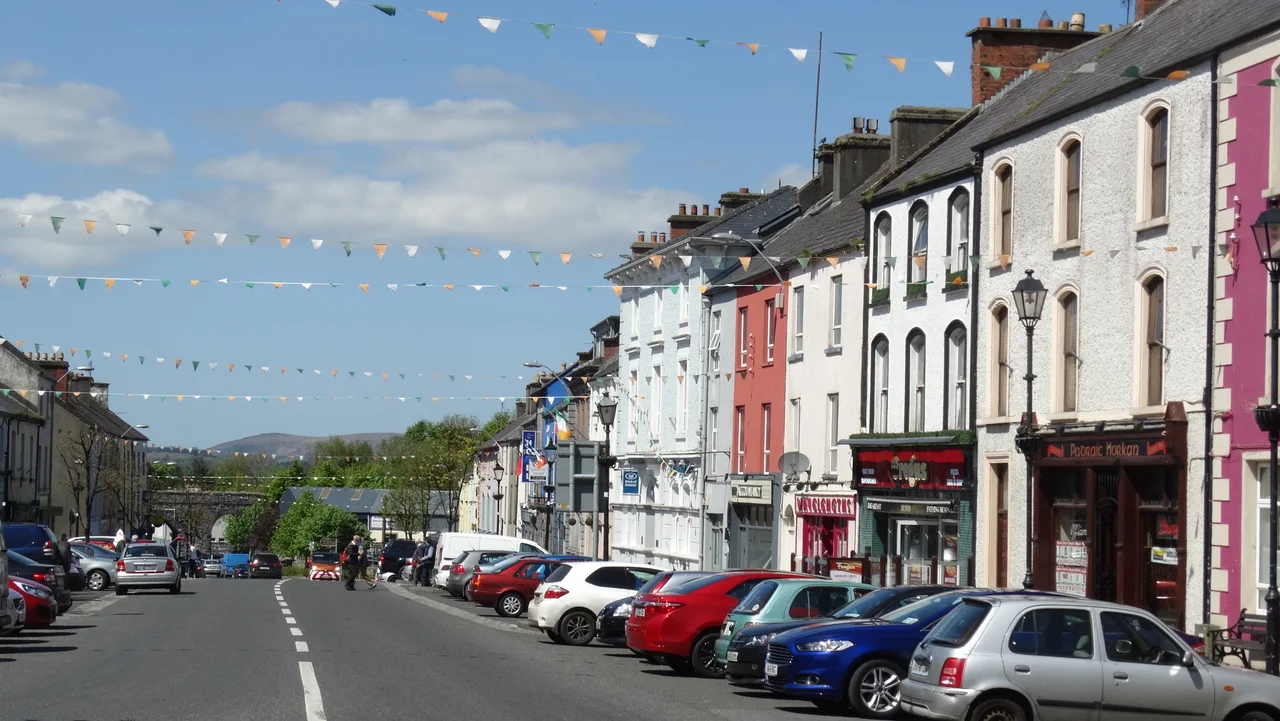

Swinford
Two stories try to explain the name Swinford. The first traces it to Swineford, after a pig market once held in the town, and is supported by the official Irish name Beal Atha na Muice - the mouth of the ford of the pigs. The second says the town has always been Swinford, named after Swinford in Leicestershire, where the founding Anglo-Irish Brabazon family originally came from. Both might be true; in 18th-century Ireland, the English name and the Irish name often grew up alongside each other and pointed at different things. What is definitely true is that Swinford was a planned town, laid out from scratch in the late 1700s on a tributary of the River Moy, and that it was the first town in County Mayo to be bypassed when the new N5 swung around it in 1993.
The Brabazons and the Forty Plots
The Brabazon family had originally been settled in County Galway, but they backed the wrong side in the Williamite War and watched their Galway estates confiscated after the Treaty of Limerick in 1691. As a consolation, they were granted new land in County Mayo. In 1769 they began laying out a town: forty people were given the right to build houses according to a pre-planned pattern, on leases from William Brabazon, the family's landlord. Brabazon encouraged good quality construction by donating lumber and slate, and the initial structures were unusually substantial for a rural Irish town - many three storeys tall. The grid layout, the consistent building line, the planned market square - these are all marks of the planned-town tradition that produced places like Westport, Strokestown and Mountbellew elsewhere in Connacht. In 1855, the Sisters of Mercy arrived to build a convent, take over the local workhouse, and eventually run primary and secondary schools for the town. In 1916 they took over the old Brabazon estate house and converted it into a school - a quiet completion of a circle that had begun more than a century earlier.
Swinford in the War of Independence
Swinford had a sharp share of activity during the Irish War of Independence from 1919 to 1921. The town's nationalists had been divided since the Parnell crisis of 1890, with the factions in Swinford and the nearby village of Meelick particularly hostile to each other. That bitterness slowed the organisation of the IRA in the area until around 1920. When the volunteers did finally get organised, they moved quickly. On 19 August 1920, IRA members broke into the goods shed at Swinford Railway Station and destroyed ten tons of food and fuel belonging to British security forces. Eight days later, on 27 August, volunteers from Swinford and the neighbouring village of Bohola attacked and captured Ballyvary RIC barracks. In November of that year, two Swinford men - James Henry and Thomas Fraher - were convicted at a Galway military court of possessing weapons and intelligence on the RIC, and sentenced to prison. Local tradition has it that the volunteers later climbed onto the roof of the Royal Irish Constabulary barracks in the town - now the site of the Gateway Hotel - and burned it down by breaking slates and pouring petrol through the openings.
Siamsa Sraide and Hardy Bucks
Since the mid-1980s, Swinford has hosted one of County Mayo's largest summer street festivals: Siamsa Sraide Swinford - Fun in the Streets of Swinford. The five-day festival in the first week of August fills the town with ceili dancing, live bands, open-air concerts, history walks, busking competitions and heritage displays of East Mayo traditions. Children swarm the square. Tourists who came in for the day stay overnight. The festival has become the town's distinguishing event, the thing that gets it onto the regional calendars of Galway, Sligo and beyond. In a different register, Swinford has also served as the fictional town of Castletown in the cult Irish TV comedy Hardy Bucks, the series that captured small-town Irish lad culture with affectionate ferocity. The same streets that once burned down a barracks now show up on screen as scenery for adolescent misadventure.
Brabazon's Town, Three Centuries In
Swinford railway station opened on 1 October 1895 and closed to passengers in 1963, finally shutting altogether in 1975 - a familiar arc for the rural lines that once knitted Connacht together. The town now sits 18 kilometres from Ireland West Airport at Knock, off the N5 that bypassed it. The Sisters of Mercy convent eventually merged with the local boys' college and vocational school in August 1992 to form Scoil Muire agus Padraig, the town's secondary school. The fishing waters around the town - the Callow lakes, the lakes of Conn and Cullin - are still the main draw for visiting anglers. The town has produced bishops, footballers, boxers, disability rights activists and the Irish tenor John Feeney, who is buried in Swinford. Three centuries on from William Brabazon's leases, the forty plots have multiplied, the schools have changed names, and the planned town has settled comfortably into being just a town.
From the Air
From the cockpit window, Swinford is a small but clearly designed town on flat country, with the N5 sweeping past it to the north on its run from Dublin to Westport. The river runs through. Old Brabazon-era stonework is visible in the centre. The town gives way quickly to the patchwork of small farms and bog that defines rural east Mayo. Ireland West Airport sits off to the south-west, close enough that approaching pilots can pick out Swinford as a recognisable landmark before they touch down. A planned town, founded by losers of a 17th-century war, that has been on the map ever since.
From the Air
Located at 53.94 degrees north, 8.95 degrees west, in central County Mayo, just off the N5 between Castlebar and Longford. Ireland West Airport (EIKN) lies 18 km to the south-west - Swinford is often a recognisable landmark on approach. Distinct grid layout from the air thanks to its 18th-century planned origins.
Nearby Stories
- Newport, County Mayo 3.7 km away
- Bellanagare Bog 5.5 km away
- Ballygar 13 km away
- Leenane 13 km away
- Creevelea Abbey 13 km away
- St Mary's Cathedral, Tuam 13 km away
- Bangor Erris 16 km away
- Easky 17 km away