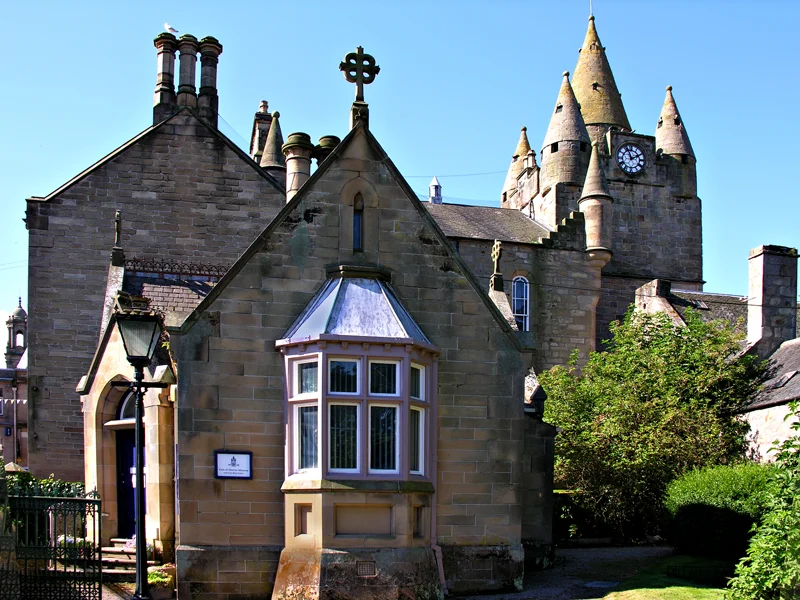

Tain & District Museum
On 17 July 1492 - three months before Columbus sighted the Bahamas - Pope Innocent VIII signed a papal bull concerning a small Scottish burgh on the Dornoch Firth. That bull now sits in a cottage behind the Old Collegiate Church in Tain, looked after by volunteers who unlock the door each morning from April through October. The Tain & District Museum is small the way mountain springs are small: modest at the source, but feeding something much larger. Inside the converted caretaker's cottage, built in the 1880s, you can trace nine centuries of Highland life through the objects a single town refused to let slip away.
Rosemary's Hoard
The museum exists because one woman would not let go. In 1966, the burgh of Tain was preparing to celebrate the 900th anniversary of its royal charter, and Rosemary Mackenzie was asked to organise an exhibition of local material. She had been collecting Tain history for years, quietly, in the way that only a true local historian collects - notebooks, photographs, oddments of silver, the kind of papers families throw out after a death. The exhibition turned into a museum. Mackenzie became its first curator. Her timing proved providential: when Scottish local government was reorganised in 1975, much of the burgh's historical material would have been carted off to regional archives elsewhere. Because of her, it stayed in Tain. The growing collection settled into the old caretaker's cottage of the Collegiate Church, and there it has remained.
The Silversmiths of a Tiny Town
Most Scottish silver bears the assay marks of Edinburgh or Glasgow. A small but stubborn quantity bears the marks of Tain. Between roughly 1700 and 1850, this Highland town of a few thousand people supported its own silversmiths - the Rosses, the Stewarts, the Skinners - whose work now turns up in auction catalogues and private collections worldwide. From 2007 to 2013, with help from the Art Fund, the museum systematically built its Tain silver collection. The 1997 exhibition that started it all included pieces lent from the Royal Collection at Windsor, alongside one work that had travelled to the 1938 Empire Exhibition in Glasgow. A snuffbox by Hugh Ross sits in the cabinet now, the kind of object a Highland gentleman would have carried as casually as a modern man carries a phone.
Stones the Picts Left Behind
Long before any cathedral or charter, the Picts were here. From roughly 50 BC to 900 AD, East Ross supported a large active Pictish population, and they left their signature in carved stones - knotwork, beasts, mirror symbols whose meaning we can only guess at. Most of the great Pictish stones of Scotland have been removed to Edinburgh's National Museum, but Tain's museum kept a few at home. The Ardjachie Stone stands here. A fragment of the magnificent Nigg Stone is here too. The cottage is also the Clan Ross Centre, helping the Ross diaspora trace its way back to this stretch of the Dornoch Firth, and connecting living descendants to the carved stones their distant ancestors raised.
Tain Through Time
The museum is one piece of a larger site called Tain Through Time, which threads together the Collegiate Church, the old schoolhouse - now a gallery called The Pilgrimage - and the museum itself. The Pilgrimage gallery tells of King James IV, who made repeated pilgrimages to Tain to venerate the relics of St Duthac. Kings travelling north along bad Highland roads to a shrine on the edge of nowhere: it tells you how seriously this little burgh once mattered. In 1998, the museum won a Hydro-Electric Scottish Museum of the Year award for its publication *A Balance of Silver*, a history of the local silversmiths. The displays rotate each season - Highland regiments one year, croft houses another, 19th-century transport, snuff and whisky, mid-century home technology - so a visitor who came in 2011 and returns in 2025 will not see the same museum twice.
From the Air
Tain sits at 57.81°N, 4.05°W on the south shore of the Dornoch Firth, about 40 miles north of Inverness. From cruise altitude over EGPE (Inverness), the firth's distinctive double-mouth shape - bounded by the Tarbat peninsula to the south and the Sutherland coast to the north - makes Tain easy to locate. The town clusters around the Tolbooth steeple visible from low pass; the museum sits just south, behind the squat Collegiate Church. Glenmorangie distillery's white buildings mark the northern edge of town near the railway. Best viewed from 2,000-3,000 ft AGL in clear conditions.
Nearby Stories
- Moray Firth 1.1 km away
- Culloden Viaduct 1.2 km away
- Cardhu Distillery 9.5 km away
- Clynelish Distillery 10 km away
- Alladale Wilderness Reserve 15 km away
- Corrimony Chambered Cairn 18 km away
- Ardvreck Castle 31 km away
- Hill o' Many Stanes 40 km away