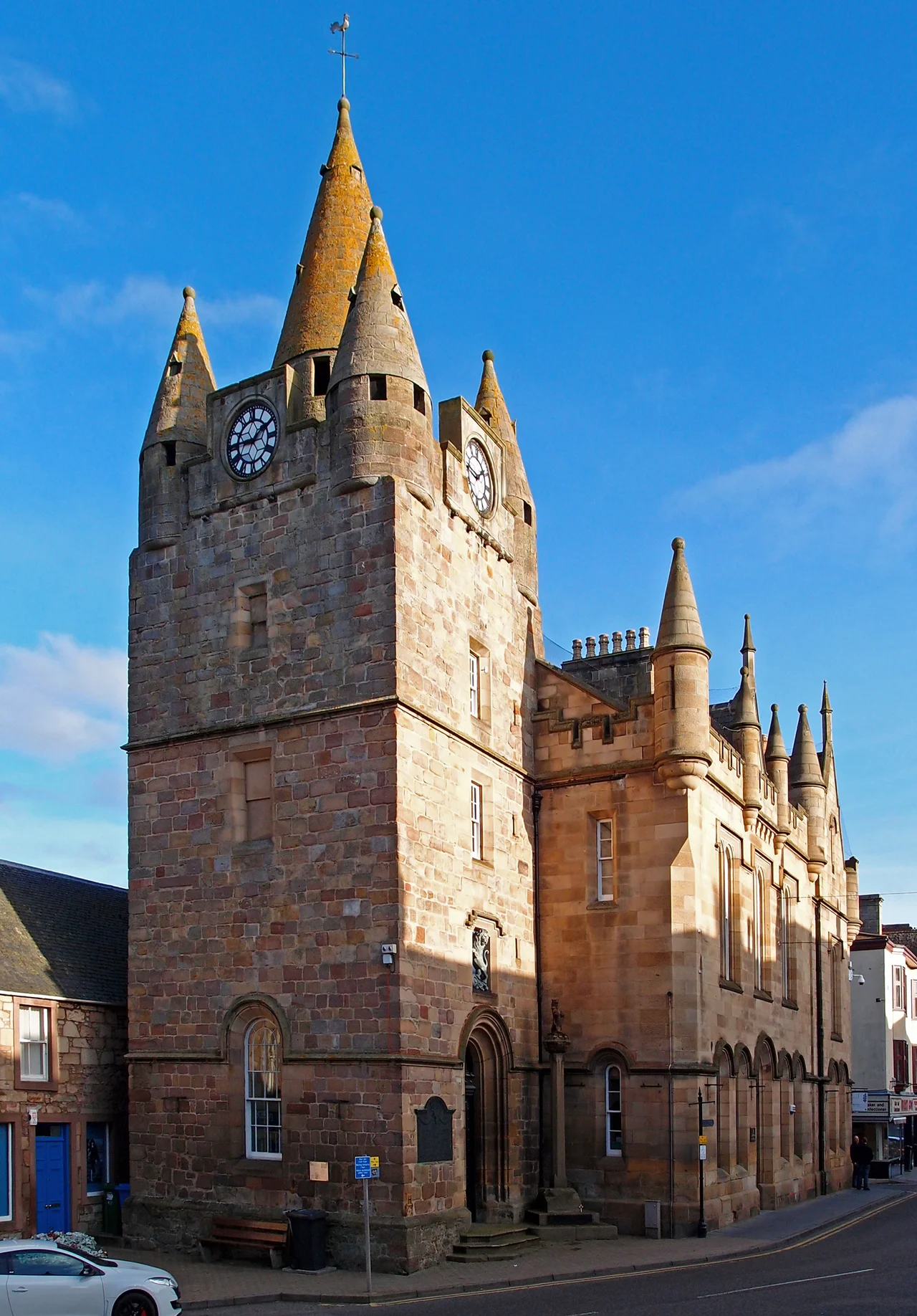

Tain Tolbooth
Three prisoners broke out of the Tain Tolbooth in 1829, and the bell that rang to alert the town was the same bell a Dutch foundryman had cast in Middelburg two centuries earlier. It still hangs in the steeple. That is the kind of place the Tolbooth is - a building where the layers do not so much accumulate as compound interest. The current tower has stood at the top of the High Street since 1708, but the institution underneath it goes back to 1631, when Provost John McCullough decided that the burgh of Tain needed somewhere to hold its courts, store its weights and measures, and lock up the occasional troublemaker.
A Bell from Holland
The first Tain tolbooth was built in 1631 with one striking detail: its bell came from the Netherlands. Michael Burgerhuys of Middelburg, one of the great Dutch foundrymen of his age, cast the bell specifically for the new building. Why a Highland burgh of perhaps a thousand souls reached across the North Sea for its bell rather than to a Scottish founder is an open question - probably trade connections through the Baltic ports, possibly a Tain merchant who knew Burgerhuys's work. Whatever the reason, the bell arrived, rang for three-quarters of a century, and then survived the destruction of the building that housed it. In 1675, the non-conformist minister Thomas Ross was locked up in this tolbooth for refusing to acknowledge the bishops; he was held for the better part of a year. In 1703, a storm tore down the steeple. The building had to come down. The bell did not.
Scottish Baronial
Alexander Stronach designed the replacement, completed in 1708 in the Scottish baronial style - coursed stone, a three-stage tower, small sash windows climbing the upper levels. Twenty-five years later, in 1733, the upper part was crowned with corner bartizans and a spire, giving the silhouette that still defines Tain's High Street today. The Dutch bell, recovered from the wreckage of 1703, was hung in the third stage that same year. A clock followed in 1750. The tolbooth was always meant to be more than ornamental: alongside it stood a two-storey council house extending southeast along the street, where the burgh's business was done. That council house was eventually demolished in the early 1820s, and the tower's relationship with its neighbour reset.
Fire and Rebuilding
The foundation stone of a new courthouse went down in 1825, to a design by Alexander Gordon, and was completed around 1826. Six years later, it burned. The 1833 fire took the courthouse but spared the tower, and the rebuild produced the asymmetrical four-bay frontage you can see today: round-headed doorway in the second bay from the left, gabled right-hand bay, paired round-headed windows on the ground floor, bi-partite mullioned windows above, a crenelated parapet with corner turrets at roof level. Andrew Maitland added a four-bay block to the rear in 1876. A new clock went into the tower in 1877. Through all of it, the bell from Middelburg kept time.
Still in Session
When the Ross and Cromarty District Council was enlarged in 1975, Tain stopped being the local seat of government. The council chamber became the meeting place of the Royal Burgh of Tain Community Council, and the building continues as the venue for hearings of Tain Sheriff Court. The 1907 portrait by George Fiddes Watt of Alexander Wallace - Honorary Sheriff Substitute for Ross and Cromarty and Sutherland - watches over proceedings. A Category A listed building, the Tolbooth is the kind of structure that quietly insists places have memories. Three centuries on, the bell from the Middelburg foundry still marks the hour over the High Street.
From the Air
Tain Tolbooth sits at 57.81°N, 4.05°W on the High Street at the centre of Tain, on the south shore of the Dornoch Firth. The spire is the most prominent vertical feature in the burgh and provides an unmistakable landmark when approaching from the south along the A9 corridor or from Inverness (EGPE), 40 miles south. The steeple climbs above the Victorian rooflines and is easy to pick out from 1,500-3,000 ft AGL. The Dornoch Firth opens out to the north and east; the Glenmorangie distillery's white buildings sit at the northern edge of town. Best viewed in clear visibility, late morning when the east-facing High Street is lit.
Nearby Stories
- Moray Firth 1.1 km away
- Culloden Viaduct 1.2 km away
- Cardhu Distillery 9.5 km away
- Clynelish Distillery 10 km away
- Alladale Wilderness Reserve 15 km away
- Corrimony Chambered Cairn 18 km away
- Ardvreck Castle 31 km away
- Hill o' Many Stanes 40 km away