
Taiping Mountain Forest Railway
They called it the Bongbong Train - an onomatopoeia for the sound its wheels made rattling over narrow-gauge track laid through mountain forest at nearly 2,000 meters. Commissioned in 1920 and connected to the Luodong Forest Railway four years later, the Taiping Mountain Forest Railway once carried massive cypress and camphor logs down 36.4 kilometers of switchbacks, trestle bridges, and aerial tramways from the cloud forests of Yilan County to the lumber yards below.
The logging stopped. The passenger services ended in 1979. Typhoons battered the tracks. But the Bongbong Train refused to disappear entirely, and in September 2018 a restored three-kilometer section reopened, carrying tourists through the same misty landscape where loggers once rode beside stacked timber.
Built for Timber, Remembered for Sound
The Japanese colonial administration built the Taiping Mountain Forest Railway to extract the island's valuable hardwoods - hinoki cypress, camphor, and red cypress that grew in dense stands at high elevation. The engineering challenge was formidable: the railway had to descend from nearly 2,000 meters to the coastal plain, navigating terrain so steep that conventional rail grades were impossible. The solution combined narrow-gauge track with inclined planes and aerial tramways, creating a hybrid system that could move heavy loads down slopes no locomotive could climb.
By 1924, the railway connected to the Luodong line, completing a route from mountaintop to sawmill. For decades, the trains ran loaded with timber, their wheels producing the distinctive percussion that gave the system its nickname. The Bongbong sound became synonymous with Taiping Mountain itself - a rhythm as natural to the forest as birdsong or rainfall.
Ruins Along the Railbed
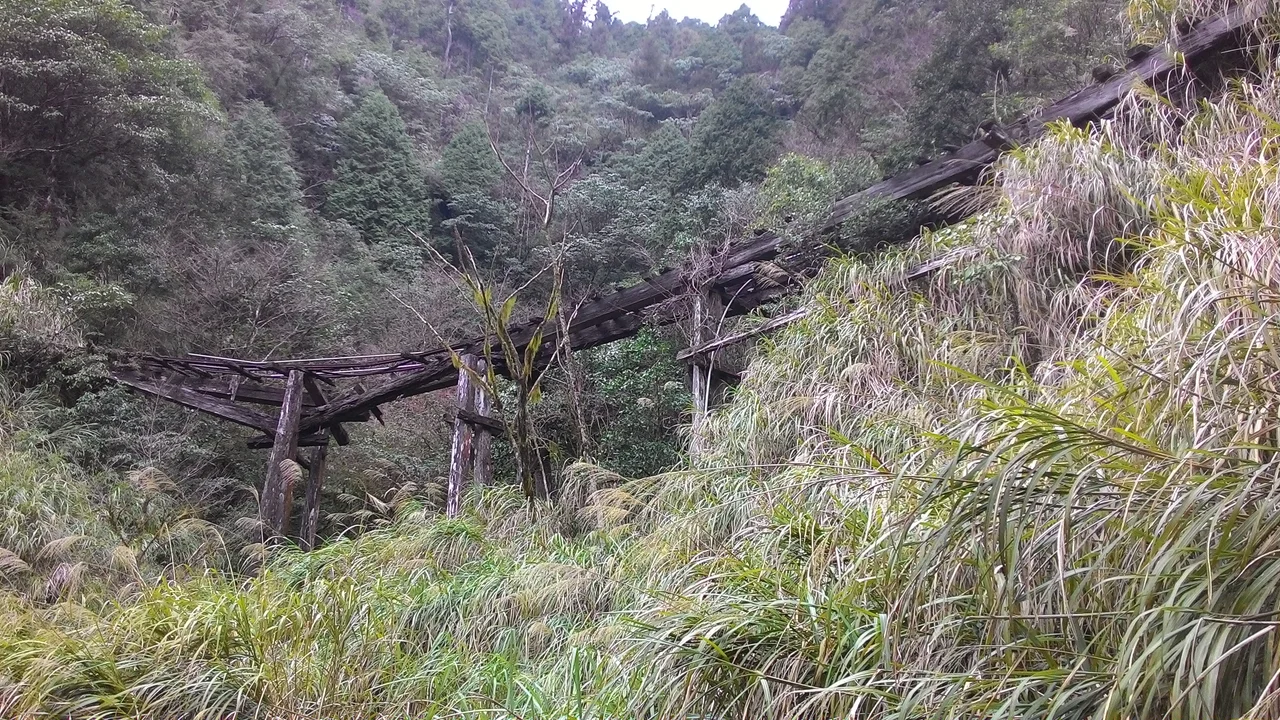
When commercial forestry was phased out on Taiping Mountain, the railway's purpose evaporated. Sections of track fell into disrepair. Trestle bridges, built of wood to span the mountain's ravines, collapsed or rotted. A typhoon in 2012 damaged the sightseeing train service that had kept a short section alive, silencing the Bongbong Train for six years.
What remains is haunting. The Maosing Reminiscent Trail follows 1.5 kilometers of the old railbed at elevations between 1,870 and 1,950 meters, where rotting railway sleepers have been covered in gravel to create a footpath while the iron rails remain in place on either side. Some trestle bridges have been repaired; others stand as skeletal ruins; still others have been replaced by modern suspension bridges that swing gently in the mountain wind. Walking this trail means walking through layers of time - functional infrastructure, romantic decay, and pragmatic repair all visible within the same kilometer.
The Three-Kilometer Revival
On September 19, 2018, the Bongbong Train ran again. A restored three-kilometer section between Taiping Shanzhuo station and Shigeru station now operates eight trips per day at thirty-minute intervals, each one-way journey taking twenty minutes. The pace is deliberately unhurried. Passengers sit in open carriages as the train threads through forest so dense that sunlight arrives in narrow shafts, filtered through layers of canopy.
The revived service is tiny compared to the original system's 36.4-kilometer reach, but it captures the essential experience: the clatter of narrow-gauge wheels on old track, the smell of damp wood and mountain air, the sense of traveling through a landscape that was shaped by an industry now gone. The Jancing Forest Railway, a branch line of roughly 5.5 kilometers, offers additional access to the area's heritage, though a landslide has reduced the publicly accessible section to just 900 meters. Along it, abandoned trolleys and bogies rust quietly beside the tracks.
Forest Above, Memory Below
Taiping Mountain's transformation from logging operation to recreation area mirrors a broader shift in Taiwan's relationship with its mountain forests. The trees that the railway was built to remove are now the reason people come. The same cypress groves that loggers measured in board feet are now measured in hiking hours and camera frames. The sightseeing area that replaced the lumber operation draws visitors who want to walk through cloud forest, ride a heritage train, and stand on a trestle bridge looking down into a ravine that once echoed with the crash of falling timber.
Information boards along the trails tell the story of the lumber industry without romanticizing it. The environmental cost of decades of logging is visible in the landscape - in the secondary growth that differs from old-growth forest, in the erosion patterns on deforested slopes, in the landslides that have swallowed sections of track. But the forest is reclaiming what was taken. Moss covers the old sleepers. Ferns push through gaps in the ballast. The Bongbong Train still runs, but the forest has the last word.
From the Air
Located at 24.49°N, 121.54°E in the mountains of Yilan County, northeastern Taiwan. The railway runs along the slopes of Taiping Mountain at elevations between 1,870m and 1,950m. From the air, look for the cleared areas of the Taiping Mountain National Forest Recreation Area amid dense forest cover. Taipei Songshan Airport (RCSS/TSA) is approximately 60km to the northwest. Taiwan Taoyuan International Airport (RCTP/TPE) is about 90km west. The terrain is extremely mountainous with frequent cloud cover and fog, especially in the rainy season (April-August). Annual rainfall exceeds 3,000mm. Best aerial visibility on clear winter mornings.
Nearby Stories
- Dongshi Forestry Culture Park 11 km away
- Taroko Gorge 11 km away
- Miaoli Ceramics Museum 12 km away
- Wulai Atayal Museum 12 km away
- 2022 Chinese Military Exercises Around Taiwan 69 km away
- Sinking of MV Sewol 1116 km away
- Yellow Sea 1169 km away
- Twin Forts of Romblon 1299 km away