.jpg)
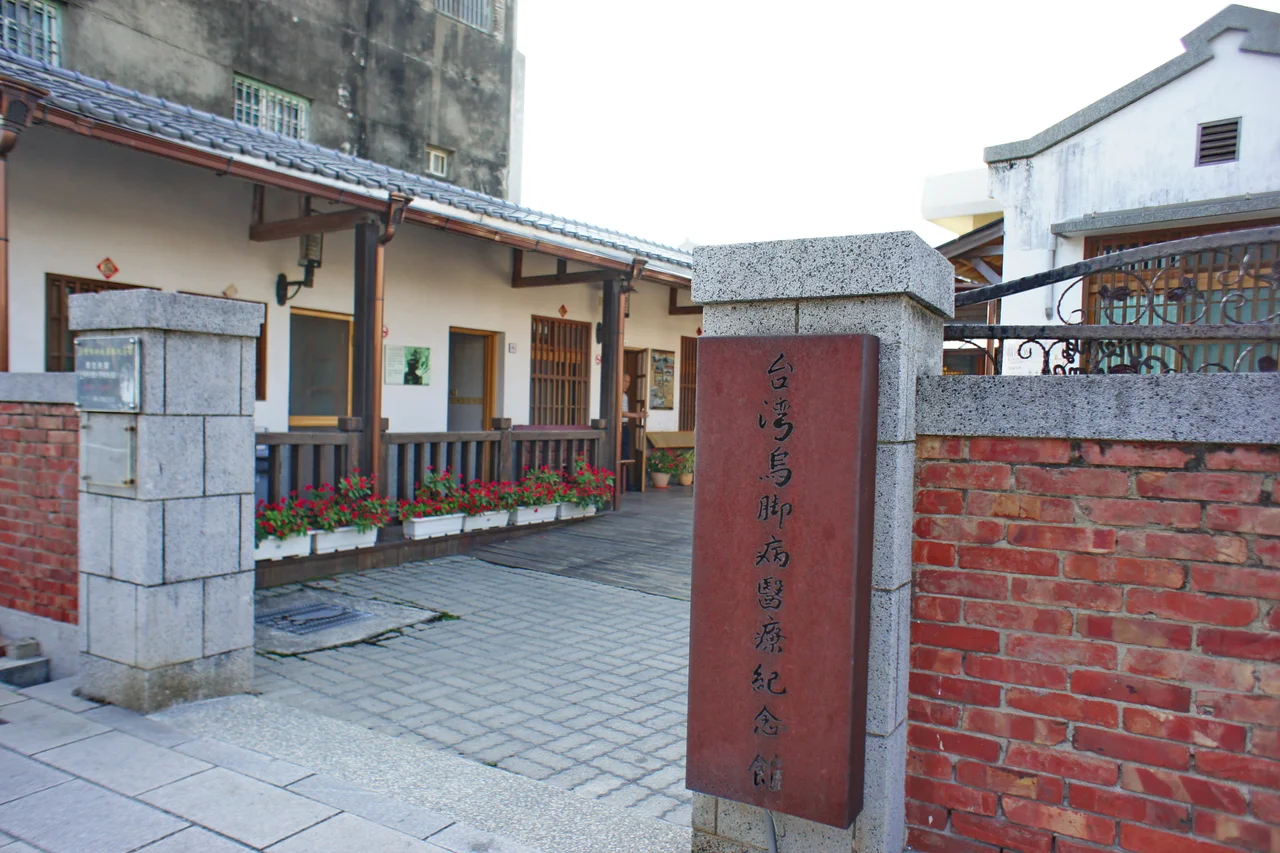
Taiwan Blackfoot Disease Socio-Medical Service Memorial House
Dr. Wang Jin-he did not have to stay. He had trained as a physician, and there were better-paying practices elsewhere. But the people along Beimen's coast were suffering in ways that demanded a response, and so he stayed for 25 years — running a free clinic out of a modest building in Yonglong Village, treating patients who had no other options. The disease they came with was called blackfoot disease. It began with numbness in the extremities. It ended, for many, in gangrene and amputation. The building where Dr. Wang worked still stands. It is a memorial now, and it holds the weight that such places carry.
The Water That Poisoned a Coast
For much of the 20th century, residents of the southwestern Taiwan coastal plain — in areas around Tainan and Chiayi — drew their drinking water from artesian wells. The wells were deep, reliable, and heavily contaminated with arsenic. This was not widely understood at first. The communities that depended on the wells were rural and poor, and the connection between the water and the disease that began appearing among them took years to establish.
Blackfoot disease — known in Chinese as wūjiǎobìng, 烏腳病 — is a peripheral vascular disease caused by chronic arsenic poisoning. Blood flow to the extremities diminishes. The skin discolors, the tissue dies. The disease progresses from numbness and cold feet to unbearable pain and, in the worst cases, the blackening of the flesh that gave the condition its name. Among patients who developed full blackfoot disease, the majority required amputation — often of the feet or lower legs. The reamputation rate was significant. People who survived the disease often survived it incomplete.
Twenty-Five Years of Free Care
Dr. Wang Jin-he set up his clinic in Beimen's Yonglong Village and committed himself to serving the patients blackfoot disease brought to his door. For 25 years, he provided free medical services to people from Beimen and the surrounding regions — communities where the cost of medical care was itself a burden beyond many families' reach.
The clinic was not just a treatment center. Dr. Wang and those who worked alongside him understood that what was happening here was a public health catastrophe with a social dimension: these were poor fishing and salt-farming households, people whose labor was essential to the coastal economy and who had been poisoned by the infrastructure they depended on. Caring for them was an act of medicine and of justice simultaneously. The government initiated a tap-water supply system in blackfoot-endemic areas in 1960, and by 1970 most southwestern Taiwan residents had stopped drinking from the artesian wells. But the damage done to those who had already been exposed lasted for the rest of their lives.
Preserving a Difficult History
After Dr. Wang's decades of service, the clinic where he worked fell into disuse. The question of what to do with it became a civic and cultural question. Tainan County Magistrate Su Huan-chih and Department of Cultural Affairs Commissioner Ye Tzer-shan proposed converting the building into a memorial, arguing that the history of blackfoot disease — and the response of the people who fought it — deserved a permanent home.
Construction on the memorial house began in November 2006 and was completed in September 2007. President Chen Shui-bian formally opened it in late September 2007. After the inauguration, the Wang Jin-he Culture and Arts Foundation assumed stewardship of the site. The memorial preserves records, artifacts, and the physical space of the clinic itself — the building where patients arrived in pain and where a doctor made the decision, repeatedly, over 25 years, to stay and help.
What the Memorial Holds
Standing in a quiet village in Beimen District, the memorial house is not a grand monument. It is a modest building, and that modesty is part of what it means. The people who suffered from blackfoot disease were not famous. Most of them are not named in any official record. They were farmers, salt workers, fisherfolk — people whose lives ran close to the land and the water, who lost the use of their limbs to a slow poison they could not have known was there.
The memorial honors them alongside the physicians who served them. It does not treat the disease as a curiosity of medical history or as an abstraction. The people who came to Dr. Wang's clinic were individuals — they had families, they had work they could no longer do, they had pain that was real and particular. A memorial that understood only the science would miss the point. This one tries not to. The building still holds the shape of a place where care was given freely, to those who needed it most.
From the Air
The Taiwan Blackfoot Disease Socio-Medical Service Memorial House is located at approximately 23.270°N, 120.124°E in Yonglong Village, Beimen District, Tainan. The building is modest in scale and not easily distinguishable from altitude — this is a quiet village in the flat coastal plain, not a landmark visible from high altitude. At lower altitudes of 500–1,000 feet, the village structure and surrounding salt-farm landscape are visible. Tainan Airport (RCNN) is approximately 30 km to the southeast; Kaohsiung International Airport (RCKH) is roughly 55 km to the south. The surrounding Beimen coast — home also to the Jingzaijiao Salt Fields and the Crystal Church — is a historically layered landscape worth a slow, low pass.
Nearby Stories
- Chung Li-ho Museum 10 km away
- Anping Tree House 11 km away
- Battle of Penghu 11 km away
- Namasia District 15 km away
- 1904 Douliu Earthquake 20 km away
- Xitou Nature Education Area 25 km away
- Heyuan 493 km away
- Daya Bay 514 km away