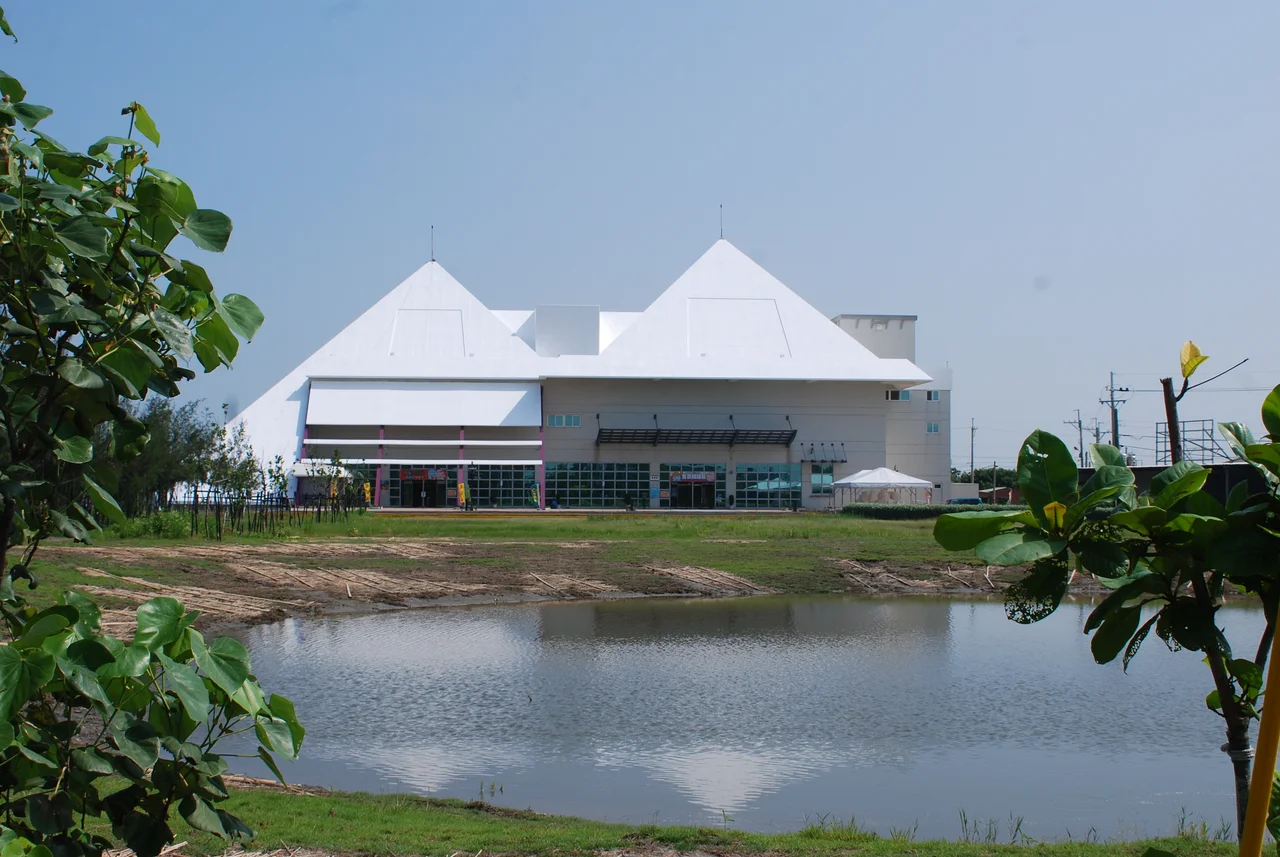

Taiwan Salt Museum
Salt built empires and salted fish kept fleets at sea. In Taiwan, it kept the people fed for centuries. The Cigu salt fields in what is now Tainan's Cigu District were once the largest sea salt production area in the country, their white expanse visible for miles across the flat coastal plain. Production ceased in May 2002, after decades of declining demand made the labor no longer viable. What remained were the fields themselves, the brine channels, the scraping tools — and the memory of an industry. From that memory, and from the salt itself, rose the Taiwan Salt Museum.
The Geometry of White
The first thing visitors see are the salt mountains — two enormous conical piles of compressed sea salt, shaped by design to resemble white pyramids rising from the flat coastal landscape. They are not a natural formation or an accident of storage logistics. The Taiyen Company, which refurbished the site after production halted, deliberately shaped the piles for visual effect. Against the open sky of the Cigu coast, they read as monuments, which is perhaps fitting: monuments to an industry that ran for centuries and stopped within living memory. The salt in those piles is real salt, crystallized from seawater just as it always was, and it weathers in the coastal air the way all salt does — slowly, stubbornly, shaped by rain and wind into textures that shift with the seasons.
The Long History of Salt
Sea salt production in the Cigu area traces its roots to the early settlement period of southwestern Taiwan. The flat coastal land, shallow lagoons, and reliable sunshine and wind of the Taiwan Strait created near-ideal conditions for solar evaporation saltworks. Workers raked the crystallized salt from the pans by hand, a labor-intensive process repeated across acres of shallow brine pools. At its peak, the Cigu operation was the largest sea salt producer in Taiwan, supplying domestic demand across the island. The post-war decades brought industrial food processing, cheaper imports, and shifting economics. By the late 20th century the salt field's commercial days were numbered. When Cigu shut down in 2002, it marked the end of an era for coastal salt production in Taiwan.
What the Museum Holds
Inside the museum, the story of salt moves from geology to industry to daily life. Exhibits trace how salt was produced, how it was distributed, and how deeply it was woven into Taiwanese culture — preserving food, performing rituals, marking important moments. The collections include tools of the salt trade: rakes and scrapers, weighing equipment, transport vessels. Books and historical records document the salt industry's place in Taiwan's economic development. The building also displays salt-related products that derived from the Cigu fields over the years. Together, the exhibits make the case that salt was not merely a commodity. It was infrastructure — one of the fundamental substances on which life in Taiwan was organized for generations.
Between Industry and Landscape
The setting of the Taiwan Salt Museum matters as much as what is inside it. The surrounding landscape — flat, open, bright with the particular light of the southwestern coast — is itself a remnant of the salt field era. The geometric outlines of the old evaporation pans are still visible in the ground and water around the museum site. Some of the former salt field area has transitioned to ecological use, with Cigu Lagoon and its surrounding wetlands now part of the adjacent Taijiang National Park system. Flamingos occasionally visit the shallow coastal pools. Black-faced spoonbills winter in the nearby wetlands. The salt museum stands at the intersection of what this coast was — industrious, productive, worked by human hands for centuries — and what it is becoming.
Getting There
The Taiwan Salt Museum is reachable by bus from Tainan's main railway station and from Xinying Station, making it accessible without a car, though the coastal location means the journey takes some planning. The museum sits in Cigu District (also romanized as Qigu), roughly in the center of the long stretch of coast that now forms Taijiang National Park's northern section. Visitors who combine the museum with a walk along the Cigu Lagoon trail or a boat tour of the mangrove channels get a fuller sense of the relationship between this built history and the living coastal landscape it occupies.
From the Air
The Taiwan Salt Museum is located at approximately 23.155°N, 120.106°E in Cigu District, Tainan. From the air, the site is identifiable by the two conical white salt mountain formations — distinctive landmarks against the flat coastal terrain. The surrounding evaporation pond geometry is visible at lower altitudes. RCNN (Tainan Airport) lies roughly 25 kilometers to the south-southeast. RCKH (Kaohsiung International) is approximately 70 kilometers to the south. Best viewed at 1,500-3,000 feet on a clear day to distinguish the salt mounds and lagoon landscape.
Nearby Stories
- Battle of Penghu 1.2 km away
- Xiaolin Village Memorial Park 7.1 km away
- Maolin National Scenic Area 12 km away
- Fenqihu 18 km away
- Republic of China Air Force Academy 23 km away
- Southern Branch of the National Palace Museum 26 km away
- Penghu Air Raids 42 km away
- Daya Bay 512 km away