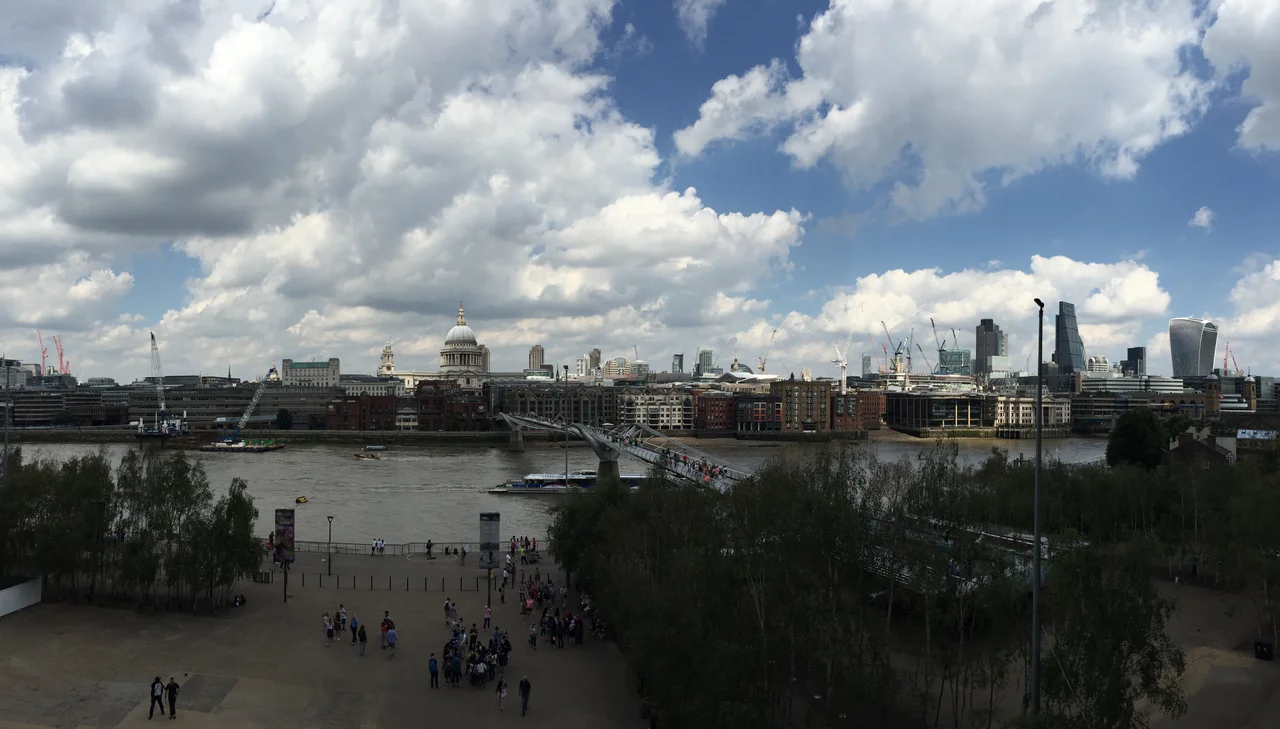

Tate Modern
On a winter afternoon in 2003, two million Londoners lay on the floor of a power station looking up at an artificial sun. Olafur Eliasson's The Weather Project filled the Turbine Hall at Tate Modern with mist and amber light and a vast semi-circle of monofrequency lamps overhead, doubled by a mirrored ceiling into a full disc. Visitors made shapes with their bodies on the concrete floor below, looking up at themselves reflected in the mirror as tiny silhouettes against the sun. The work ran for six months. More than two million people came. Nobody who experienced it has forgotten. That is the genius of Tate Modern - the building gives artists a 3,400-square-metre cathedral of concrete and steel to fill with their dreams, and the public arrives by the millions to lie down inside them.
From Power Station to Picasso
Bankside Power Station was designed by Sir Giles Gilbert Scott - the same architect who gave London its red telephone boxes and the brick fortress of Battersea Power Station across the river. Bankside was built in two stages between 1947 and 1963, a 200-metre brick fortress directly opposite St Paul's Cathedral, generating electricity for the City of London. By 1981 the oil-fired plant had become uneconomic and it shut down. For nearly two decades it stood empty and threatened, an industrial behemoth in the way of every redevelopment proposal for the south bank. The Tate Gallery had been outgrowing its Millbank home for years. In 1994 the trustees announced that the empty power station would become Tate Modern. Swiss architects Herzog and de Meuron won the conversion commission with a design that left the brick exterior almost intact and added a discreet two-storey glass extension along the ridge of the roof. The gallery opened in May 2000. It received 5.25 million visitors in its first year - more than the rest of Tate's London galleries combined had managed across the entire decade preceding.
The Turbine Hall
Walk through the western doors and the floor drops away. Herzog and de Meuron preserved the immense rectangular cavity where the power station's generators once spun - five storeys tall, 155 metres long, 3,400 square metres of empty volume. The original overhead travelling crane still runs the length of it. The Turbine Hall has become the most coveted commission in contemporary art. Since 2000 a single artist each winter has been invited to fill it with whatever they can dream up at that scale. Louise Bourgeois built giant steel spider sculptures. Anish Kapoor's Marsyas stretched a single membrane of red PVC 150 metres from wall to wall. Doris Salcedo cracked a fault line 167 metres long down the entire concrete floor; it is still there, visible if you look. Ai Weiwei poured 100 million hand-painted porcelain sunflower seeds across the floor for visitors to walk on. The Unilever Series, named for its corporate sponsor, ran from 2000 to 2012. Hyundai took over in 2013 with what was then the largest single sponsorship of any British gallery, a ten-year commitment worth around 5 million pounds.
The Brick Pyramid
By 2010 the gallery was attracting nearly twice the visitors Herzog and de Meuron had designed for, and the trustees commissioned the same architects to design an extension. Three enormous circular oil storage tanks beneath the south end of the building had been left unused. The first phase of the project converted them into the Tanks - the first museum spaces in the world dedicated to live performance and installation art - which opened in 2012. Above them rose a ten-storey pyramid of brick lattice work, twisting slightly as it climbed, finished in 2016 at a final cost of 260 million pounds. Originally designed as a stepped glass pyramid, the tower was redrawn with a sloped brick exterior to harmonise with Scott's power station. The extension was first called the Switch House, then in 2017 was renamed the Blavatnik Building after Sir Leonard Blavatnik, who had contributed a substantial portion of the cost. From the tenth floor a public viewing terrace offers one of the best free views in London - the river, St Paul's, the City spread out across the water. The terrace was so close to the windows of a luxury apartment block to the south that the residents sued for invasion of privacy. They lost the case but won, eventually, screens limiting the view.
The Collection
Tate Modern holds the United Kingdom's national collection of international modern and contemporary art - everything made from 1900 onwards. The Boiler House shows the broader sweep; the Blavatnik Building focuses on art from 1960 to today. The collection arranges itself thematically rather than chronologically. Recent rehangs have organised works around concepts like Materials and Objects, In the Studio, Citizens and States, and a permanent room dedicated to Mark Rothko's Seagram murals - a body of nine vast purple-and-maroon paintings the artist intended for a Manhattan restaurant before deciding the diners were unworthy of them. He gave them to the Tate instead, where they hang in a single dark room that some visitors find life-changing and others find unbearable. Picasso's Weeping Woman is here. Monet's Water-Lilies. Claude Cahun's photographs. Kazimir Malevich's Black Square. Paula Rego's Dog Woman series. The collection's growing emphasis on artists from outside the western canon - Latin American conceptualism, African modernism, Indian and Chinese painters of the late 20th century - has steered Tate Modern away from being merely the British answer to MoMA toward something more globally various.
The Crowds and the Cost
By 2022, Tate Modern was again drawing 3.9 million visitors a year, the fourth-most-visited art museum in the world. Entry to the permanent collection remains free, in line with the principle that has held for all British national museums since the 19th century. The temporary exhibitions charge. The most successful of those - a Matisse cut-outs show in 2014 - drew 562,000 visitors over nearly five months. Not all of the museum's stories are happy ones. In 2019 a six-year-old French boy was thrown from the tenth floor of the Blavatnik Building by a teenager with a record of violent behaviour; the child survived but with life-changing injuries. Two adults have died falling from balconies, in 2012 and 2024. The protest collective Liberate Tate spent years staging unauthorised performance interventions inside the museum to pressure the Tate group into ending its sponsorship deal with BP, which the gallery eventually wound down in 2017. Maman, the giant bronze spider by Louise Bourgeois that stood guard outside the building for years, returned in 2025 for the museum's 25th anniversary - a familiar steel-legged sentinel watching over the queue that still snakes back from the doors every morning the gallery opens.
From the Air
Tate Modern sits at approximately 51.5078 degrees north, 0.0994 degrees west, on the south bank of the Thames in Bankside, directly across the river from St Paul's Cathedral. From altitude the building is unmistakable - a long brown-brick rectangle 200 metres long with a single tall central chimney rising 99 metres, plus the brick-lattice Blavatnik Building twisting upward at the south end. The Millennium Bridge, a slender white pedestrian footbridge, crosses the Thames directly between Tate Modern and St Paul's. London City Airport (EGLC) is roughly five nautical miles east; London Heathrow (EGLL) about thirteen nautical miles west. Best viewing altitudes are 1,500-3,000 feet.
Nearby Stories
- Stevenage 5.7 km away
- Malling Abbey 5.7 km away
- 1952 Farnborough Airshow Crash 7.7 km away
- Ingatestone Hall 8.2 km away
- Hellfire Caves 9.1 km away
- The Carrington Event: The Solar Storm That Could Happen Again 9.8 km away
- Bletchley Park 16 km away
- Castle Hedingham 23 km away