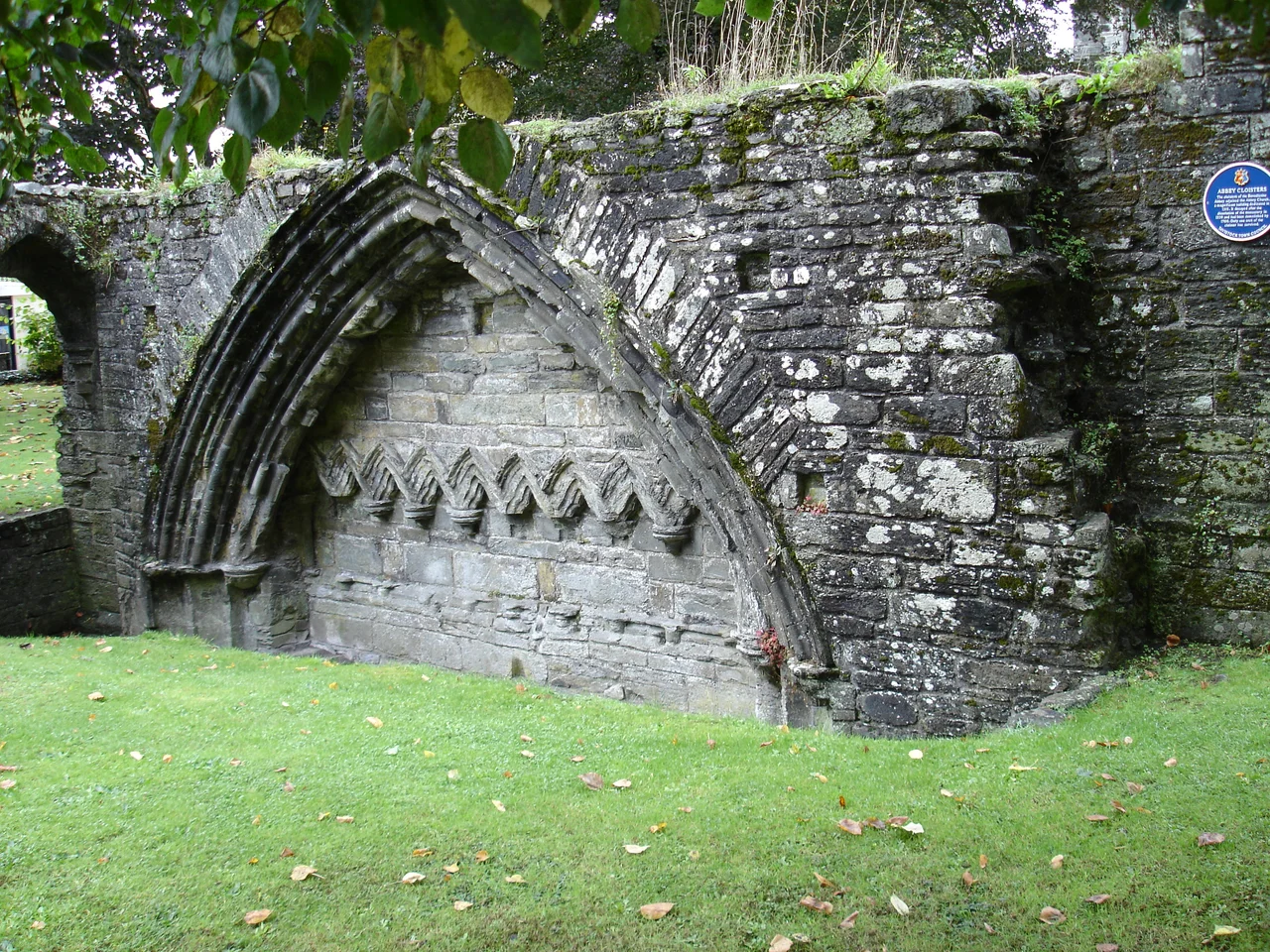

Tavistock Abbey
Two of the early abbots of Tavistock became Bishops of Worcester, and one of them - Ealdred - is said to have placed the crown on William the Conqueror's head at Westminster in 1066. By that date Tavistock Abbey was already roughly a century old, had been sacked once by Danish raiders, had been rebuilt and confirmed in its lands by Æthelred the Unready, and was on its way to becoming the second-richest abbey in all of Devon. Today almost nothing of it stands: a refectory, two gateways, a porch, fragments of a wall. Yet the town of Tavistock is built largely from the abbey's own quarry, and the family who acquired its lands at the Dissolution would shape English political life for the next four centuries.
The Founding and the Vikings
Tavistock Abbey was founded as a Benedictine house dedicated to Saint Mary and Saint Rumon, the latter probably an Irish missionary who came to the West Country in the early Middle Ages and whose feast at Tavistock is kept on 28 or 30 August. The traditional founding date is 961. In 981 King Æthelred the Unready - nephew of the abbey's founder Ordwulf - granted the charter of confirmation. Sixteen years later, in 997, Danish raiders sweeping along the southwest coast burned the abbey church to the ground. It was rebuilt. The combination of royal patronage, durable infrastructure, and a steady acquisition of lands in Devon, Dorset, and Cornwall made it one of the great Benedictine houses of western England. By the 11th century its abbots were taking up bishoprics elsewhere - Lyfing and Ealdred both to Worcester - and the abbey itself was a regional power.
Lands Across Three Counties
A 1193 papal bull of Pope Celestine III preserved the abbey's land holdings on paper, and the list reads like a gazetteer of the West Country. Milton Abbot in Lifton hundred, Hatherleigh, Burrington in North Tawton hundred, Romansleigh, Abbotsham, Worthygate in Parkham, Orleigh, Annery, Thornbury, Roborough near Tavistock, a house in the city of Exeter, Coffinswell and Daccombe in Haytor hundred, Plymstock, Raddon near Thorverton, Hound Tor at Manaton, Ottery in Lamerton - and that was only Devon. In Cornwall the abbey held Sheviock, Antony, Rame, Tregrenna, Penharget, and Tolcarne at the time of Domesday Book, with three Cornish churches dedicated to St Rumon at Ruan Lanihorne, Ruan Major, and Ruan Minor. The abbey's southeastern Cornish holdings explain a long anomaly of English geography: that corner of Cornwall was administratively part of Devon from the medieval period until 1844. The Isles of Scilly were granted to the abbey by Henry I, displacing a confederacy of hermits who had held them for centuries, and Tavistock established a priory on Tresco.
Greenish Stone
The abbey owned Hurdwick quarry just to the north of the town, and the stone the monks pulled out of it has an unusual character: a distinctly greenish cast, with a pitted surface that visitors sometimes mistake for weathering damage. The pitting is original to the stone. Most of the historic core of Tavistock is built from Hurdwick stone - the medieval bridges, the parish church, the abbey buildings themselves, the 19th-century buildings put up by the Dukes of Bedford - and the town has a quietly distinctive coloring as a result, neither the silver of Dartmoor granite nor the warm tan of Cotswold limestone but something between green and gray that changes character with the light. When you stand in the town and see the same colour pulled into buildings across eight or nine centuries, you are looking at the abbey's long architectural shadow.
Surrender, 1539
On 3 March 1539, John Peryn, the last abbot of Tavistock, signed the surrender deed. Twenty monks signed with him. The abbey's annual income at that point was assessed at £902 - second in Devon only to Plympton Abbey, and nearly twice the wealth of Buckfast Abbey. Peryn was granted a pension of £100 a year, more than most working men would earn in a decade. In 1540 Henry VIII handed the abbey and all its lands to John Russell, 1st Baron Russell of Chenies, who became 1st Earl of Bedford in 1550. The Russell family kept the connection. In 1694 they received the additional titles Marquess of Tavistock and Duke of Bedford. Throughout the 19th century they spent enormous sums turning the town into a model Bedford estate, putting up town halls, statues, schools, and public buildings at their own expense. In 1810 the 6th Duke commissioned the architect Sir Jeffry Wyatville to build Endsleigh Cottage at Milton Abbot - another former abbey manor - as a summer residence. It still stands as the Hotel Endsleigh.
What Remains
Of the medieval abbey itself, the visible remains are modest: the refectory, two gateways, a porch, and stretches of perimeter wall, scattered through the centre of modern Tavistock. The Tavistock Heritage Trust manages the site, which is open daily from 10am and free to enter. A 2023 grant of £6,932 from Historic England has funded ongoing restoration work. The buried context is far larger. The Russells preserved the medieval street pattern of the town, so the abbey's footprint is still readable in the way modern Tavistock falls together. Among those known to be buried at the abbey are Lyfing of Winchester, Ordgar Ealdorman of Devon, Eadwig Ætheling (a half-brother of King Edward the Confessor's predecessor), and Ordwulf, the founder's nephew - early medieval English nobility whose names few visitors now recognize. Morwellham Quay on the Tamar, the river port that grew into the richest copper port of Victoria's empire, was set up by the monks of Tavistock to handle their freight, a piece of medieval ecclesiastical infrastructure that outlasted the institution that built it by more than four centuries.
From the Air
Tavistock Abbey is centred at 50.549N, 4.145W in the heart of Tavistock town, on the west bank of the River Tavy about 6nm west of the Dartmoor National Park boundary. Recommended viewing altitude 1,500-3,000 feet AGL. The historic core of Tavistock - including the abbey ruins, the parish church, and the Bedford Square buildings - reads clearly as a tight cluster of greenish Hurdwick-stone buildings along the Tavy. The river itself and the higher Dartmoor tors to the east are useful navigation references. Nearest airport Plymouth (EGHO) about 12nm south-southwest; Exeter (EGTE) about 25nm east-northeast. Dartmoor live-fire training areas to the east - check NOTAMs.
Nearby Stories
- Bodmin Moor 4.1 km away
- South Devon Railway sea wall 4.8 km away
- Tiverton Castle 12 km away
- Hope Cove Lifeboat Station 14 km away
- Caerhays Castle 20 km away
- Holsworthy 22 km away
- HMS Formidable (1898) 32 km away
- HMS Montagu 41 km away