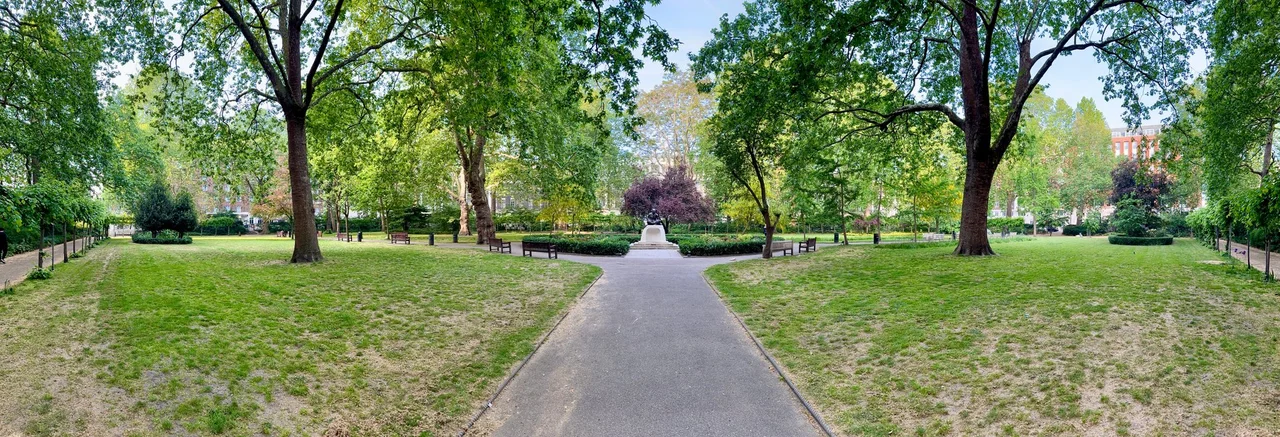

Tavistock Square
A cherry tree stands in Tavistock Square's garden. It was planted in 1967 in memory of the victims of the atomic bombings of Hiroshima and Nagasaki. Each spring it blossoms. Each August, at ceremonies marking the anniversary of those bombings, people gather beneath it. The square has accumulated meaning this way—layer by layer, memorial by memorial—until it has become something rarer than a pleasant Bloomsbury garden. It has become a place where grief is tended.
Built on a Duke's Estate
Tavistock Square was laid out shortly after 1806 by the property developer James Burton and builder Thomas Cubitt, working for Francis Russell, 5th Duke of Bedford. It formed part of the Bedford Estate, the great landholding that shaped much of Bloomsbury's grid. The name comes from the Marquess of Tavistock, the courtesy title given to the eldest sons of the Dukes of Bedford. The east side of the square was once the site of Tavistock House, home first to James Burton while he developed the area, and then—from the 1850s—to Charles Dickens, who wrote Bleak House, Hard Times, Little Dorrit, and A Tale of Two Cities while living there. A blue plaque on BMA House commemorates him. Tavistock House was demolished in 1901. In its place stands the British Medical Association's headquarters, designed by Edwin Lutyens in 1911.
The Square as Peace Garden
Three monuments have given the square its unofficial character as a peace garden. Gandhi stands at the centre, sculpted by Fredda Brilliant and installed in 1968. The hollow pedestal is deliberately open at the base so that visitors can leave floral tributes to the man who led nonviolent resistance first in South Africa and then against British rule in India. In 1994, the Conscientious Objectors Commemorative Stone was unveiled, honouring 'men and women conscientious objectors all over the world and in every age,' in the words carved into it by sculptor Hugh Court. Annual ceremonies are held at each of these three memorials—Gandhi's statue, the Hiroshima cherry tree, and the Conscientious Objectors stone. The square also contains a memorial to Dame Louisa Aldrich-Blake (1865–1925), a pioneering surgeon and one of the first women to gain a British medical degree.
7 July 2005
On the morning of 7 July 2005, four suicide bombers attacked London's transport network simultaneously. Three detonated devices on Underground trains. The fourth, 18-year-old Hasib Hussain, was on a bus—route 30, diverted from its normal Euston Road route because of the disruption caused by the other three explosions. The bus reached Tavistock Square. The device exploded outside the British Medical Association building at 9:47 that morning. Thirteen passengers died, along with Hussain. Many more were injured. BMA staff came out immediately to help the injured. In September 2018, a memorial honouring the victims and those who gave assistance was unveiled in the square's gardens, replacing a temporary plaque that had been fixed to the BMA railings. The square holds both the tragedy and its commemoration now, as it holds everything else: quietly, in the open air.
Bloomsbury's Institutional Heart
Beyond its memorials, Tavistock Square is surrounded by the institutions that give Bloomsbury its character. The BMA has its headquarters here. Woburn House on the north side contains the headquarters of Universities UK. Connaught Hall, a University of London residence, stands on the west side. Passfield Hall, a residence for London School of Economics undergraduates, is close by. The Tavistock Clinic—founded in the square in 1920 as a pioneering psychiatric clinic whose early patients included shell-shock survivors of the First World War—has since moved to Swiss Cottage, but its successor institution continues its work. The Tavistock Institute of Human Relations, which separated from the Clinic in 1946, still operates. The square's gardens are public, its trees are old, and its weight of history is carried lightly.
From the Air
Tavistock Square lies at 51.525°N, 0.129°W in the London Borough of Camden, Bloomsbury, near Euston Station. From altitude it is identifiable as one of several garden squares in the Bloomsbury grid, north of the British Museum. The square sits roughly between Euston Road to the north and Russell Square to the south. Nearest airport is Heathrow (EGLL, about 14 miles west). The nearest tube stations are Euston, Russell Square, and King's Cross. The area sits at approximately 20 metres elevation. Look for the rectangular green of the square's garden among the dense urban blocks of Bloomsbury.
Nearby Stories
- Stevenage 5.7 km away
- Malling Abbey 5.7 km away
- 1952 Farnborough Airshow Crash 7.7 km away
- Ingatestone Hall 8.2 km away
- Hellfire Caves 9.1 km away
- The Carrington Event: The Solar Storm That Could Happen Again 9.8 km away
- Bletchley Park 16 km away
- Castle Hedingham 23 km away