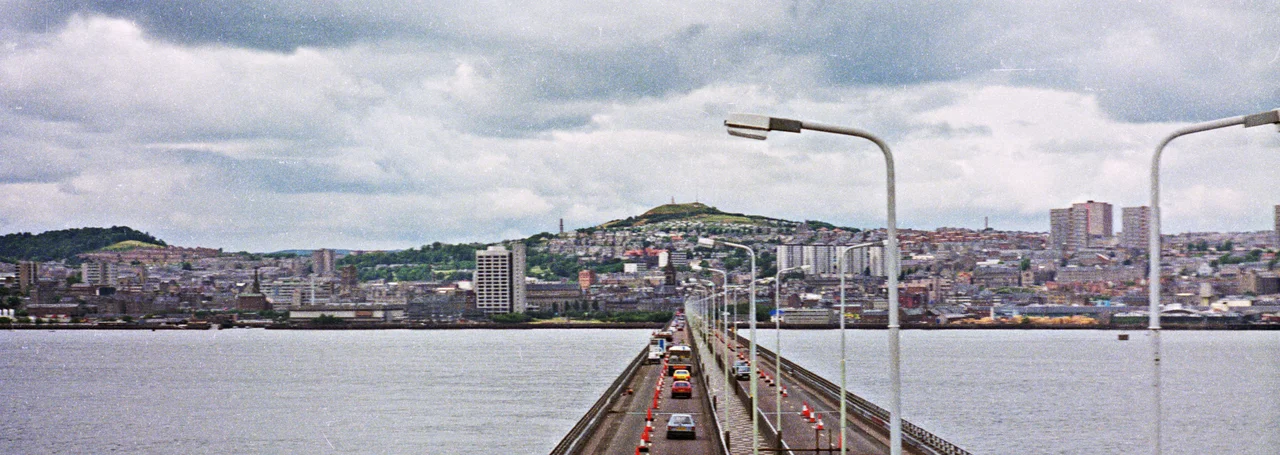

Tay Road Bridge
Its name is Steve. In September 2017, after a radio campaign and an online poll, the Tay Road Bridge — 42 spans of concrete and steel stretching 2,250 metres across the Firth of Tay — was officially given a nickname by Dundee councillor Stewart Hunter and Chris Duke of Wave 102. Beating out solemn suggestions in favour of something gloriously ordinary felt right for a bridge that runs slightly downhill all the way into Dundee. An earlier slogan competition in 2002 had to be abandoned after "It's all downhill to Dundee" — geographically accurate, the bridge drops from 38.1 metres at the Fife end to 9.75 metres at Dundee — won by a landslide and was deemed unsuitable. Steve, at least, gave offence to no one.
The Ferry It Replaced
Before Steve, there was the Fifie. Three vessels worked the Craigie Pier to Newport-on-Tay crossing: the paddle steamer B. L. Nairn, built in 1929 and held in reserve, and the diesel-powered Abercraig and Scotscraig, both fitted with Voith Schneider propellers and built at the Caledon Shipyard in Dundee. For decades these boats ferried passengers and vehicles across the Tay, a slow, salt-spray crossing that defined the relationship between Fife and Dundee. The bridge ended all that on opening day in 1966. The paddle steamer was scrapped; the two diesels ended their working lives in Malta. The railway line from Tayport to Dundee, which had once terminated where the new approach road now ran, hung on briefly before closing for good in 1969. A causeway had replaced a culture.
Building Against the Government
Westminster opposed the project. Local lobbying, led by Dundee businessman Sir Douglas Hardie, ground down the resistance until a deal was struck. Construction began in March 1963 under William Fairhurst of WA Fairhurst and Partners, with Duncan Logan Construction handling the civil work and Dorman Long providing the steel. The build consumed 140,000 tons of concrete, 4,600 tons of mild steel, and 8,150 tons of structural steel, all assembled across 42 spans with the navigation channel set closer to the Fife side. To make room for the Dundee approach, three docks — West Graving, King William, and Earl Grey — were filled in, and the city's Victorian Royal Arch, the ceremonial gateway through which Queen Victoria had entered Dundee in 1844, was demolished. The arch's rubble became the foundation of the on-ramp. The final 65-ton girder dropped into place on 4 July 1966, three and a half years and roughly six million pounds after the first cofferdam was sunk.
Memorials in the Shape of Piers
Two obelisks stand at either end, and their height is no accident. The fifty-foot column at the Newport side matches the bridge piers there; the smaller one at Dundee mirrors the lower piers above the city dock. They commemorate Willie Logan, the managing director of the construction firm, who was killed in a plane crash near Inverness before the bridge was finished, and the five workers who died during the build. The Queen Mother officially opened the bridge on 18 August 1966, and for four days afterwards the public crossed for free. The original tolls were measured in shillings and half-crowns; by 2008, when the Scottish Parliament abolished bridge tolls altogether, cars paid 80 pence. The crossing now employs 20 staff in a small administration block at the Dundee end, watching the winds. At 45 mph, double-decker buses are turned back. At 60, lorries and cyclists. At 80, the bridge closes to everything.
From the Air
Tay Road Bridge: 56.453°N, 2.947°W, just downstream of the Tay Rail Bridge between Newport-on-Tay (Fife) and Dundee. At 2.25 km long with 42 visible spans and a slight downward grade to the north, it makes an unmistakable linear feature against the Firth of Tay. Best viewed from 2,000–5,000 ft AGL in clear conditions. Nearest airport is Dundee (EGPN), 2 nm west; Edinburgh (EGPH) lies 30 nm south. North Sea coastal weather can change quickly; check winds, as the bridge itself closes above 80 mph gusts.
Nearby Stories
- Battle of Dunkeld 7.2 km away
- Balgonie Castle 9.8 km away
- Bell Rock Lighthouse 10 km away
- Inverbervie 13 km away
- Battle of Dollar 14 km away
- Battle of Mons Graupius 16 km away
- HMS Pathfinder (1904) 23 km away