.jpg)
Teatro Colón
Luciano Pavarotti once said the Teatro Colón had one flaw: the acoustics were so perfect that every mistake could be heard. He meant it as the highest compliment a singer can pay a room. When acoustician Leo Beranek surveyed leading opera and orchestra directors for his definitive study of the world's halls, the Colón came out with the best acoustics for opera anywhere, and the second best for concerts. Inside its horseshoe of scarlet and gold, a voice does not simply carry. It blooms.
A Building That Refused to Be Built
The present Colón replaced an earlier theater of the same name that had opened in 1857 with Verdi's La traviata, just four years after the opera's Italian premiere. By the late 1880s the city had outgrown it, and a grander house was begun on Libertad Street, overlooking Plaza Lavalle. What followed was nearly two decades of misfortune. The cornerstone was laid in 1889 by the Italian architect Francesco Tamburini, who died in 1891. His pupil Vittorio Meano carried the design forward in lavish Italian style - until Meano was murdered in 1904. Angelo Ferrari, the Italian businessman financing the work, died as well, and Argentina's financial crisis of 1890 stretched the delays even longer. The Belgian architect Julio Dormal finally completed the theater, adding French touches to the decoration. Twenty years after the first stone, the house was ready.
Aida on the Day of the Nation
On 25 May 1908 - the Día de la Patria, Argentina's national day - the Teatro Colón opened at last with Verdi's Aida, sung by an Italian company under conductor Luigi Mancinelli. Seventeen operas filled that first season, with stars like the baritone Titta Ruffo and the bass Feodor Chaliapin. Almost immediately the Colón took its place beside La Scala and the Metropolitan Opera among the world's great stages, drawing the finest singers and conductors alive. The roll of artists who have since performed here reads like a century of music history: Toscanini, Caruso, Stravinsky, Richard Strauss, Maria Callas, Herbert von Karajan, Nijinsky and Pavlova, Nureyev and Margot Fonteyn, Plácido Domingo and the three tenors, and Argentina's own Alberto Ginastera, Daniel Barenboim, Martha Argerich, and the tango master Astor Piazzolla.
Inside the Horseshoe
The auditorium seats 2,487 - slightly more than London's Royal Opera House - with standing room for another thousand. A central chandelier blazes with some seven hundred light bulbs, and behind it the cupola was painted in 1966 by the Argentine artist Raúl Soldi. Soldi worked not on the dome itself but on strips of canvas, more than three hundred square meters in all, filling them with dancers, singers, and musicians before they were set overhead. The stage runs deep and tall, the building drops three floors below ground and rises six above, and the whole structure is wrapped in applied masonry. One detail from the older auditorium reveals an earlier age: it kept boxes with metal grilles and a private entrance, so that mourners in black could attend a performance without being seen in public.
Closed for a Century's Repair
Time and Argentina's turbulent economy wore the building down. A restoration that began in 2005 grew far beyond its plans. What had been budgeted as an eighteen-month, twenty-five-million-dollar project with five hundred workers swelled into a three-year, hundred-million-dollar effort employing some fifteen hundred people, including a hundred and thirty architects and engineers. The theater's last performance before the work was a 2005 concert by the beloved folk singer Mercedes Sosa with the Argentine National Symphony Orchestra. The Colón reopened on 24 May 2010 - the eve of its own 102nd birthday and of Argentina's Bicentennial - with Tchaikovsky's Swan Lake and an act of Puccini's La bohème. A private concert had already confirmed what the city most wanted to know: the acoustics were intact. The voice still bloomed.
From the Air
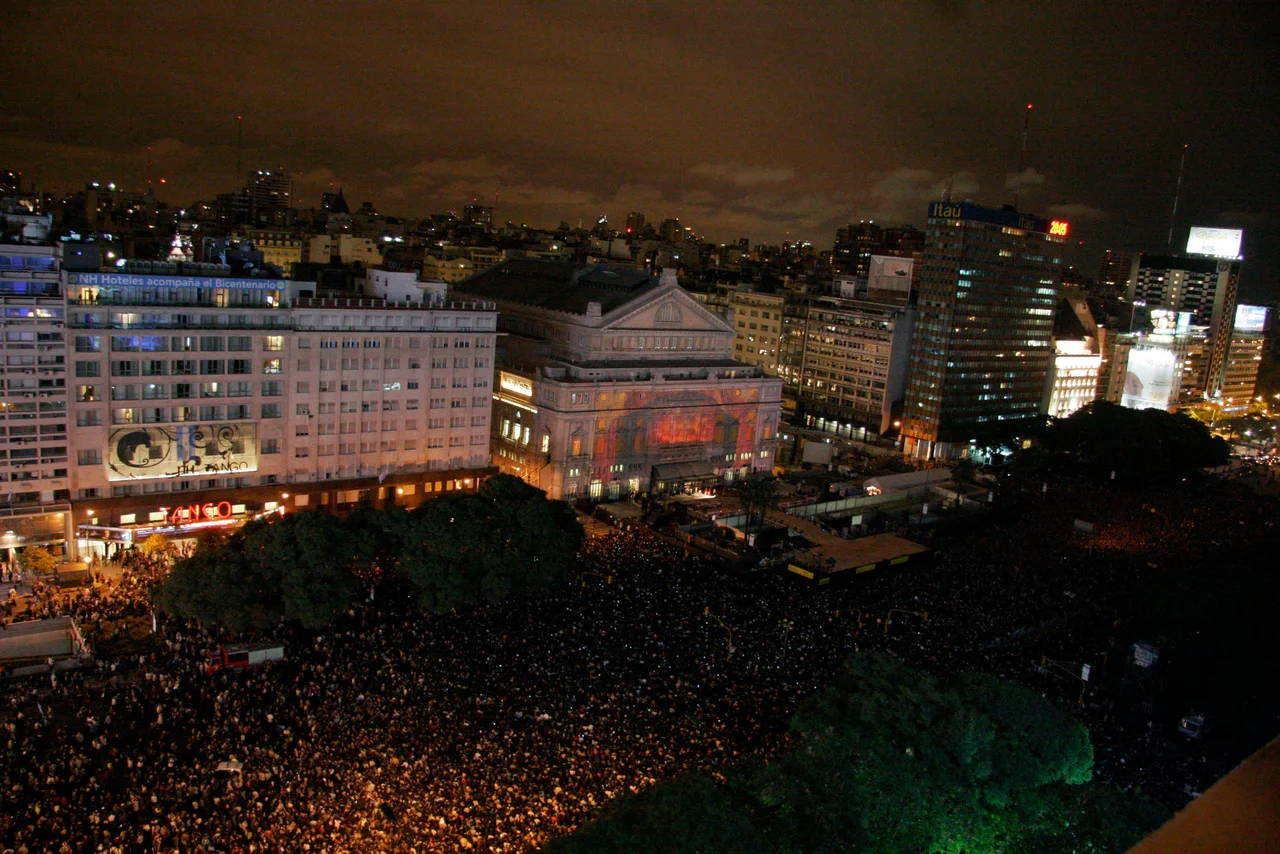
The Teatro Colón stands at 34.60°S, 58.38°W, in the heart of central Buenos Aires, bounded by the immensely wide 9 de Julio Avenue and facing Plaza Lavalle. From the air the giant ribbon of 9 de Julio - one of the broadest avenues in the world - is the surest landmark; the theater's pale, ornate block sits along its western edge near the Obelisco. The nearest field is Aeroparque Jorge Newbery (ICAO SABE) on the Río de la Plata about 5 km northeast; Ministro Pistarini (ICAO SAEZ, Ezeiza) lies roughly 25 km southwest. Best appreciated at low altitude in clear conditions, with the avenue and the river giving the eye its bearings.
Nearby Stories
- Ezeiza Massacre 1.9 km away
- Luján, Buenos Aires 5.1 km away
- Curutchet House 13 km away
- Colonia del Sacramento 17 km away
- Martín García Island 28 km away
- Atucha Nuclear Power Plant 37 km away
- Lobos 43 km away
- Cry of Asencio 87 km away