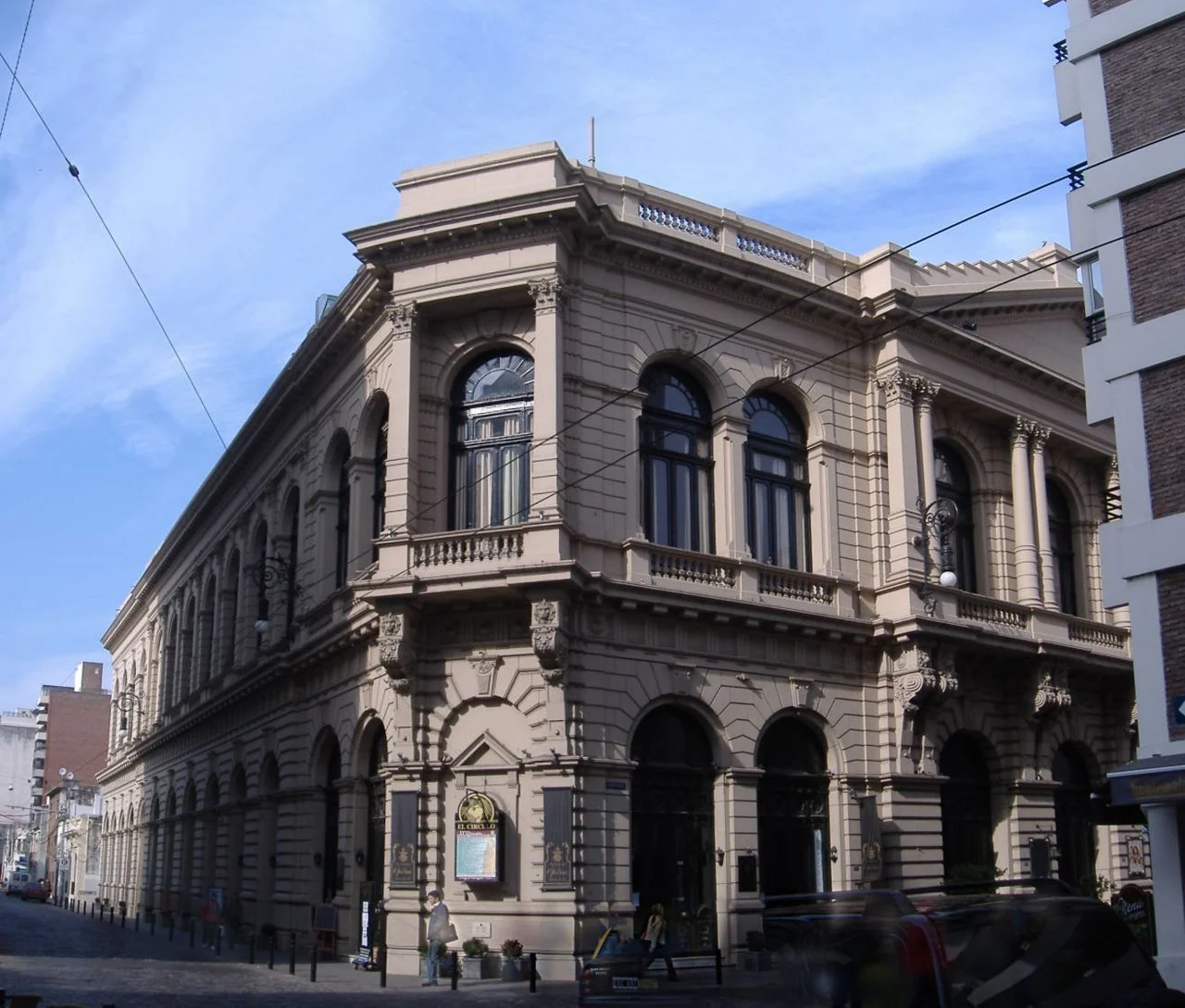

Teatro El Círculo
In 1915 the most famous voice in the world walked onto a stage in Rosario, sang, and then paid the room a compliment that the city has never let go of. Enrico Caruso, the Italian tenor who defined the early age of opera recordings, performed here that July in Pagliacci and Manon Lescaut. Afterward he said the acoustics had nothing to envy from the great halls he had sung in across the world - that this theater, in a river port in Argentina, stood comparison with the Metropolitan Opera in New York. It was an extraordinary thing to say about a building that, only a decade earlier, had nearly failed before it opened.
Built on the Edge of Ruin
The theater began as one man's ambition. In 1889 Emilio O. Schiffner bought a company that planned a lyric theater and set out to build Teatro La Ópera. He hired the German engineer George Goldammer, an acoustician who reworked the original design - the decision that would later draw Caruso's praise. Then the money nearly ran out. The Panic of 1890, a financial crash that rippled out of London and hit Argentina hard, stalled everything, and the old company's debts pressed in. Construction did not truly begin until 1903. What rose out of that long delay was not a compromise but a jewel.
Italian Hands, Greek Gods
Rosario at the turn of the century was a city of immigrants, and many of them were Italian. It shows in the theater's bones. A team of Italian artists led by Luggi Levoni decorated the interiors and exteriors, and Giuseppe Carmignani painted the great stage curtain with scenes from Greek mythology, echoing the curtain of the Teatro Regio di Parma in Italy. The result feels less like a provincial playhouse than a slice of Europe transplanted to the Paraná, which is exactly what its makers intended. On June 4, 1904, the house opened with Verdi's Otello - a fittingly operatic christening for a hall that would spend the next century welcoming singers, ballet companies, and orchestras from around the world. Five tiers of seating rise toward a painted ceiling, holding an audience of 1,450, and the proportions are intimate enough that the human voice carries without strain - the very quality that would stop Caruso in his tracks.
The Library Circle
The theater owes its present name to a reading group. A cultural association called El Círculo de la Biblioteca - the Library Circle - had been meeting at the Biblioteca Argentina and needed a home of their own. In 1943 they bought the building, preserved it, and renamed it Teatro El Círculo. Theirs was an act of stewardship as much as ownership; rather than let a grand opera house drift into disrepair, a society of readers took it on. Today it functions mostly as a cultural center, still hosting performances beneath Carmignani's gods and goddesses.
A Corner Frozen in Time
For the theater's hundredth anniversary in 2004, Rosario restored it completely, and made it the stage for the Third International Congress of the Spanish Language - a gathering of writers and scholars from across the Spanish-speaking world, held beneath the same ceiling Caruso had sung under. The city also did something quietly theatrical to the streets outside. At the corner of Laprida and Mendoza, the sidewalks and roadways were remade to look as they might have in 1904 - asphalt torn up and replaced with cobblestones, old-fashioned lampposts installed - turning the approach into a small plaza out of another era. You arrive, in other words, by stepping backward in time before you ever reach the door. For a building that almost did not survive a financial panic, that nearly went unbuilt, it is a remarkable second act: more than a century on, El Círculo is still Rosario's grandest room.
From the Air
Teatro El Círculo stands near the historic center of Rosario at 32.95 degrees south, 60.63 degrees west, a few blocks inland from the Paraná River in Santa Fe Province. It is a dense-downtown landmark rather than a feature visible from cruising altitude - look for it within Rosario's tight street grid at the corner of Laprida and Mendoza. The nearest airport is Rosario - Islas Malvinas International Airport (ICAO: SAAR, IATA: ROS), about 13 km west-northwest. Best appreciated from the ground; from the air, orient on the riverfront and the city center just south of the National Flag Memorial.
Nearby Stories
- Battle of Cepeda (1859) 19 km away
- Battle of the Tonelero Pass 24 km away
- Abadía del Niño Dios 45 km away
- Ramallo Massacre 60 km away
- Sa Pereira Rail Disaster 126 km away
- San José Palace 152 km away
- Battle of Quebracho Herrado 185 km away
- The Pampas 212 km away