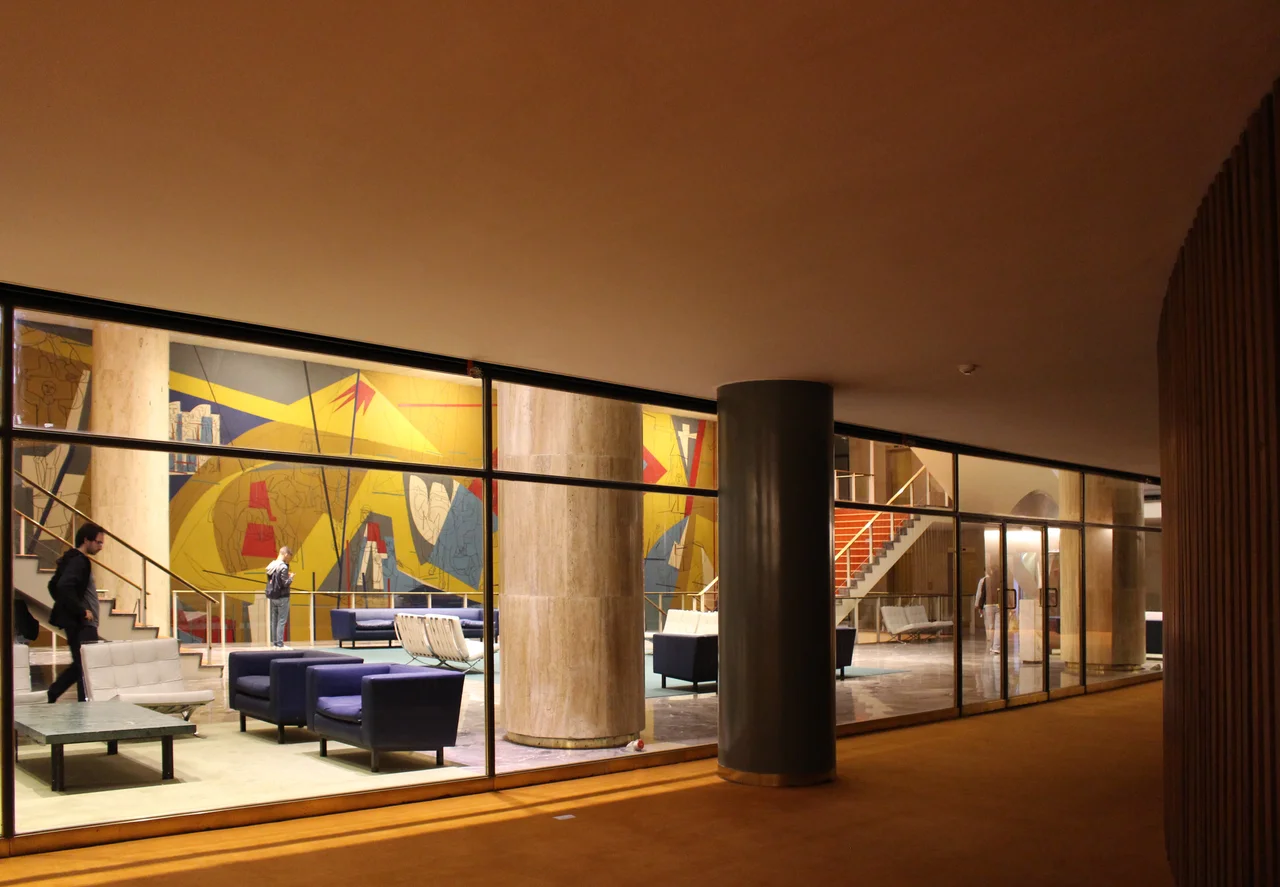

Teatro General San Martín
In 1971, the move that would change chess history was made not in Reykjavik but on Corrientes Avenue in Buenos Aires. Inside the Teatro General San Martín, an American challenger named Bobby Fischer faced the former world champion Tigran Petrosian in the final Candidates Match. Fischer won. The road to his legendary 1972 defeat of Boris Spassky ran straight through this theater - a clean modernist tower on the street Argentines call the Broadway of Buenos Aires.
A People's Theater, Long Delayed
The idea was born in 1908, when the Socialist congressman Alfredo Palacios introduced a bill to build a people's theater for the city. The city council agreed, the mayor signed on, and then the project stalled for decades. Real movement came in 1936, when the city expropriated a theater at 1530 Corrientes Avenue to house the Teatro del Pueblo under the director Leonidas Barletta. A nationalist coup in 1943 stripped away the company's concession, and a municipal theater rose in its place in 1944. In 1950, on the centennial of the death of General José de San Martín - the liberator who freed much of South America from Spanish rule - President Juan Perón renamed the institution in the hero's honor.
Thirteen Floors of Modernism
Perón commissioned the architects Mario Roberto Álvarez and Macedonio Ruiz to design a new home, and construction began in 1954. The building they raised was inaugurated on 25 May 1960 and opened the following year - and it was unlike the gilded opera houses elsewhere in the city. Spare, rational, and modern, it packs some thirty thousand square meters into thirteen floors above ground and four basements below, holding three performance stages, exhibition halls, and a cinema. It soon became one of the most influential cultural centers in Latin America. Both the theater and its adjacent cultural center were thoroughly renovated between 2010 and 2011, keeping the mid-century design sharp for a new century of audiences.
Three Rooms, Three Visions
Each of the theater's main halls carries the name of a figure from Argentine drama. The largest, the Martín Coronado, seats 1,049 across two tiers of stalls; its Italian-style stage can rise and fall in sections through nine separate lifts, and its ceiling holds a colored-cement relief, the Allegory to the Theater, completed by the sculptor José Fioravanti in 1962. The Casacuberta Salon, named for the first classically trained actor in Argentine history, seats 566 and is graced by Luis Seoane's mural The Birth of the Argentine Theater. The smallest, the Cunill Cabanellas chamber, opened in 1979 for experimental work and can rearrange its own seating around the action. Murals, terracotta reliefs, and steel sculpture turn the building's circulation spaces into a gallery in their own right.
Machinery and Memory
The San Martín was built to do things older houses could not. The Casacuberta's semicircular orchestra divides into three radial sectors, and its platform can slide forward for an extended stage or lift the orchestra pit up to meet the actors. The Cunill Cabanellas chamber carries its own buried history: it began life in 1957 as the Teatro San Telmo, was nearly destroyed by fire in 1970, and was absorbed into the San Martín in 1999, so that a wounded older theater found new purpose inside a younger one. The walls remember the artists who made them, too - the allegorical sculptures to drama and comedy by Pablo Curatella Manes, finished in the late 1950s, and the ceramic mural by Luis Diego Pedreira honoring the Podestá brothers, pioneers of the Argentine stage. The building does not merely house performance. It is built, layer by layer, out of the country's theatrical past.
Where the City Comes to Watch
A public theater earns its meaning from the moments it gathers people around. The San Martín has hosted more than premieres and rehearsals. The 1971 Fischer-Petrosian match drew the world's attention to its stage; in November 1980 the Latin American song contest known as the OTI Festival was held in the Martín Coronado Salon. Set on Corrientes Avenue amid the neon marquees and late-night bookshops that make the street legendary, the theater belongs to the rhythm of porteño nightlife - a place where drama, film, dance, and exhibition share a single address, and where the line of theatergoers under the lights is itself part of the city's evening performance.
From the Air
The Teatro General San Martín stands at 34.60°S, 58.39°W, on Corrientes Avenue in central Buenos Aires, a short walk from the Obelisco and the broad expanse of 9 de Julio Avenue. From the air, look for the grid of the city center and the bright artery of Corrientes running northwest from the Obelisco; the theater's modernist block sits along it. The nearest field is Aeroparque Jorge Newbery (ICAO SABE) on the Río de la Plata roughly 5 km northeast, with Ministro Pistarini (ICAO SAEZ, Ezeiza) about 25 km southwest. Best viewed at low altitude in clear weather, using the Obelisco and 9 de Julio as anchors.
Nearby Stories
- Ezeiza Massacre 1.9 km away
- Luján, Buenos Aires 5.1 km away
- Curutchet House 13 km away
- Colonia del Sacramento 17 km away
- Martín García Island 28 km away
- Atucha Nuclear Power Plant 37 km away
- Lobos 43 km away
- Cry of Asencio 87 km away