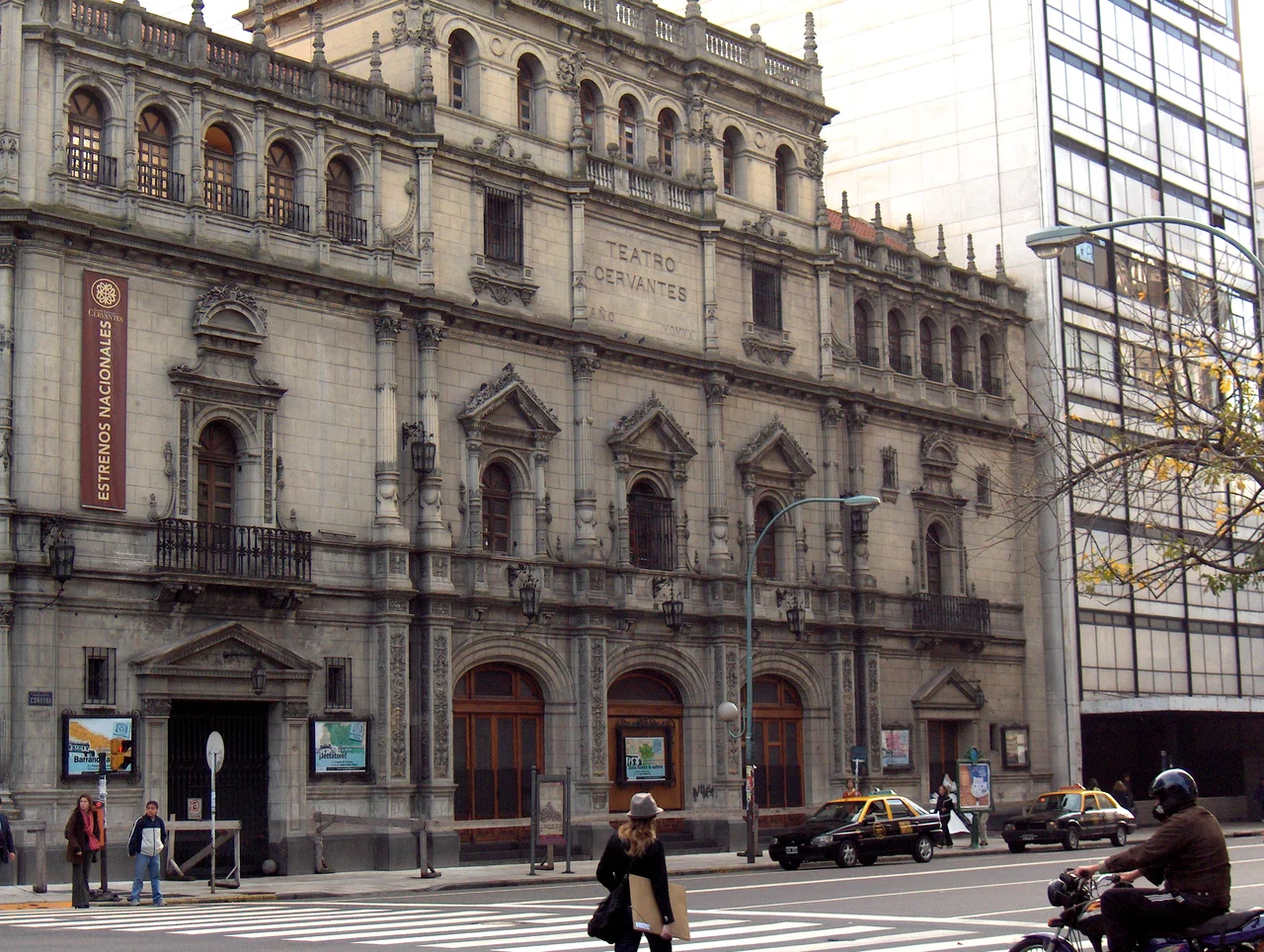

Teatro Nacional Cervantes
A king of Spain helped furnish it. A celebrated actress paid for it with her own fortune. And within five years of opening, she had to sell it at auction. The Teatro Nacional Cervantes, Argentina's national stage, began as one woman's extravagant gamble - a Spanish baroque jewel box raised on Córdoba Avenue, two blocks from the Teatro Colón, named for the author of Don Quixote.
María Guerrero's Wager
The Spanish theater producer and actress María Guerrero arrived in Argentina in 1897 with her company, and her adaptations of the Spanish classics made her a sensation. A commercial success at the Teatro Odeón, she toured the country's theaters and decided Buenos Aires deserved a grand house of her own making. In 1918, she and her husband, Fernando Díaz de Mendoza, set aside part of their fortune to build it. The ambition caught the eye of high society and of King Alfonso XIII of Spain himself, who contributed to the project by commissioning artisanal fixtures, materials, and stagecraft. Built in Spanish baroque style, the theater was named for Miguel de Cervantes, Spain's legendary novelist and dramatist.
Opening Night, and the Reckoning
On 5 September 1921 the Cervantes opened with a production of Lope de Vega's La dama boba, The Foolish Lady. But Buenos Aires already had a great many theaters, and a new rival was rising fast: radio. As broadcasting spread across Argentina, the Cervantes saw its audience drain away, and by 1926 Guerrero and her husband were forced to auction the institution they had built only five years earlier. The story might have ended there. Instead, the assistant director of the National Music Conservatory, Enrique García Velloso, lamented the loss and persuaded President Marcelo Torcuato de Alvear to step in. Alvear's wife, Regina Pacini, was a former opera singer and a devoted patron of the arts - and the ailing Cervantes was reborn as the National Stage Theater. The National Comedy Theater made it home in 1933.
A Piece of Spain on Córdoba Avenue
Few buildings in Buenos Aires announce their heritage so openly. The Cervantes was raised in Spanish baroque style, and King Alfonso XIII's contributions meant that fixtures, materials, and elements of stagecraft were commissioned and shipped from Spain expressly for it. The result is a theater that feels transplanted - an homage to the country María Guerrero had left, set down two blocks from Argentina's grandest opera house, the Teatro Colón. Its very name is a tribute to Miguel de Cervantes, and its opening production reached even further back into the Spanish canon, to the Golden Age playwright Lope de Vega. To walk into the Cervantes is to step into a deliberate act of cultural memory: a Spanish actress, in a new country, building a monument to the literature that had made her career.
Fire and Renewal
In 1961 a massive fire nearly destroyed the Cervantes. Out of the disaster came a thorough modernization, including a seventeen-story annex, while the main hall was rebuilt to its original specifications, and the renovated theater reopened in 1968. The building still wears María Guerrero's ambitions in its details. Her name graces the principal hall, the María Guerrero Salon, whose stage spans 456 square meters and turns on a twelve-meter rotating platform that can be extended further still. The room seats 860, more than five hundred of them in the galleries. A smaller hall, the Orestes Caviglia Salon, holds 150 for chamber concerts, and the multipurpose Luisa Vehíl Salon glitters with extensive gold-leaf decoration - a flourish worthy of the woman who dreamed the place into being.
The Nation's Stage
What began as a private folly became a public institution. The advocacy of Lito Cruz - actor, director, and one of the best-known figures in Argentine film and theater - helped push a National Theater Law through Congress in 1997, securing yearly subsidies for the dramatic arts and confirming the Cervantes as an official national entity. Today it stands as the national stage and comedy theater of Argentina, a designated National Historic Monument. Stand on Córdoba Avenue and look up at its ornate Spanish facade, and it is hard to imagine that this confident landmark was once a failing house sold off in defeat. María Guerrero lost her theater. The nation kept it.
From the Air
The Teatro Nacional Cervantes stands at 34.60°S, 58.38°W, on Córdoba Avenue in central Buenos Aires, just two blocks north of the Teatro Colón and near the wide 9 de Julio Avenue. From the air, find the giant ribbon of 9 de Julio and the Obelisco; the Cervantes sits a short distance off, its ornate facade distinct among the surrounding blocks. The nearest field is Aeroparque Jorge Newbery (ICAO SABE) on the Río de la Plata roughly 5 km northeast, with Ministro Pistarini (ICAO SAEZ, Ezeiza) about 25 km southwest. Best viewed at low altitude in clear conditions, using the Colón and 9 de Julio as nearby reference points.
Nearby Stories
- Ezeiza Massacre 1.9 km away
- Luján, Buenos Aires 5.1 km away
- Curutchet House 13 km away
- Colonia del Sacramento 17 km away
- Martín García Island 28 km away
- Atucha Nuclear Power Plant 37 km away
- Lobos 43 km away
- Cry of Asencio 87 km away