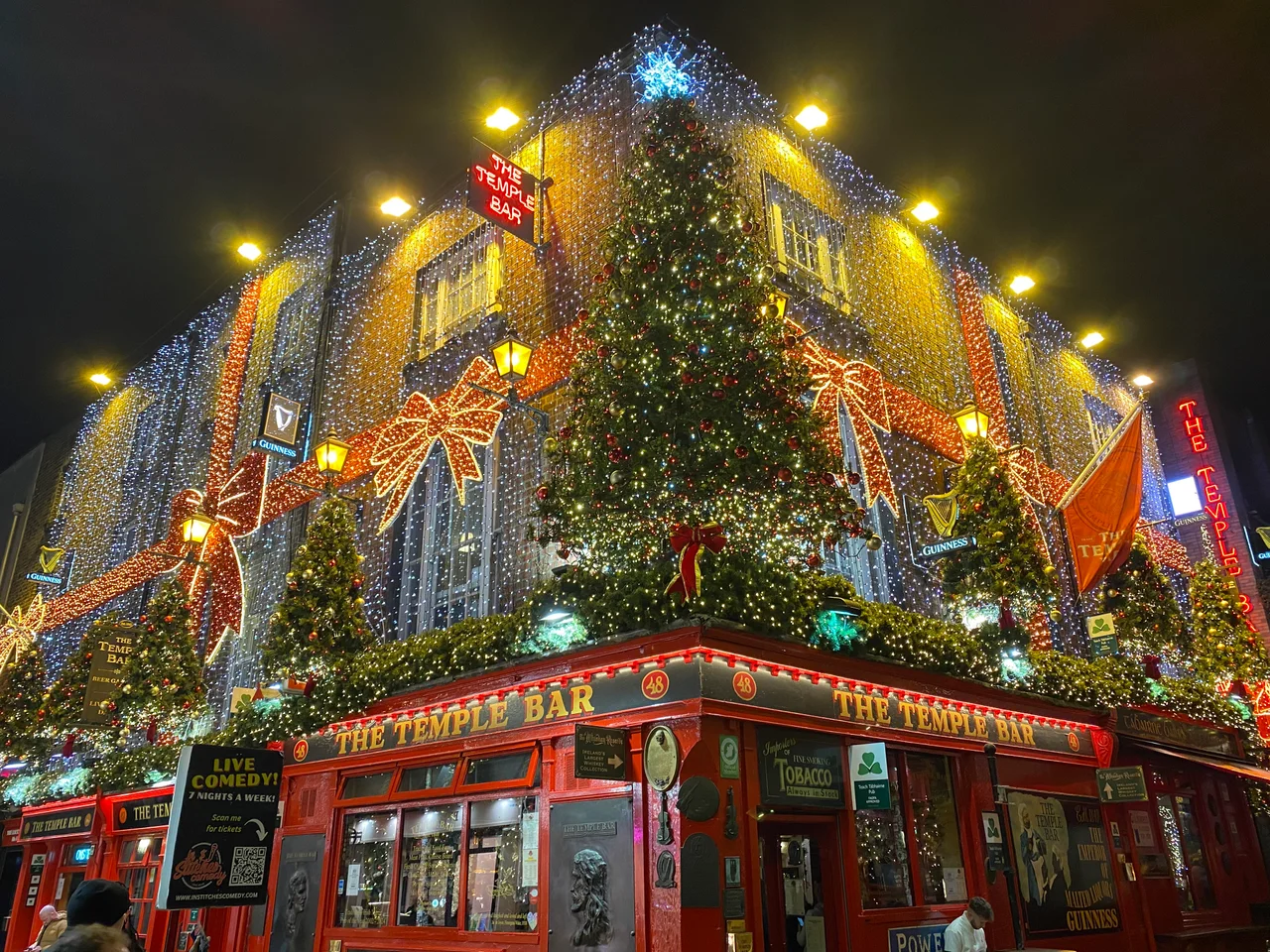

Temple Bar, Dublin
Most of what saved Temple Bar was a bus station that never got built. In the 1970s the state transport company CIÉ began quietly buying up properties across the cobbled streets between Dame Street and the Liffey, with plans to demolish everything and erect a vast bus terminus over an underground 1,500-space car park. While they waited for the planning to go through, they leased the half-empty buildings to anyone who would pay rent. Artists moved in. Galleries opened. Cafes appeared. By the time the bus station plans were finally killed in the late 1980s after years of protest, the squatter-tenants had accidentally created exactly the kind of bohemian district that Dublin had no idea it wanted - and the city decided to keep it.
The Templar Bar
Long before any bohemia, Temple Bar was just a stretch of riverbank outside the medieval city walls. An Augustinian Friary of the Most Holy Trinity sat near Cecilia Street from about 1259, but the area was repeatedly attacked by Gaelic raiders and largely abandoned by the fourteenth century. Around 1600, Sir William Temple - secretary to the executed Earl of Essex and later Provost of Trinity College - built a house and gardens on what is now Temple Bar street. His son John became a senior Irish judge; his grandson, also named William, became a famous English statesman. The Temple family gave their name to a stretch of riverbank that already, in a kind of architectural pun, resembled the Temple Bar district in London - both have an Essex Street to the west and a Fleet Street to the east. The name 'does honour to London and the landlord in nicely-gauged proportions,' as one Victorian put it.
Messiah on Fishamble Street
On 13 April 1742, in a hall on Fishamble Street at the western edge of what is now Temple Bar, George Frideric Handel personally conducted the world premiere of his oratorio Messiah. Ticket sales had been so successful that the audience was asked, in the published announcement, to come without hoop skirts and swords to fit more people into the room. The performance raised funds for three Dublin charities, and the response was so enthusiastic that the work was performed again before Handel left the city. The Music Hall building is gone, but every year on 13 April an annual performance of Messiah is held at the same spot, with proceeds still going to local charity. Fifty years after Handel, in 1791, the Society of the United Irishmen - the republican movement that would lead the 1798 rebellion - was founded in a tavern on Eustace Street, just one block east.
Decline and the Bus Station
The eighteenth century had brought Temple Bar its prosperity and, by some accounts, its reputation as the centre of Dublin's prostitution trade. The nineteenth century brought decline. The twentieth century brought urban decay - by the 1960s the cobbled streets and Georgian buildings between Parliament Street and Westmoreland Street were a half-derelict warren that the city did not much care about. Then CIÉ, the state bus company, decided the warren would make an excellent site for a central bus station - a six-storey concrete complex with an underground car park, a shopping centre, and double-decker ramps overhead. The compulsory purchases began. While they waited for permissions, CIÉ rented out the buildings cheaply to artists, theatres, second-hand shops and small cafes. By the late 1980s a genuine alternative scene had grown up among the buildings condemned to demolition. An Taisce, residents, and the new tenants fought the bus station hard. In 1987 Taoiseach Charles Haughey publicly declared that CIÉ should not control the area. The bus station died.
Temple Bar Properties
In 1991 the Irish government established Temple Bar Properties, a not-for-profit company chaired first by Paddy Teahon and then by Laura Magahy, charged with regenerating the area as Dublin's official 'cultural quarter.' The streets were re-cobbled. The Georgian buildings were restored. New street lighting went in. The Project Arts Centre, the Irish Film Institute, the Gallery of Photography, the Ark children's cultural centre (opened on 1 July 1996 with a performance by soprano Virginia Kerr and concerts featuring Anuna and the Corrs), Temple Bar Gallery and Studios, the Irish Stock Exchange - all clustered into a few square blocks. New squares were created: Meeting House Square, with summer outdoor cinema; Cow's Lane, with a Saturday fashion and design market. The Saturday Temple Bar Food Market grew into one of the city's most popular weekend events. The plan worked - perhaps too well.
Stag Parties and Saturday Mornings
By the early 2000s, the bars had multiplied faster than the galleries. Temple Bar became the default destination for British stag and hen parties, drawn by cheap Ryanair flights and late opening hours. The residential population, which peaked around 2,000 in 2011, mostly in the quieter west end between Parliament Street and Fishamble Street, fought back through Dublin City Council and An Bord Pleanála to regulate amplified music and late-night licensing. The cultural quarter survives. The arts venues still run. Meeting House Square still hosts Speaker's Corner debates. The Saturday food market still sells oysters and brown bread. But on Friday nights the streets fill with hen parties in matching pink tutus, the live music covers Garth Brooks at top volume from every pub door, and the EarthCam livestreams the chaos to the entire internet. Walk through on a wet Tuesday morning, though, when the cobblestones are clean and the cafes are opening, and you can still see the bohemian quarter that the developers accidentally saved when they tried to build a bus station here forty years ago.
From the Air
Temple Bar lies at 53.35°N, 6.26°W on the south bank of the River Liffey in central Dublin, bounded by Dame Street to the south and Fishamble Street to the west. From altitude the district is a dense web of narrow streets between the wider thoroughfares - recognisable mostly by its position immediately south of the Liffey across from O'Connell Bridge. Trinity College sits one block east, Dublin Castle just to the southwest. Dublin Airport (EIDW) lies 9 km north.
Nearby Stories
- Wicklow Mountains 12 km away
- Mornington 14 km away
- German submarine U-1051 16 km away
- Abbey of Kells 18 km away
- Irish Military Intelligence Service 20 km away
- HMS Manners (K568) 37 km away
- Templemore 42 km away
- Irish Sea Bridge 43 km away