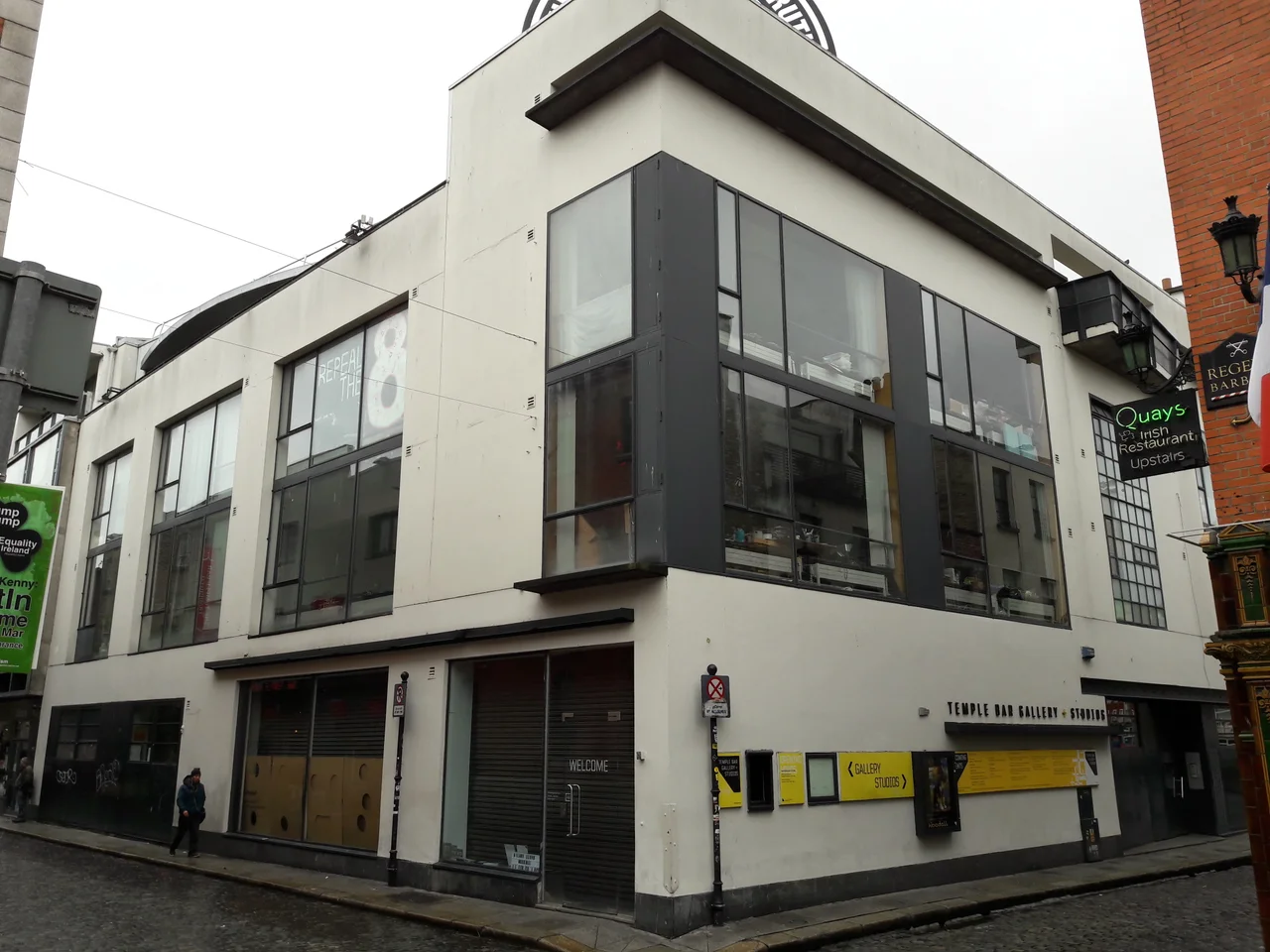

Temple Bar Gallery and Studios
Founded in 1983 by artists for artists, in a derelict shirt factory in a half-condemned cobbled district that the state was preparing to demolish for a bus station. That single sentence captures most of what makes Temple Bar Gallery + Studios unusual. The artists were squatters in a building scheduled to disappear. They organised themselves into a co-operative, paid CIÉ the minimal rent the state company was demanding to maintain its compulsory-purchase paperwork, and kept making work in the rafters of a former factory while everyone around them argued about whether the bus station would actually be built. The bus station was eventually killed, the building was saved, and the gallery is still there.
Shirt Factory to Studio
The original Temple Bar Gallery + Studios opened in 1983 in a former shirt factory on Temple Bar street, one of the buildings CIÉ had bought up as part of the bus station scheme. Thirty artists took studio space. A single gallery downstairs showed exhibitions. The rent was negligible because the building was supposed to be demolished. When the bus station plans collapsed in the late 1980s and the Irish government established Temple Bar Properties in 1991 to regenerate the area as Dublin's cultural quarter, the gallery and studios were central to the plan that justified the regeneration. The Dublin architects McCullough Mulvin overhauled the entire shirt factory, retaining its industrial character while opening up the gallery space, and the new building was completed in October 1994. Thirty studios, plus a contemporary gallery downstairs, in a building that one critic described as 'an off-square space, with pillars, openings, a shop-front aspect and other departures from white cube purity.'
How an Artist Gets a Studio
Temple Bar Gallery + Studios is a limited company with charitable status. Its board is elected by the artist membership and consists of four artist members and five external professionals. Artists apply for membership in six- or three-year terms, or for Associate Membership and Project Studio access in one-year terms, and are reviewed by a board-appointed panel. The studios are subsidised by the Arts Council of Ireland - this is one of the only ways for a working visual artist in Dublin to afford central studio space in a city where rent has otherwise crushed the practice. Garrett Phelan's 2013 rooftop sculpture, Our Union Only in Truth - a metal arch bearing those four words above the building - was funded by an online crowdfunding campaign and remains visible from the surrounding streets, a quiet declaration of the collective principle that runs the place.
Helsinki and Venice
Since 2007 TBG+S has run a residency exchange with HIAP, the Helsinki International Artist Programme - one Finnish artist comes to Dublin for a year, one Irish artist goes to Helsinki. The Finnish photographer Heli Rekula spent her year here in 2008. In 2014 the gallery launched a Recent Graduate Residency, providing stipend, travel award, and free studio space to artists just out of art school. That same year TBG+S won the Allianz Business to Arts Award for Best Small Sponsorship. Most prominently, in April 2022 the gallery curated and produced the Irish pavilion at the 59th Venice Biennale, presenting work by Niamh O'Malley. Few small artist-run organisations get to represent their country at Venice. The fact that Temple Bar Gallery did - twice now, since they have a long history with the pavilion - says something about how seriously Ireland takes this particular building.
A Difficult Decade
Not everything has gone smoothly. In 2010, the gallery's long-time Director Marian Lovett - in the role since 2001 - was made redundant in a restructuring the organisation blamed on Arts Council budget cuts. She took the case to the Employment Appeal Tribunal through the union IMPACT. In October 2012 the tribunal upheld her claim that the redundancy had been 'a sham,' and awarded her thirty thousand euros for unfair dismissal. Claire Power was appointed Director in the wake of the controversy; Rayne Booth came in as Programme Curator and stayed until 2018. Clíodhna Shaffrey took over as Director in 2014, with Michael Hill joining as Programme Curator in 2019. The institutional bruise was real and the public coverage was unflattering, but the building stayed open and the artists kept working through it - which is, in the end, the only durable measure of an artist-run space.
Inside the Gallery
Walk in off Temple Bar street and the gallery is to your left. The exhibitions tend toward conceptual and time-based work - video, sculpture, installation. A partial list of recent past shows: Ed Atkins's video piece 'Or tears, of course' (2013); Nathaniel Mellors's 'The Sophisticated Neanderthal Interview' (2014); Charlotte Prodger's 'Stoneymollan Trail' (late 2015) - Prodger won the Turner Prize three years later; Amie Siegel's 'Imitation of Life' (early 2016). The Finnish photographer Elina Brotherus showed 'The New Painting' here in 2006. The Slovenian architect-artist Marjetica Potrc showed 'Florestania' in 2007. Above the gallery, behind locked doors that visitors do not see, thirty artists work in their studios on whatever they are working on next. The shirt factory still makes things. Different things, now.
From the Air
Temple Bar Gallery + Studios sits at 53.35°N, 6.26°W on Temple Bar street in the heart of the Temple Bar district, on the south bank of the River Liffey in central Dublin. From altitude the building is indistinguishable from the surrounding dense fabric of the district - what marks it is its position one block south of the river, two blocks east of Dublin Castle, and one block north of Dame Street. Dublin Airport (EIDW) lies 9 km north.
Nearby Stories
- Wicklow Mountains 12 km away
- Mornington 14 km away
- German submarine U-1051 16 km away
- Abbey of Kells 18 km away
- Irish Military Intelligence Service 20 km away
- HMS Manners (K568) 37 km away
- Templemore 42 km away
- Irish Sea Bridge 43 km away